

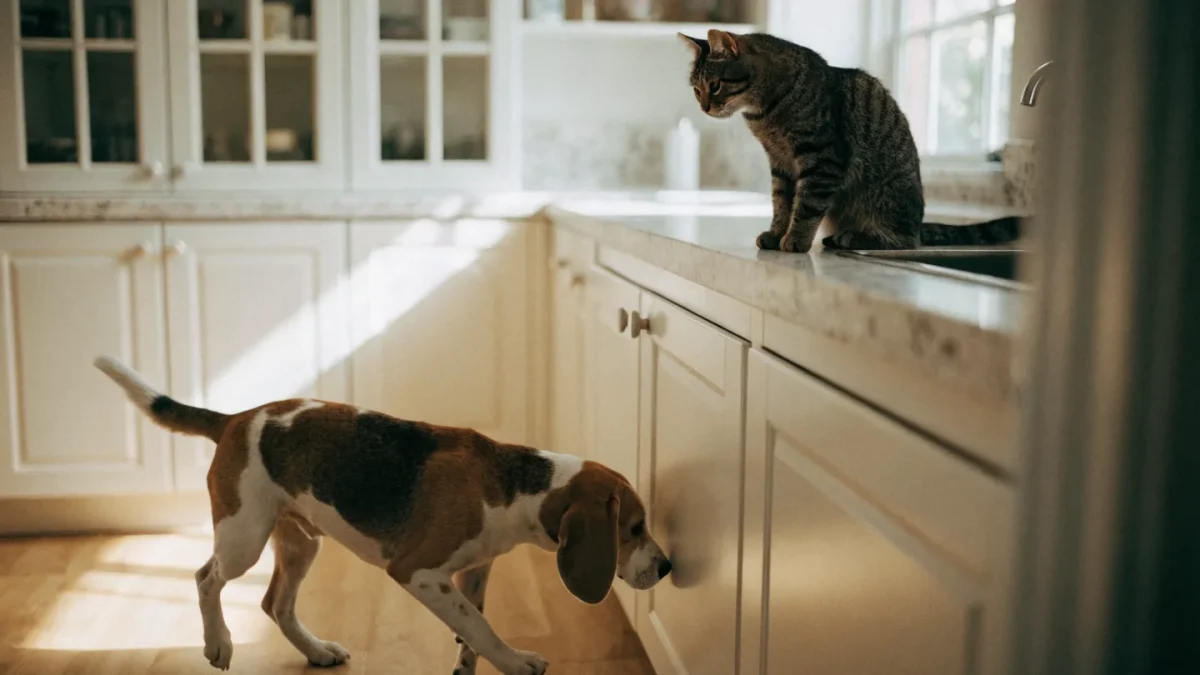
The first few weeks after I got my own dog — a Beagle named Hazel, twelve years ago — I discovered approximately fourteen ways she could hurt herself in my apparently normal house. The trash can was a personal project for her. The power cord behind my desk was apparently fascinating. A container of ibuprofen on my nightstand. These things had coexisted peacefully with previous housemates because those housemates had not possessed Hazel's combination of curiosity, nose, and complete disregard for her own survival.
Pets don't evaluate danger. That's our job.
This guide walks every major area of a typical home from the perspective of what a dog or cat can actually reach, mouth, knock over, or fall from.
How Pets Get Into Trouble
Understanding the mechanism helps you find the hazards you'd otherwise miss.
Dogs are primarily oral and olfactory explorers. They find things with their nose and investigate with their mouth. Counter-surfing is the bane of medium-to-large dog owners. Floor-level access to bags, trash, laundry, and accessible cabinets is a universal vulnerability.
Cats are vertical creatures. A cat considers any horizontal surface — countertops, bookshelves, refrigerator tops, window ledges — fair territory. They're also curious about small enclosed spaces, which means washers, dryers, cabinets, and drawers are all potential traps. Their smaller body weight makes certain toxins more dangerous at lower doses than for dogs.
Puppies and kittens require a significantly higher standard of proofing. Puppies chew indiscriminately; kittens climb without having learned about falling. The standards I'm describing below are puppy/kitten standards — adult animals who have established patterns of behavior may have fewer active hazards, but it's worth the audit regardless.
The Kitchen
The kitchen is where I see the most serious accidental poisonings. It's where you store food, medications, cleaning products, and trash in roughly the same area.
Countertop access — Dogs who can counter-surf (most medium and large breeds given adequate motivation) have access to onions, grapes, sugar-free gum (xylitol), chocolate, medications left out, and anything else on prep surfaces. Cats have countertop access by default. This is worth treating as a given rather than hoping your pet "just doesn't jump up."
Toxic foods in reach: Grapes and raisins (kidney failure in dogs), onion and garlic family (hemolytic anemia in dogs and cats), xylitol in sugar-free products (hypoglycemia and liver failure in dogs), macadamia nuts, raw dough (expands, produces alcohol), chocolate. Any of these accessible means the food needs to be secured, not just placed out of casual reach.
Under-sink cabinets: Cleaning products live here. Bleach, drain cleaners, dishwasher pods (highly concentrated detergent — one pod can seriously injure a cat). A child-safety latch takes sixty seconds to install and prevents the majority of chemical exposures I see from this area.
Trash cans: Cooked bones, food wrappers with residual food, coffee grounds, onion scraps, moldy food. Dogs find trash irresistible. A can with a secure lid — not just a lid that can be knocked off, but one that requires deliberate action — is the solution. More in the dedicated piece on trash can safety.
Stove and oven: Burns from surfaces, ingestion of dripped grease, and for very small dogs and cats, falling into large pots. Don't leave the stovetop unattended with curious animals nearby.
The pet-proofing your kitchen guide goes deeper on every cabinet, appliance, and food storage scenario.
The Bathroom
Bathrooms are medicine cabinets with plumbing. The hazard density is high.
Medications are the primary concern. Human ibuprofen and acetaminophen (Tylenol) are among the most common pet poisonings we see — and among the most serious. A single regular-strength ibuprofen tablet can cause kidney failure in a medium-sized dog. Two acetaminophen tablets can kill a cat. These should never be stored anywhere accessible, including on countertops.
Never leave medications on countertops "just for tonight." Cats will knock them down; dogs who have counter access will find them on the floor.
Toilet water: Mostly benign for dogs with bad drinking habits, except when you're using automatic toilet bowl cleaners (which are highly concentrated and toxic). Lid down solves this.
Hair ties, dental floss, cotton swabs, bobby pins: These are GI obstruction and strangulation hazards. Cats especially find string-like objects irresistible. A small trash can with a lid, and keeping hair accessories in a closed drawer, is the fix.
Drain cleaners and caustic chemicals: These belong behind a locked or child-latched cabinet. They're highly caustic — contact with mucous membranes causes immediate, serious burns.
Standing water in the bathtub: Unusual, but drowning in bathtubs has happened with small dogs who've fallen in. Don't leave standing water in tubs.
The Living Room and Bedroom
Calmer hazard profile, but not zero.
Electrical cords: Puppies and kittens chew cords. Electrocution from cord chewing causes mouth burns, respiratory failure, and cardiac arrhythmia. Cord covers and cable management — routing cords behind furniture, through cable covers, or using spiral wrap — significantly reduce access. Unplugging chargers and removing cords from floor level when not in use helps.
Blind and curtain cords: These are strangulation hazards, particularly for cats. Loop cords up high, cut them with cordless alternatives, or install cord cleats to keep them off the floor. I have personally seen a cat get a looped cord around her neck — this is not a theoretical risk.
Small items on the floor: Hair ties, rubber bands, children's toys, coins, batteries. All potential obstructions or toxins (button batteries cause severe internal burns if swallowed). The "floor level scan" when you move in with a new pet is worth doing.
Recliner chairs: Serious hazard, covered in its own article — mechanism is a pet hiding in the footrest mechanism and being crushed when the chair closes.
Plants: A separate topic entirely, but many common houseplants are toxic to pets. Lilies (fatal to cats in very small doses), pothos, philodendron, peace lily. Anything green on the floor or within cat jump distance warrants a toxicity check.
The pet-proofing living room and bedroom guide covers each of these scenarios with practical fixes.
The Garage and Utility Room
The garage is where the most concentrated chemical hazards live, and the area most commonly overlooked in pet-proofing.
Antifreeze (ethylene glycol): The most important hazard in this space. Sweet taste, attracts both cats and dogs, causes fatal kidney failure quickly. Keep containers sealed and stored high, wipe up any spills immediately, and consider switching to propylene glycol-based antifreeze which is significantly less toxic. Any suspected antifreeze ingestion is a same-day emergency.
Automotive products generally: Motor oil, brake fluid, windshield wiper fluid — these all contain compounds that are harmful if ingested. Store in sealed containers in locked or high cabinets.
Rodent bait and insecticides: If you use rodent poison anywhere, know that secondary poisoning is real — a dog eating a poisoned rodent can be poisoned too. Snap traps are safer than poison if you have pets. All insecticides should be stored where pets can't access them, and re-entry times after application should be followed.
Sharp tools, nails, screws: Floor-level storage means paw injuries.
Washing machine and dryer: Cats who seek warm enclosed spaces will climb into dryers. Always check before running. This issue deserves its own section because it's genuinely fatal when it happens — see the separate article on laundry room dangers.
The Yard
Not just a question of fences.
Toxic plants in landscaping: Common culprits include sago palm (fatal in dogs, even in small amounts), oleander, azalea, yew. The ASPCA toxic plant database is the definitive reference. Walk your yard and identify everything growing.
Mulch: Cocoa mulch is toxic to dogs — contains theobromine, same compound as chocolate. Keep pets away from it or choose non-toxic alternatives.
Pesticides and fertilizers: Many lawn treatments are harmful to pets. Read application instructions, observe labeled re-entry times, and store products in secured areas.
Standing water: Breeding ground for leptospirosis-carrying mosquitoes and a potential drowning hazard for small animals.
Pool fencing: Drowning is a real risk for dogs who can't find the pool exit, and for cats who fall in. Covered separately in the water safety section.
Fencing gaps and gates: Escape risks. Dogs especially will find any gap and exploit it systematically. Walk your fence line periodically.
The Hierarchy of Risk
Not all hazards are equal. Here's a rough prioritization:
Highest priority (life-threatening, fast onset):
- Medications accessible to pets
- Antifreeze
- Toxic foods (especially xylitol, grapes, raisins)
- Electrical cord access for puppies/kittens
- Blind/curtain cord loops
- Pool and standing water access
- Washer/dryer access for cats
Medium priority (serious but more treatable):
- Household chemical access (under-sink cabinets)
- Toxic plants within reach
- Trash can access
- Small items on floor (obstruction risk)
Lower priority (injury risk, less commonly fatal):
- Sharp object access
- Counter-surfing for non-toxic items
- Furniture falls
Fix the top tier first. Then work down.
The Walk-Through
Here's the exercise: get on your hands and knees in each room. Look at what's accessible from floor level. Then assess what's accessible from counter or shelf height for cats. Ask yourself: if my pet spends thirty unattended minutes in this room, what could go wrong?
Do this when you move into a new home. Do it again when you get a new pet. And revisit it when anything changes — a medication moves to the nightstand, a renovation creates new gaps in fencing, a new plant arrives.
For specific hazards by room, each dedicated guide goes deeper: pet-proofing your kitchen, pet-proofing living room and bedroom, bathroom, garage, and yard. For the chemical hazards specifically, the household chemicals dangerous to pets guide covers mechanisms and treatments.
FAQ
Q: My dog has never gotten into anything. Do I still need to pet-proof?
Yes, with some nuance. A six-year-old dog with established behavior patterns has different risk than a new puppy. But dogs change with age, opportunity, and stress. The hazards worth fixing — medications accessible, cleaning products under unlocked sinks, antifreeze accessible — are cheap fixes with outsized risk reduction. Don't rely entirely on past behavior.
Q: My cat is indoor-only and very calm. Is cat-proofing less important?
Indoor-only actually increases some risks because indoor cats have unlimited access and boredom. Cats who are perfectly calm can still knock things over, investigate the washing machine, find the one lily plant, and chew on a charging cord. The "calm" part doesn't tell you much about the curious part.
Q: What age should I start pet-proofing — before I get the pet, or after?
Before. The week you pick up a puppy or kitten is the worst possible time to discover the hazards in your home, because you're overwhelmed and the animal is investigating everything simultaneously. Do the walk-through before they arrive.
Q: Are some dog breeds or cat breeds more likely to get into things?
Absolutely. Beagles, Labradors, and Basset Hounds are notorious counter-surfers and trash investigators. Sighthounds can reach surfaces most people don't expect. Young cats of any breed are significantly more hazard-prone than adults. But any individual animal's personality matters more than breed generalities — I've seen impeccably behaved Beagles and chaos-causing Persian cats.
Q: I rent and can't make permanent changes. What can I do?
Plenty. Child-safety latches (removable), cord covers (removable), securing cabinets with bungee-style loops, keeping doors closed, rearranging furniture to block access. None of the highest-priority pet-proofing measures require drilling holes or permanent modification.