

The call came in on a Tuesday morning in November. Learn more about poisoning in pets: common here. A woman's cat, Marble, had been acting "drunk" the night before — stumbling, falling over, not really responding normally. She'd thought maybe he'd eaten something bad and waited to see how he'd do overnight. By Tuesday morning he seemed better, almost normal, so she called to ask if she should bring him in.
I told her to come immediately.
She came. His kidney values were already catastrophic. We tried everything. Marble died Wednesday afternoon.
He'd likely lapped up a small puddle of conventional antifreeze from the garage floor. The initial drunk-seeming phase had resolved — as it always does — and she'd understandably taken that as a sign he was improving. He wasn't. He was dying, silently, from inside.
Antifreeze poisoning is one of the most treatable emergencies in veterinary medicine if you get there in time. And one of the most heartbreaking things I see because timing is everything, and pets almost always come in too late.
Why Pets Drink It
Ethylene glycol, the active ingredient in most conventional green or yellow antifreeze, has a distinctly sweet taste. This isn't accidental — the molecule's chemical structure includes multiple hydroxyl groups that taste sweet to mammals. Dogs are drawn to it. Cats are less likely to seek it out actively, but will lick puddles or contaminated surfaces they happen to encounter.
Common exposure routes:
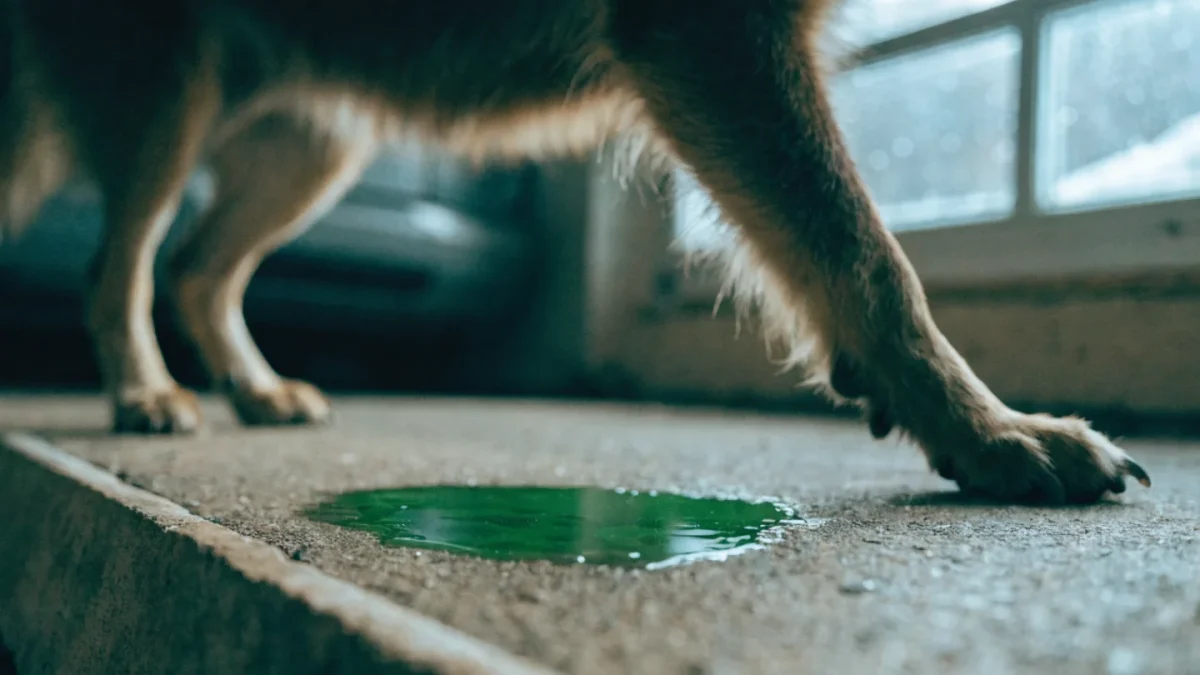
Garage floor drips and puddles. Radiators leak. Cars drip coolant after overheating. The bottle gets bumped. A small puddle sits on the floor and your dog wanders through the garage.
Outdoor puddles. Antifreeze runoff from driveways and parking lots can pool in street gutters, yard edges, and near storm drains. Dogs who drink from puddles on walks — which many do — can ingest it this way.
Paw contamination. Both cats and dogs may walk through antifreeze, then groom their paws. This is one of the main exposure routes for cats who don't tend to actively seek out and drink puddles.
Improperly stored containers. Open or poorly sealed bottles, improperly labeled containers, bottles stored within pet reach.
A lethal dose for a medium-sized dog (30 pounds) is roughly 1.5-3 mL per kilogram. That's about 2-4 tablespoons for a 30-pound dog. For a cat, the lethal dose is even smaller — less than half a teaspoon per pound of body weight. These are tiny, easy-to-encounter amounts.
The Deceptive Progression of Toxicity
This is the part I want everyone to understand, because it's the mechanism that kills pets.
Stage 1: 30 Minutes to 12 Hours After Ingestion
Initial signs look like severe intoxication: stumbling, disorientation, apparent dizziness, vomiting, lethargy, excessive thirst and urination. The ethylene glycol itself acts directly on the nervous system, causing these CNS effects.
And then — this is the dangerous part — the signs improve. In dogs, this CNS phase usually lasts 6-12 hours. In cats, it's shorter: about 2-4 hours. The animal starts acting more normally. They might eat. They might drink water. They might seem almost okay.
Stage 2: 12-24 Hours After Ingestion (Dogs) / 6-12 Hours (Cats)
The ethylene glycol has been metabolized into intermediate compounds — glycolaldehyde, glycolate, glyoxylate — and finally into oxalic acid. These metabolites are what actually cause the organ damage. The heart rate increases. Breathing becomes faster as the body tries to compensate for metabolic acidosis. Muscle twitching may appear. The animal looks unwell again, but in a different way — not drunk, but systemically sick.
Stage 3: 24-72 Hours After Ingestion (Dogs) / 12-24 Hours (Cats)
Oxalic acid combines with calcium to form calcium oxalate crystals, which deposit in the kidney tubules. Acute kidney failure develops. Signs: severe lethargy, vomiting, loss of appetite, decreased or absent urination (as the kidneys shut down), swollen/painful kidneys, seizures, coma.
By Stage 3, the kidneys are already destroyed. Dialysis might keep an animal alive while you wait for kidney transplant, which isn't widely available. Some pets survive Stage 3 with intensive management, but many do not.
Treatment: Why Every Hour Matters
Effective treatment requires getting an antidote in before the ethylene glycol has been significantly metabolized. For dogs, this window is approximately 8 hours. For cats, it's approximately 3 hours — cats metabolize ethylene glycol faster and have less safety margin.
If your pet was exposed to antifreeze and you're reading this, stop reading and call your vet.
Fomepizole (4-MP) is the preferred antidote in dogs. It blocks the enzyme (alcohol dehydrogenase) that metabolizes ethylene glycol into its toxic breakdown products. If given within the treatment window, it's highly effective. It is not reliably effective in cats, unfortunately.
Ethanol (IV alcohol) competes with ethylene glycol for the same enzyme — the enzyme preferentially processes ethanol, buying time for the ethylene glycol to be excreted. This is the main treatment option in cats. It requires careful IV administration and monitoring.
Supportive care — IV fluids, bicarbonate for acidosis, monitoring kidney values — is also critical regardless of antidote use.
The decision tree at the emergency vet is: How long ago did exposure occur? Can we confirm ingestion? What are the current kidney values? Treatment protocols differ based on the answers.
Diagnosis: What Your Vet Is Looking For
If your pet comes in and you know or suspect antifreeze exposure, tell us that immediately. Don't wait to be asked.
We can test serum or urine for ethylene glycol, though these tests aren't available at every clinic and have timing limitations. For more about xylitol poisoning in dogs:, see our detailed guide. We'll also run bloodwork — metabolic acidosis, elevated kidney values, decreased serum calcium (because calcium is being pulled out to form oxalate crystals), and a high osmolal gap (the difference between measured and calculated osmolarity) are all suggestive.
Under UV light, ethylene glycol-containing antifreeze fluoresces (a fluorescent dye is added to most products to help mechanics find leaks). Vomit, urine, or material around the muzzle may glow under a Wood's lamp. This is a useful but imperfect test — propylene glycol antifreeze and other products may also fluoresce.
Calcium oxalate crystals in the urine, visible on urinalysis, are a significant finding — but by the time they're appearing in quantity, serious kidney damage has usually already occurred.
If You Find Your Pet Has Been Exposed: Exactly What to Do
-
Do not wait for symptoms. If you find your dog licking an antifreeze puddle, or you find the container knocked over near your pet, or you see evidence of ingestion — call a vet immediately. Don't wait to see how they do.
-
Do not induce vomiting at home without veterinary guidance. Unlike some other toxins, timing matters, and your vet needs to know how recently exposure occurred to determine the best approach.
-
Call the ASPCA Animal Poison Control Center (888-426-4435) if you can't immediately reach your vet. They can advise on risk assessment and first steps. Note that a consultation fee applies.
-
Bring a sample of what you think they ingested if you can — the product label, a photo of the container, anything that helps us confirm what we're dealing with.
-
Be honest about timing. I know it's uncomfortable to say "I noticed something was off several hours ago but thought he was fine." I've heard it many times. It's important information. The treatment protocol changes based on time elapsed.
Prevention: What Actually Works
Switch to propylene glycol antifreeze. It's available at most auto parts stores, often marketed as "pet-safe" antifreeze or RV antifreeze. It does not contain ethylene glycol. It still requires careful handling, but the margin between exposure and toxicity is vastly wider. If you have pets, this switch costs almost nothing and could save their life.
Clean spills immediately and thoroughly. A drip on the garage floor is enough to poison a cat. Don't leave it for later.
Store antifreeze containers sealed and out of reach. In a locked cabinet or on a high shelf. Not on the garage floor, not on a low shelf, not in an open container.
Wipe your dog's paws after garage visits. If your dog walks on the garage floor, wipe their paws before they groom.
Don't let dogs drink from puddles. Especially in parking lots, driveways, and near roads in winter. This is good practice for multiple reasons.
If a neighbor's car leaks or your street has puddles, be vigilant. You can't control what your neighbors use in their vehicles.
FAQ
I just saw my dog lick what might be antifreeze. He seems totally fine. Do I need to go to the vet right now?
Yes. Not tomorrow, not after he's been observed for a few hours. Right now. The treatment window is narrow, and "seeming fine" is exactly what Stage 1 toxicity looks like before it progresses.
What does antifreeze poisoning look like in cats?
In cats, the initial drunk-seeming phase may last only 2-4 hours before appearing to resolve. Cats then often show rapid deterioration to Stage 3 kidney failure. The window for treatment is much shorter than in dogs. Any suspected exposure in a cat is a true emergency.
My pet had antifreeze poisoning and we caught it early — will there be any lasting effects?
Pets treated very early (within the antidote window) with effective treatment often recover fully with no lasting kidney damage. Those treated during Stage 2 may have some kidney impairment. Those who survive Stage 3 frequently have chronic kidney disease.
Is the "pet-safe" antifreeze actually safe?
Propylene glycol antifreeze is substantially safer than ethylene glycol — the lethal dose is much higher, and the toxic metabolites are less severe. But it is not completely non-toxic. Large amounts can still cause problems, particularly in cats. "Safer" is more accurate than "safe."
How can I tell if there's antifreeze on my garage floor?
Fresh ethylene glycol antifreeze has a characteristic sweet smell and is typically bright green or yellow. Under a UV flashlight (blacklight), it fluoresces. But small amounts dry almost invisibly — the smell is often the only indicator. If in doubt with pets, mop the floor.