

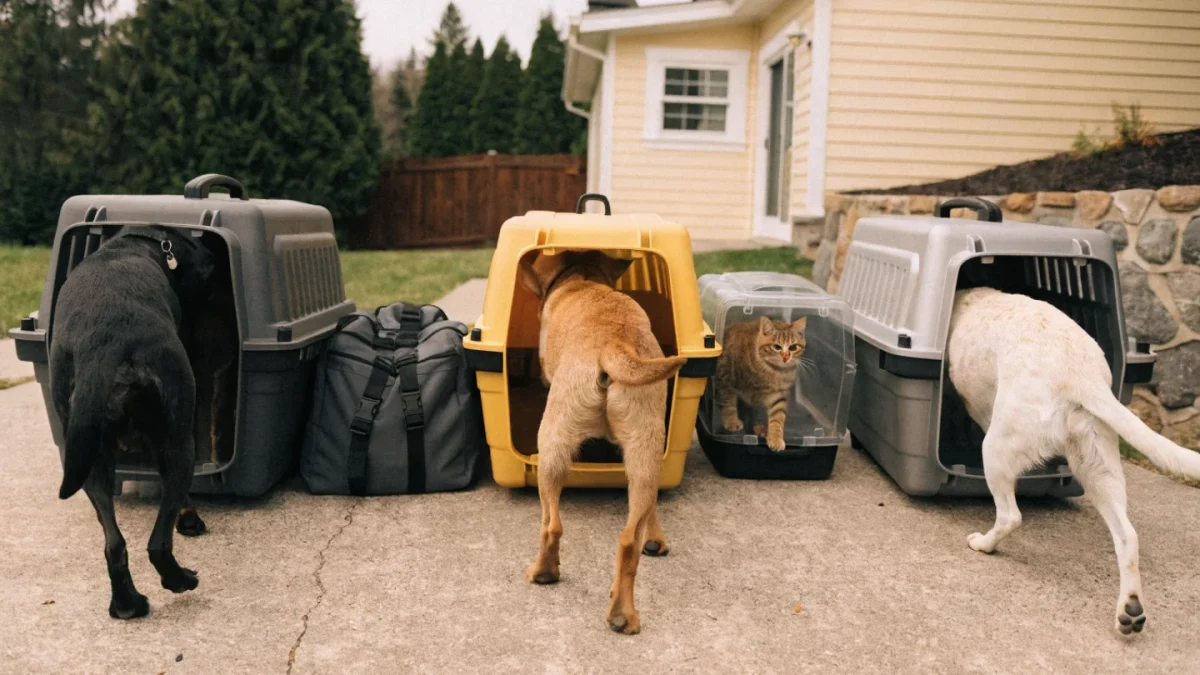
The Tubbs Fire in 2017 started spreading around midnight. I had a client who lived in Coffey Park, Santa Rosa — she woke to phone alerts at 1:30 a.m., had maybe twenty minutes to get out, and she had three dogs and a cat. She got everyone out. But she told me later that the frantic scrambling she did — finding carriers, getting medications, trying to figure out where she could go with four animals — was pure adrenaline-fueled chaos that she got lucky to navigate.
"I had no plan," she said. "I got lucky. Next time I'll have a plan."
She's right. Emergencies in real life are nothing like the orderly exercises we imagine when we think about preparedness. They're loud, dark, confusing, sometimes smoky, sometimes in the middle of the night, and you're trying to manage it with a panicked dog and your phone at 12% battery. The plan you make right now, when it's calm and you're sitting in your kitchen reading this, is the thing that saves you when there is no calm.
The Four Pillars of Pet Emergency Preparedness
Pillar 1: Identification — The Single Most Important Thing
If there's one thing I want you to do after reading this, it's this: ensure every animal you own has a current microchip with a current registration, and a collar with a current ID tag.
Disasters scatter pets. A dog who bolts from fear during a wildfire evacuation, a cat who escapes in the chaos of a house flood, a hamster cage that tips in an earthquake — pets get separated from owners in every major disaster. The animals who come home are the ones with current identification.
Microchip: effective only if registered. The chip is worthless if the registration database has an old address, a disconnected phone number, or is with a company you've never heard of. Look up your pet's chip number right now. Verify the registration. Update it if needed. It takes five minutes.
ID tags: redundant with the chip and better for immediate reunification because anyone — not just a shelter with a scanner — can reunite you. Write your cell phone number, not your home number. Many people lost in disasters don't have access to their home.
GPS trackers add a third layer for dogs who escape frequently or who will be in high-risk evacuation situations. The pet identification options guide compares all three methods in detail.
Pillar 2: The Go-Bag
A go-bag is a pre-packed bag or bin that you grab when you're leaving in a hurry. You should be able to take it and go without thinking. If you have to assemble it during the emergency, you will forget things.
What goes in a pet go-bag:
Food and water:
- Minimum 3 days of food per animal, ideally 7 days. Vacuum-sealed, waterproof, labeled with species and feeding instructions
- Collapsible bowls
- 3–5 gallons of water for dogs; cats need less but still need it
- Manual can opener if you use wet food
Medications:
- Full 2-week supply of any daily medications, rotated so they stay current
- Clearly labeled with medication name, dose, and schedule
- Include a copy of the prescription and recent bloodwork if relevant
Documents:
- Vaccination records (rabies certificate specifically — required by emergency shelters)
- Medical records including current medications list
- Photos of you with your pets (to prove ownership)
- Copies of registration papers for cats/purebred dogs if applicable
- Your vet's number and the address of the nearest 24-hour emergency clinic
Containment:
- Carrier or crate appropriate to each animal's size (important: cats and small dogs often need this to be admitted to shelters)
- Leash and collar with ID tags (extra set)
- Pet-specific harness if your dog is a flight risk under stress
Comfort and sanitation:
- A piece of clothing or bedding with your scent (reduces animal stress in unfamiliar environments)
- Litter and disposable litter pan for cats
- Waste bags
- Calming aids if your pet has anxiety — discuss options with your vet and have them ready
Review and restock the go-bag every six months. Food expires. Medications change. Don't let the bag become outdated.
Pillar 3: The Evacuation Plan
Know where you're going before you need to go. Not vague plans — specific addresses, specific contacts.
Destination 1: A pet-friendly hotel or motel. Call ahead, verify their pet policy, and have the address and phone number written down (not just in your phone, which might be dead).
Destination 2: A friend, family member, or pet-friendly Airbnb in a different direction from Destination 1, at least 50 miles away. Many disasters affect large geographic areas; your first-choice destination may also be in the evacuation zone.
Destination 3 (for declared disasters): Know the location of your county's emergency shelter that accepts pets. Most jurisdictions now have pet-friendly shelters after PETS Act passed post-Katrina, but policies vary. Call your county emergency management office now and ask where it is.
Identify two separate exit routes from your neighborhood. One road congested or on fire means you need an alternative.
Plan for going without a vehicle. What if your car isn't accessible? Who in your neighborhood has a vehicle large enough for your animals? Do you have a relationship with them?
The contingency for if you're not home when a disaster hits. Who has a key and authorization to get your pets? Is that person capable of managing your animals? Have this conversation explicitly, don't assume.
Pillar 4: Emergency Contacts and Information Systems
Keep a card — physical card, in your wallet — with:
- Your vet's name, address, and phone number
- Nearest emergency vet (with address)
- ASPCA Animal Poison Control: 888-426-4435
- Local animal control (for reporting or claiming a found pet)
- Your pet emergency contact person's name and number
- Your pets' names, microchip numbers, and brief descriptions
The card matters because phones die, lock, or get lost. The person you've designated as your pet emergency contact should have a copy of this information too.
Register with your local emergency management office if they have a pet registry for residents who need help evacuating. Many counties have voluntary registries for people with animals (and with mobility limitations) precisely because they're harder to help in unplanned mass evacuations.
The Hard Question: What If You Can't Take Your Pets?
This is the scenario people don't want to think about. A sudden mandatory evacuation, a building fire, a medical emergency on your part — sometimes you genuinely cannot take your animals with you.
If you must leave pets behind temporarily:
- Leave them in an interior room away from windows
- Leave multiple days of food and water in large containers they can access
- Leave a note on a door or window: "PETS INSIDE — Dog: [name/breed/location], Cat: [name/location]" — this is what emergency responders look for
- Contact animal control or a neighbor as soon as possible to arrange check-in
- Return as soon as you're allowed to
If you cannot return:
- Contact your emergency vet or boarding facility — many hold animals during local disasters
- Connect with local rescue organizations who often deploy specifically to collect pets from evacuation zones
- Post on Nextdoor and local Facebook groups with the information about your pets and location
The people who lose their pets in disasters are largely the people who thought they'd be back in a few hours. Plan for longer.
Shelter-in-Place Scenarios
Disasters aren't always evacuations. Sometimes you're staying home: extended power outages, floods that trap you in, quarantine situations. Shelter-in-place preparedness differs from go-bag preparedness.
For extended home sheltering:
- 2 weeks minimum food supply, stored correctly (cool, dry, sealed)
- Water — 1 gallon per day per large dog, less for smaller animals and cats, but at minimum 2 weeks' worth
- Manual tools for opening food
- Extra medications — I recommend asking your vet for a 90-day supply of any maintenance medications for this reason
- A battery-operated or hand-crank radio for emergency information
Backup heat and cooling:
Extended power outages in summer are dangerous for pets (heatstroke) and in winter (hypothermia for small animals, especially cats and small dogs with limited insulation). Know which friends or family members have generators or alternative heating. Have a plan for where your animals can go if your home becomes unsafe.
Special Considerations by Animal Type
Cats are highly stress-reactive in carrier situations and to new environments. Carrier training in advance — leaving the carrier out with comfortable bedding so it's not a foreign object — dramatically reduces the fight to get them in. Pheromone products (Feliway) in the carrier and in the go-bag can help.
Multiple pets — create a system. In an emergency, a single person managing three cats and two dogs is chaos. Practice getting everyone in carriers quickly. Have a loading order. The one most likely to hide goes first.
Birds are extremely sensitive to temperature changes, respiratory irritants (smoke), and stress. They need protected transport in a covered cage, away from smoke and fumes, and warmth during winter evacuations.
Reptiles and small mammals (guinea pigs, rabbits, hamsters) are often forgotten in disaster scenarios. They can't alert you to their need to be evacuated. Include them explicitly in your plan — carriers, warmth sources, specific requirements.
Senior or medically compromised pets may have additional needs — power-dependent medical equipment, specific medications, stress that exacerbates medical conditions. Have a conversation with your vet about your specific animal's needs in a disaster scenario.
The Time to Do This Is Now
The common denominator in every story I've heard from clients who lost pets in disasters is some version of: "I thought I had more time." Wildfires, flash floods, tornadoes, major earthquakes — these events often provide minutes, not hours.
A prepared household — go-bag packed, IDs current, destinations identified, key contacts established — doesn't require calm or time to execute. It requires grabbing the bag and going.
Start with the identification check. Twenty minutes right now. Then the go-bag. Then the plan. You don't have to do it all at once.
The disaster evacuation planning for pets guide walks through the logistics in more detail. And what to do if your pet gets lost in a disaster covers the recovery scenario if they do get separated.
FAQ
Is a regular gym bag okay for my go-bag or do I need something specific?
Any bag that's waterproof (or in a waterproof liner), large enough for your supplies, and easy to grab works. Some owners use a plastic bin they can carry — easier to stack and waterproof by default. The key is that it's pre-packed, in a consistent location, and everyone in the household knows where it is.
My cat hates her carrier. How do I change this before an emergency?
Leave the carrier out permanently, open, with comfortable bedding inside and occasionally with treats placed in it. The goal is for it to be part of the furniture, not an emergency-only thing. Feeding meals inside the carrier is a fast way to build positive association. It takes a few weeks but is worth the investment.
Should I include a copy of my pets' vaccination records in the go-bag?
Yes, especially the rabies certificate. Many emergency pet shelters require proof of rabies vaccination for admission. A laminated copy in a waterproof bag in the go-bag is the right approach. Update it annually.
What if I have livestock, not just household pets?
Livestock emergency preparedness is a deeper topic — it involves trailer capacity, pre-arranged pasture access, livestock registries, and large-scale food/water logistics. Your county extension service typically has resources specifically for livestock emergency planning.
How do I know which emergency shelters in my area accept pets?
Call your county or city emergency management office and ask directly. Policies have changed significantly since Hurricane Katrina, and most jurisdictions now have some provision for pets, but it varies. Do this now and write down the address and phone number for your go-bag document.
My neighbor said her dog got out during an evacuation and she never found him. Is there a systematic way to search for a lost pet after a disaster?
Yes — what to do if your pet gets lost in a disaster has the step-by-step protocol including contacting all area shelters (animals are often brought in by different agencies), posting on community apps, and working with local rescue organizations who specialize in post-disaster pet recovery.