

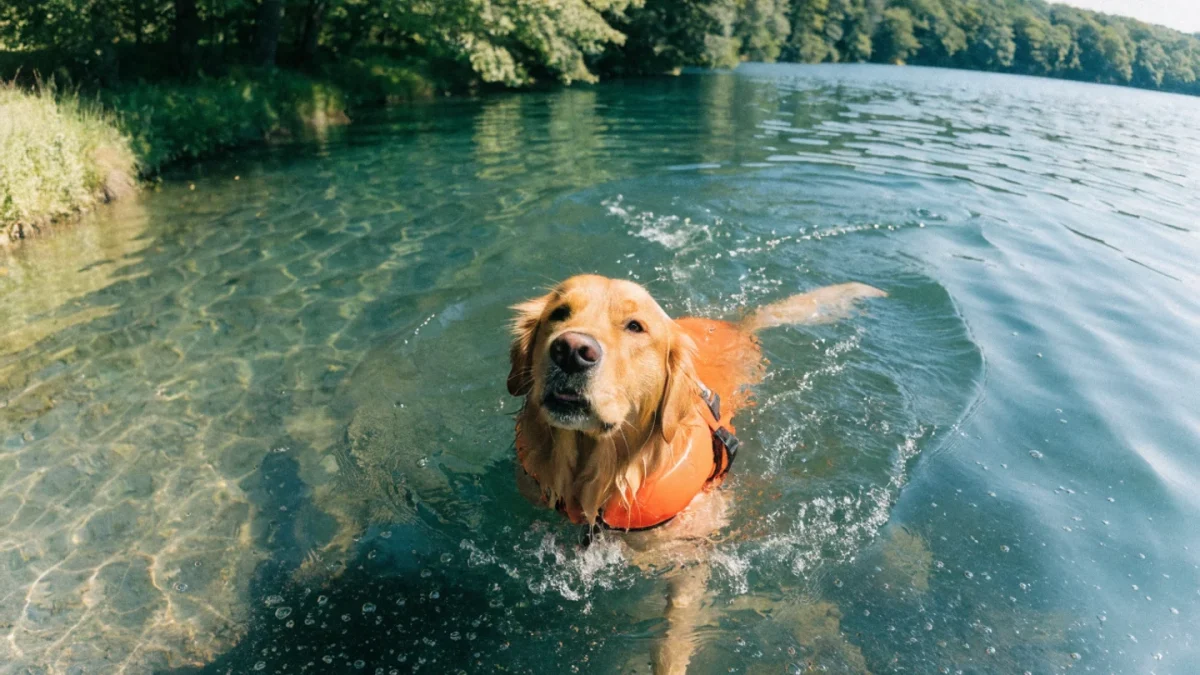
I grew up near a lake. One of my earliest veterinary memories is from a summer when I was still in school, watching a family's Golden Retriever make it to a floating dock and back at least twenty times without tiring, then watching a Bulldog, same beach, struggle visibly after two minutes in the shallows.
The cultural association between dogs and water is strong and mostly accurate — many dogs swim instinctively and love it. But "many" isn't "all," and the dogs who can't swim well are also often the ones whose owners assume they can. That mismatch is where drownings happen.
Who Can Actually Swim
Let's start with the honest answer.
Good swimmers by nature: Labrador Retrievers, Golden Retrievers, Irish Water Spaniels, Portuguese Water Dogs, Standard Poodles, Chesapeake Bay Retrievers — these breeds were developed for water work and typically take to swimming naturally. Most mid-sized, lean-bodied dogs with proportionate heads and bodies swim reasonably well.
Poor swimmers or non-swimmers:
- Brachycephalic breeds — Bulldogs, French Bulldogs, Pugs, Boston Terriers, Shih Tzus, Boxers. Their pushed-in faces and short necks put their airways close to the water surface. They tire quickly, have inefficient swimming mechanics, and are genuinely at higher risk of drowning than non-brachycephalic breeds.
- Heavy-chested, short-legged dogs — Basset Hounds, Dachshunds, Corgis. Their body proportions make staying level in water physically difficult.
- Any brachycephalic dog regardless of size. A French Bulldog owner who thinks their dog is "doing fine" in a pool may not realize how quickly that can change.
Cats: Don't swim voluntarily. Can swim if forced to — they'll make it to shore if they fall in and a shore is close — but they tire quickly and panic in open water. Cats should not have access to water depths they can't stand in.
Puppies and senior dogs: Less physically capable than adult dogs in their prime. Senior dogs tire faster and may struggle in currents that would be fine for a younger dog.
The Drowning Risk: How It Actually Happens
Most dog pool drownings aren't about swimming ability — they're about exit knowledge. A dog who falls into a backyard pool and doesn't know where the stairs are will swim along the walls indefinitely, unable to climb the smooth edge, until exhaustion takes over. This can happen in under ten minutes for some dogs.
The solutions:
Pool stairs and exit training, covered in depth in the pool safety and teaching dogs to find pool exits guide. Briefly: every dog with pool access should be taught, through repeated practice, to locate and use the pool stairs from any position in the pool.
Floating exit ramps (Skamper Ramp and similar products) attach to the pool wall and provide an accessible exit point from anywhere in the water. These work as backup devices even for dogs who know the stairs.
Pool covers that aren't specifically rated for weight support are not safety devices — a dog who walks onto a solar cover or standard winter cover will fall through or become trapped.
In open water — lakes, rivers, ocean — the drowning risk is different. Currents, cold water, unexpected waves, and fatigue in dogs who've been swimming longer than their conditioning supports are the main factors.
Life Jackets: When They're Essential
Life jackets (personal flotation devices designed for dogs) are not just for dogs who can't swim — they're recommended for any dog in open water situations.
A life jacket:
- Maintains buoyancy so a dog doesn't need to actively swim to keep their head above water
- Slows fatigue by reducing effort required to stay afloat
- Has a handle on top that allows you to lift the dog out of the water
- Increases visibility in the water
When a life jacket is essential:
- Any brachycephalic breed near any water deeper than the dog is tall
- Any dog on a boat
- Any dog in water with currents, including rivers and moving water
- Any dog swimming for extended periods
- Dogs swimming in cold water (cold water fatigue is faster than warm water fatigue)
Fitting matters: a life jacket that's loose won't maintain proper head position; one that's too tight restricts breathing. The dog should be able to breathe comfortably, the neck support should hold the head up in water, and the jacket shouldn't slip off the back end when lifted by the handle.
Blue-Green Algae: The Underappreciated Killer
Blue-green algae (cyanobacteria) blooms occur in warm, still, nutrient-rich fresh water — ponds, lakes, and slow-moving rivers during summer and early fall. They appear as green, blue-green, or brownish mats or scums on the water surface.
They can be rapidly fatal to dogs.
Cyanobacteria produce toxins — primarily cyanotoxins (hepatotoxic and neurotoxic) — that can cause liver failure, respiratory failure, and death within hours of exposure. A dog who swims through an algae bloom, drinks from an affected water body, or licks algae off their coat after exposure is at serious risk.
There is no antidote. Treatment is supportive, and survival depends on the toxin type and amount of exposure.
Recognition: Not all green water contains toxic cyanobacteria, and not all cyanobacteria blooms are toxic — but there's no visual way to distinguish toxic from non-toxic in the field. The rule: if the water looks like pea soup, has visible surface scum, or smells musty/earthy/sewage-like, keep your dog out of it. When in doubt, stay out.
Local health departments and wildlife agencies post alerts when bloom toxicity is confirmed; check before visiting unfamiliar bodies of water in warm months.
Swimmer's Ear (Otitis Externa)
Dogs who swim frequently are prone to outer ear infections from water that doesn't drain completely from the ear canal. The warm, moist environment supports bacterial and yeast growth.
Signs: head shaking, scratching at ear, discharge, odor, yelping when ear is touched.
Post-swim ear drying — gently wiping the visible ear canal with a dry cotton ball, and using a veterinary-recommended ear-drying solution — significantly reduces frequency of infections in swim-prone dogs.
Floppy-eared breeds (Cocker Spaniels, Bassets, Goldens) are higher risk due to reduced air circulation in the ear canal.
Water Intoxication
Less commonly known: dogs who play intensively in water — catching water from a hose, diving repeatedly for pool toys, swallowing water during extended lake swimming — can develop water intoxication (hyponatremia).
The mechanism: swallowing large amounts of water during play dilutes sodium in the blood. Clinical signs include lethargy, vomiting, unsteady gait, glazed eyes, and in severe cases, seizures.
It's more common than most people realize and more serious than it sounds. Prevention: limit water play sessions, watch for signs of excessive water swallowing, take regular breaks.
Leptospirosis and Waterborne Illness
Leptospira bacteria are carried in the urine of infected animals — wildlife, rodents — and persist in standing water and moist soil. Dogs who swim in, drink from, or wade through contaminated water can contract leptospirosis, which causes kidney and liver disease and can be fatal.
Vaccination is available and effective for the most common strains. Dogs with regular water and wildlife exposure should be vaccinated annually.
Other waterborne concerns: Giardia (from drinking water contaminated by wild animal feces), algal toxins as described above, and general bacterial contamination of water bodies near agricultural or urban runoff.
The rule for water sources: don't let dogs drink from standing ponds, pools with standing water, or water with visible surface contamination. Fresh, moving water presents lower risk; standing warm water in summer presents higher risk.
Saltwater and Ocean
Dogs who swim in and swallow significant amounts of saltwater develop salt toxicity — hypernatremia. The marine environment doesn't prevent this; a dog who enthusiastically retrieves in the surf for an hour swallows surprising amounts of water.
Signs: vomiting, diarrhea (often watery), lethargy. Severe cases cause neurological symptoms.
Bring fresh water to beach outings and offer it frequently. Take breaks from surf play.
Summary: The Rules for Water Safety
- Know your dog's swimming ability honestly — don't assume
- All dogs in open water or on boats: life jacket
- Pool dogs: exit training before unsupervised access
- Blue-green algae: if in doubt, keep out
- Post-swim: dry ears if your dog is swim-prone
- Don't let dogs drink from standing or visually contaminated water
- Cats: keep out of water they can't stand in
For pool-specific details on exit training and barrier options, see pool safety and teaching dogs to find pool exits. For the home pool safety side — fencing and covers — see the home pet-proofing guide.
FAQ
Q: My dog loves the ocean but always comes back vomiting. Is this normal?
Vomiting after ocean swimming usually indicates swallowed saltwater. Not fully normal — it means your dog is swallowing more water than is fine. Offer fresh water more frequently during beach outings, limit session lengths, and watch for signs of worsening (continued vomiting, lethargy, acting drunk) which warrant a vet call for saltwater toxicity.
Q: My Bulldog loves water. Is it okay to let him swim?
With close supervision, a life jacket, and limited session lengths in calm water — potentially yes. Brachycephalic dogs can enjoy water; the key is understanding their physical limits and not pushing past them. A Bulldog swimming in a backyard pool with you present, wearing a correctly fitted life jacket, in shallow enough water that they can stand if needed, is much different from a Bulldog in open water unattended.
Q: How do I know if water is safe from blue-green algae?
Visual inspection is unreliable — not all toxic blooms look dramatic, and not all green water is toxic. For a definitive answer on a specific body of water during warm months: check your state or local health department's website for water quality advisories, contact the local parks or wildlife agency, or search "[body of water name] + water quality alert." When advisories are in place, keep dogs completely out and away from the water's edge.
Q: Can cats get swimmer's ear?
Cats rarely swim, so the exposure is uncommon. However, cats with chronic ear infections from other causes (ear mites, allergies) can develop the same warm/moist ear canal environment. Any cat who does get wet ears (bathing, rain, accidental water exposure) with pre-existing ear disease should have ears dried gently.
Q: Is tap water safe for my dog to drink at the beach or park?
Tap water from a faucet or drinking fountain is generally safe for dogs. The concern is natural water sources — ponds, puddles, streams, bodies of water. Bring a water bottle with tap water from home and offer it at regular intervals to reduce your dog's interest in alternative water sources.