

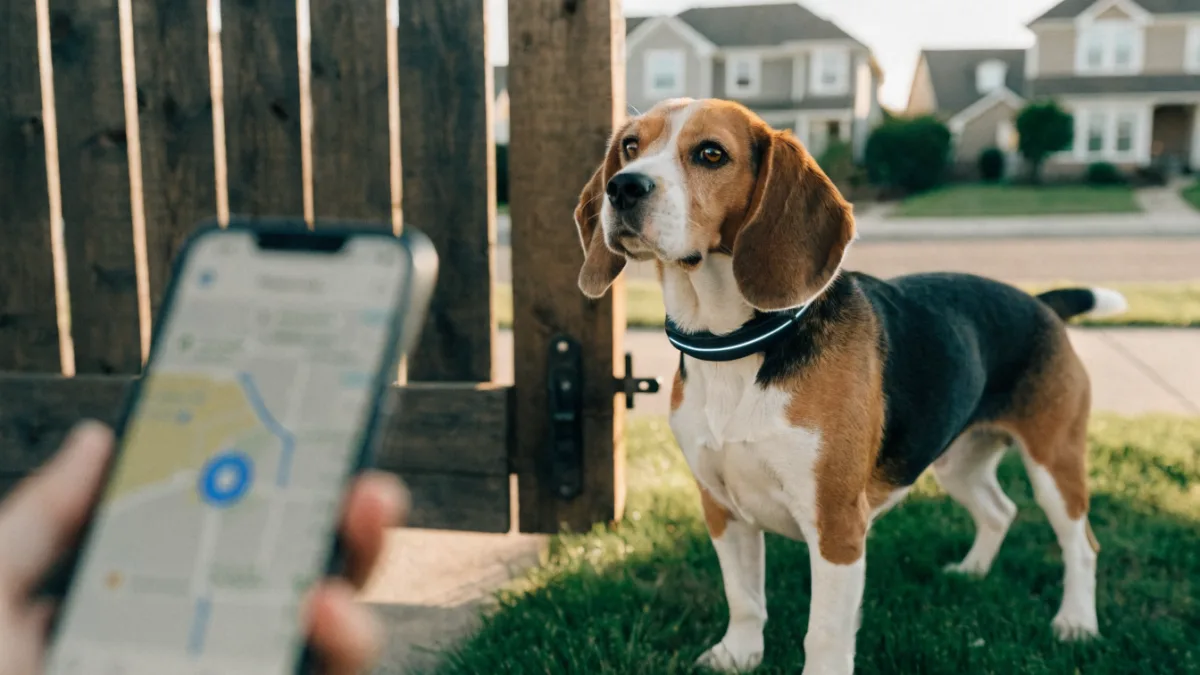
I’ll never forget the panic in Marcus’s voice when he called the clinic on a Tuesday afternoon. His eight-year-old Beagle, Buster, had bolted through an open garden gate after a rabbit. “He’s never done this before,” Marcus told me, breathless. “He’s chipped, but I have no idea where he is.” It’s a scenario I see play out all the time. Statistically, about one in three pets will go missing at some point in their lives, usually because of a single moment of distraction or a simple mistake. Marcus was lucky; a neighbor three streets over managed to wrangle Buster into their garage an hour later. But it highlights a common misunderstanding we see in the clinic: people often confuse permanent identification with active tracking. If you want to ensure your dog or indoor cat makes it home safely, you need to understand the distinct roles of microchips, GPS collars, and Bluetooth trackers.
The Tale of the Tape: How the Technology Actually Works
When clients ask me what the best tech is for finding a lost pet, I always start by explaining that microchips and GPS collars aren’t actually competing technologies—they do completely different things.
Microchips: Permanent, Passive ID
A microchip is about the size of a grain of rice and is injected under the skin, usually between the shoulder blades. It uses passive RFID (Radio Frequency Identification) technology. This means the chip has no battery and doesn’t emit any kind of signal. It simply sits dormant until a scanner at a veterinary clinic or animal shelter passes over it, transmitting a unique ID number.
The statistics backing microchips are incredible. Various veterinary studies show that microchipped dogs are returned to their owners at rates exceeding 50%, compared to about 20% for unmicrochipped dogs. For cats, the difference is even more staggering—the return rate jumps from under 2% to nearly 40% if they are chipped.
However, there is a massive caveat that I drill into my clients: a microchip is only as good as the database it is linked to. I’ll be honest, I’ve changed my mind on this over the years. Early in my career, I treated the microchip implantation as the finish line. But after seeing too many pets sit in shelters because the owners moved and forgot to update their phone numbers, I now spend just as much time stressing database management. You have to keep your contact information current.
GPS Collars: Active, Real-Time Tracking
If a microchip is a permanent ID tag, a GPS collar is a highly advanced homing beacon. These devices use satellites and cellular networks to provide real-time, live location tracking straight to an app on your phone.
Many modern GPS collars now feature “geofencing” or virtual fences. You can draw a boundary on your phone’s map around your house, and if your pet crosses that line, you get an instant push notification. The pet tech market is also moving toward “smart collars” that combine this GPS tracking with health and fitness monitoring—tracking your dog’s sleep, scratching, and daily steps. The major recent development here is miniaturization. Historically, GPS collars were far too heavy for cats or toy dog breeds, but recent advancements have led to much lighter trackers, making them safer and far more comfortable for our smaller companions.
Pros and Cons: Making the Choice
This isn’t necessarily an either/or debate, but it helps to look at the practical realities of each option. Depending on your pet’s lifestyle and behavior, you might need one or both.
Microchip Pros and Cons
- Pros: Permanent and internal. It cannot fall off, it never needs charging, and it lasts the entire life of the pet.
- Cons: It is completely passive. It relies entirely on someone finding, catching, and transporting your pet to a facility with a scanner. It won’t help you find your dog if they are hiding in the woods three miles away.
GPS Collar Pros and Cons
- Pros: Real-time tracking allows you to intercept a runaway pet immediately. You can set distance and radius alerts to catch an escape the moment it happens.
- Cons: It is a physical collar, meaning it can fall off and get lost, or get snagged on a branch. They require regular charging—sometimes as often as every few days—and usually require a monthly subscription fee to maintain the cellular connection.
The Great Indoor Escapee: A Feline Dilemma
If you have an indoor cat, the rules of the game change entirely. When an indoor cat escapes, they rarely act like a dog. Instead of running away, they typically panic and hide in silence very close to home—often under a deck, inside a bush, or in a neighbor’s garage.
Last spring, I treated a sweet indoor Russian Blue named Luna. She slipped out a patio door during a barbecue. Her owner searched the neighborhood for two days with no luck. Because Luna was terrified, she stayed hidden and silent, completely ignoring her owner’s calls. Had Luna been wearing a lightweight GPS collar, her owner could have opened an app and seen that Luna was actually hiding under the neighbor’s shed just twenty feet from the patio.
Beyond just getting the cat back, quickly recovering an indoor escapee has a massive positive impact on local wildlife conservation. Indoor cats that become stray, or outdoor cats that are allowed to roam, are responsible for devastating local bird and small mammal populations. By keeping cats contained—and recovering escapees immediately via live tracking before they go feral—we actively protect native wildlife from a highly efficient predator.
The Bluetooth Temptation: What About Key Finders?
There is an ongoing debate about using consumer Bluetooth trackers—the small coin-shaped tags designed for finding lost keys—as a cheap alternative to true GPS collars. I get the appeal; they are cheap, have great battery life, and don’t require a monthly fee.
These tags work by using localized Bluetooth signals connected to nearby passing smartphones. If a smartphone running the right app walks past your lost pet, it securely and anonymously pings the location to your app.
However, they have severe limitations for pets. They rely entirely on the density of surrounding smartphones. If your dog runs into a rural forest or a quiet canyon, there are no phones to ping the tag. Furthermore, many of these trackers are housed in hard plastic cases that pose a choking and gastrointestinal toxicity hazard if chewed by a teething puppy or a bored cat. While community,[1] occasionally show success with these tags in densely populated cities, they simply aren’t reliable enough for life-or-death pet tracking.
Avoiding the “False Security” Trap
One of the most dangerous things I see in practice is what I call the “false security” of the microchip. Some owners mistakenly believe that because their pet is chipped, they don’t need to be vigilant about physical fences or leashes. They think they can just “look up the pet’s location” if it runs away.
This is entirely false. As [2] a microchip is not a GPS tracker. Even if your dog has a real GPS collar, [3] that technology fails—batteries die, signals drop, and collars snap.
Technology should supplement responsible pet management, not replace it. If you have a “runner”—a dog with a high prey drive, a rescue with separation anxiety, or a known fence-jumper—a GPS collar is an excellent investment to intercept them before they get hit by a car. But that same dog still needs a secure physical fence and a properly fitted harness.
Ultimately, the best approach is a layered one. Invest in a microchip for permanent, lifelong identification, and keep your registration information meticulously updated. If your budget allows and your pet’s behavior warrants it, add a well-fitted, appropriately sized GPS collar for active tracking. By combining permanent ID with real-time location tech, you ensure that if your best friend ever decides to go on an unscheduled adventure, you have the tools to bring them safely back home.
Sources
- discussions and anecdotal experiences — facebook.com
- many experienced pet owners and professionals will attest — quora.com
- experts emphasize — safewise.com