

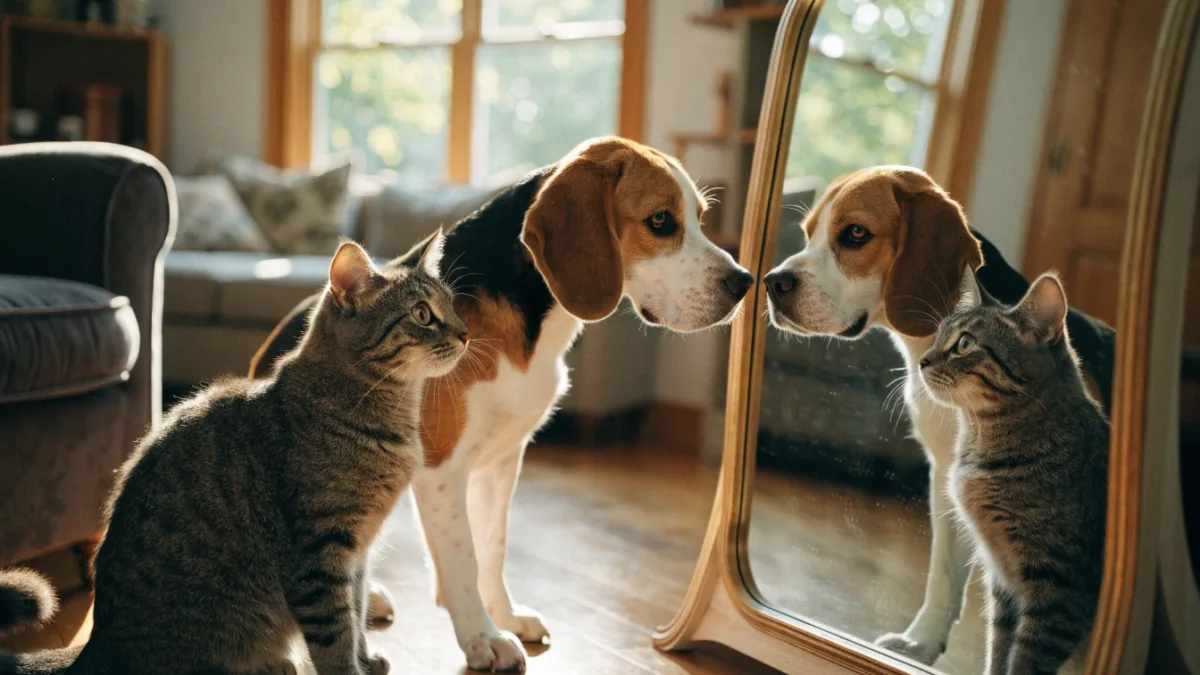
A few years back, a friend of mine brought home a twelve-week-old Australian Shepherd puppy. Within an hour, the puppy spotted his reflection in the sliding glass door. He froze, dropped his favorite chew toy, and let out a low growl. Within seconds, he was barking, spinning, and trying to flank the “other dog” from behind the curtain. It was hilarious, but it also highlights a weird quirk in animal psychology.
If you’ve ever watched a dog or cat lose their absolute mind over a mirror, you’ve probably wondered what exactly is going on in their head. Do they think it’s another animal? Do they know it’s them?
The short answer is no. Your dog and your cat have no idea that the reflection in the mirror is actually them. But the long answer—and the science behind why they don’t get it—is a lot more interesting. It all comes down to a famous psychological experiment known as the mirror test, and it might just tell us more about humans than it does about our pets.
How the Mirror Test Actually Works
To understand why our pets fail at mirrors, we have to look at how scientists test for self-awareness. Back in 1970, a psychologist named Gordon Gallup Jr. came up with something called the “mark test.”
The concept is pretty simple. You take an animal, put them to sleep or distract them, and dab a mark of odorless paint on a part of their body they can’t normally see—like their forehead. When the animal wakes up, you put a mirror in front of them.
If the animal looks in the mirror and reaches up to touch or scratch their own forehead, they pass. They understand the reflection is them, and they are investigating the new mark on their body.
Passing the test is a pretty exclusive club. Humans usually figure it out around 18 to 24 months of age. In the animal kingdom, great apes—like chimpanzees and orangutans—pass with flying colors. Bottlenose dolphins and killer whales have also passed, using their reflections to check out marks on their bodies. Asian elephants have shown signs of passing, too.
Dogs and cats? They fail every single time.
The Canine and Feline Freakouts
When dogs and cats look in a mirror, they don’t see “me.” They see a stranger.
I’ve seen dogs go absolutely bonkers when they catch their reflection, exhibiting the exact same behaviors they would if a stray dog walked into their yard. They bare their teeth, raise their hackles, and bark. Some get terrified and hide behind the sofa. Cats do the same thing—they puff up, hiss, and swat at the glass.
Over time, most pets figure out that this weird, aggressive intruder isn’t actually a threat. They move from extreme fear or territorial aggression into a phase of tolerance. Eventually, they just ignore the mirror completely. But ignoring the reflection isn’t the same as recognizing themselves. They just learn that the “other” animal isn’t going to steal their food or attack them.
The Real Reason They Fail: A Vision-Biased Test
Here’s where things get interesting. Does failing the mirror test mean your dog or cat lacks self-awareness? Not necessarily.
The core problem with the mark test is that it relies entirely on sight. Humans are incredibly visual creatures. We recognize ourselves, our friends, and our enemies by how they look. But dogs and cats don’t navigate the world the same way we do.
If you really want to blow a dog’s mind, remember that they recognize you by your smell long before they process what you look like.
Both dogs and cats experience the world primarily through olfaction—smell—and hearing. A dog’s sense of smell is tens of thousands of times more powerful than ours, and a cat’s hearing is finely tuned to pick up the high-pitched frequencies of scurrying rodents. For them, vision is a secondary sense.
Think about what a mirror actually offers: a totally silent, completely odorless image. When your dog or cat looks at a mirror, their eyes are telling them there’s another animal right there. But their noses—which they trust way more than their eyes—are telling them the room is empty. The “weird odorless cat” or “scentless dog” in the glass completely breaks the illusion of a real animal.
Is the Science Flawed?
There’s a massive debate in the animal behavior community right now about whether the traditional mirror test is just an inherently unfair metric for non-primates.
Because dogs and cats are so heavily scent-reliant, a visual test might not accurately measure their cognitive self-awareness. Researchers constantly debate whether an animal’s interest in a mirror constitutes actual recognition or if it’s merely “exploratory behavior” directed at what they mistakenly believe is another animal of the same species.
The truth is, dogs and cats absolutely have a sense of self. A dog knows the difference between their own body and another dog’s body. A cat knows the difference between their own tail being stepped on and a toy being pulled across the floor. They just don’t express that self-awareness visually.
In fact, a few years ago, researcher Marc Bekoff ran an experiment with his dog, Jethro. Instead of a visual mark test, he set up an “olfactory mirror test.” He let Jethro sniff different snow tracks—some were Jethro’s own tracks, some were other dogs, and some were his own tracks laced with a new scent. Jethro spent way more time investigating the tracks that were his own but had been altered by the new smell. He knew his own scent, and he recognized when something was off. It proved that dogs do have a concept of “mine” versus “theirs”—they just process it through their noses.
The YouTube Study: What Happens When Cats Meet Mirrors
While dogs have been put through rigorous laboratory tests, domestic cats have largely been ignored by researchers conducting formal mark tests. Cats are notoriously uncooperative in sterile lab environments, making controlled studies incredibly difficult.
So, how do we know cats don’t recognize themselves? Scientists did what any modern researcher would do when formal studies aren’t working out: they turned to the internet.
One recent, unconventional study turned to user-uploaded YouTube videos. Researchers analyzed countless hours of cats reacting to mirrors in their own homes, observing their natural behavior without the stress of a laboratory setting. The conclusion was exactly what you’d expect. Cats cannot recognize themselves in mirrors.
In the YouTube videos, researchers watched cats try to look behind the mirror, paw at the glass, or vocalize at the reflection. They watched the same progression we see in living rooms all over the world—confusion, followed by aggression or fear, followed by complete apathy. Relying on this observational data rather than laboratory controls confirmed what cat owners already suspected: Fluffy thinks her reflection is just a very confusing, slightly boring roommate.
What This Means for Your Pet
The next time your puppy barks at the hallway mirror or your cat tries to fight the feline in the bathroom glass, don’t worry about their cognitive abilities. They aren’t lacking intelligence. They just have a completely different operating system than we do.
We look at the world through a lens of light, color, and shape. They navigate the world through complex chemical signatures and ultrasonic sounds. Judging a dog or cat’s intelligence by their reaction to a piece of reflective glass is like judging a human’s intelligence by how well they can track a scent trail through the woods. We’d fail that test miserably, and we’d look pretty silly doing it.
The Bottom Line
Understanding how our pets process their environment isn’t just a fun party trick; it’s vital for how we care for them. When we recognize that a dog or cat’s self-awareness is tied to their nose rather than their eyes, we can stop anthropomorphizing—projecting human traits onto them—and start giving them what they actually need.
This takeaway applies to wildlife, too. When we look at wild animals, we have to be careful not to measure their intelligence or their capacity to suffer by human standards. A wolf tracking a herd across miles of tundra isn’t relying on sight; she’s reading an invisible, chemical map that we are completely blind to.
The fact that our dogs and cats fail the mirror test doesn’t make them any less brilliant. It just means their brilliance belongs to a world we can’t fully perceive. If we want to be good companions to them, we have to meet them in their world. Let them sniff the grass. Let them investigate the wind. And if you catch them barking at their reflection, just smile and remember—they know exactly who they are. They’re just waiting for that weird dog in the glass to smell like a friend.