

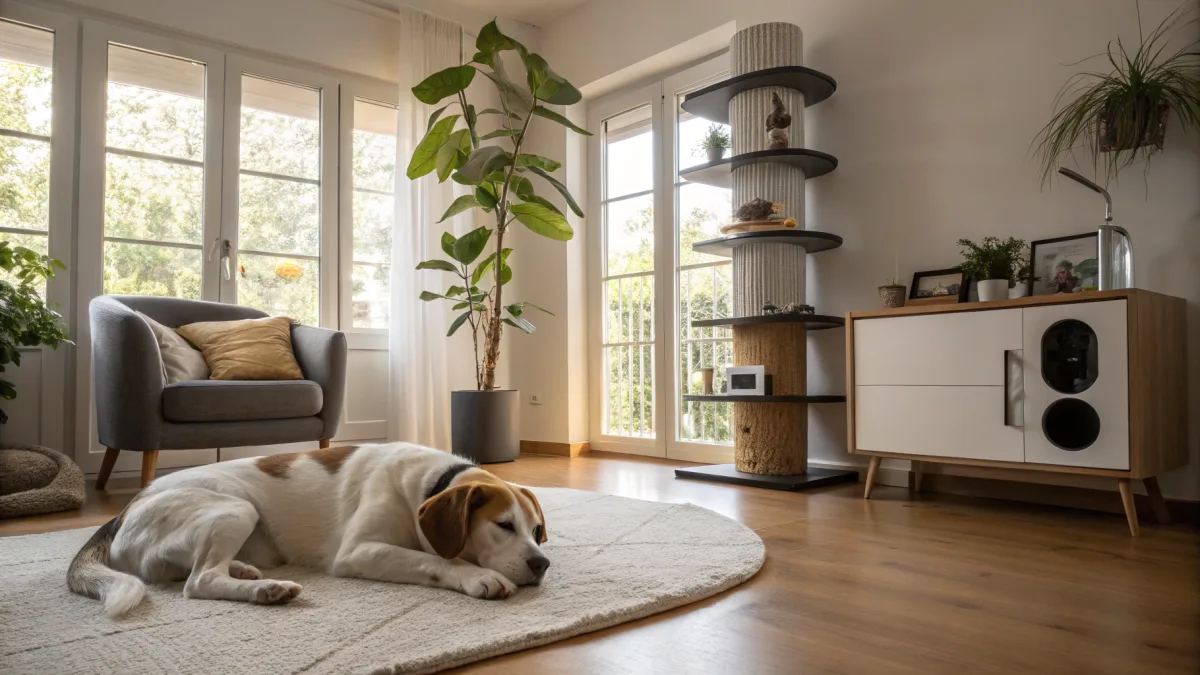
When my partner moved in with his 70-pound shepherd mix, Bear, I learned two things very quickly: my cat Mochi could teleport to the top of the refrigerator in .3 seconds flat, and nothing tests a relationship quite like trying to explain why the dog just ate $40 worth of prescription cat food out of a bowl he shouldn’t have been able to reach. We figured it out eventually, but those first few weeks were chaos—chased cats, stolen food, litter box “snacks” I refuse to describe in detail. Here’s what I’ve learned about creating a home where dogs and cats can actually coexist without anyone losing their mind.
Vertical Space Isn’t Optional—It’s Survival
Here’s the thing about cats: they’re hardwired to feel safe when they’re up high. It’s not a preference; it’s biology. Feline behavior researchers have found that access to vertical territory can reduce anxiety by up to 50% in multi-pet homes. When a cat can observe the chaos from above—say, a galloping Labrador barreling through the living room—they don’t have to choose between fight and flight. They just… watch. Judgmentally.
Mochi’s transformation when we installed her first wall shelf was immediate. She went from hiding under the bed during Bear’s evening zoomies to perching like a furry gargoyle, watching him with what I can only describe as benevolent contempt. The dynamic shifted completely. She wasn’t trapped; she was elevated. There’s a difference.
Practical Ways to Add Height
- Wall-mounted shelves and stairs: Create a pathway so your cat can cross an entire room without touching the floor. Stagger them at comfortable jumping distances.
- Tall cat trees (5+ feet): Place them near windows for bonus enrichment. The taller, the better—especially in homes with large dogs.
- Cleared bookshelf tops: If it’s sturdy and you don’t mind cat hair on your Hemingway collection, it’s free real estate.
- Cat hammocks that suction to windows: These are gold for apartments where you can’t drill into walls.
The goal is to create what behaviorists call “continuous vertical pathways”—basically, a cat highway. If Mochi can get from her tree to the shelf to the top of the fridge without coming down to Bear’s level, she has agency. And a cat with agency is a cat who isn’t stressed.
The Food Situation Is a Medical Issue, Not a Convenience Issue
I cannot stress this enough: free-feeding in a multi-pet home is a recipe for disaster. Dog food isn’t toxic to cats, but it lacks adequate protein and taurine—nutrients cats need to prevent heart and eye damage. Meanwhile, cat food is rich and fatty, and dogs who regularly snack from the cat bowl risk obesity and pancreatitis. Bear ended up at the vet after a particularly committed cat-food raid, and the bill was enough to make me rethink every design choice in my home.
Feeding Hacks That Actually Work
Elevated feeding stations for cats: If your cat is agile and your dog isn’t a jumper, feeding the cat on top of the washing machine, a high counter, or a designated elevated shelf solves the problem entirely. Just make sure it’s a spot the cat can comfortably reach and the dog genuinely cannot.
Microchip-activated feeders: This is where smart home tech has genuinely changed the game. These feeders only open for the specific pet whose microchip is registered. The cat walks up, the lid opens. The dog tries to shove his face in, nothing happens. It’s deeply satisfying to watch. If you go this route, look for models with a training mode that slowly introduces the mechanism—some cats are spooked by the motorized lid at first.
The baby-gate-with-a-cat-door method: This is my personal favorite because it’s simple and effective. Install a baby gate in a doorway—either one with a built-in cat flap, or mount a standard gate a few inches off the ground so the cat can slip underneath. Put the cat’s food on the other side. Done. No tech required, no batteries to replace, no app to update.
Litter Box Logistics (Or: How to Keep Your Dog From Being Gross)
I apologize in advance for bringing this up, but it’s a real problem that nobody warns you about. Many dogs view the litter box as a buffet. It’s revolting, it’s a health risk—cat feces can transmit parasites—and it’s one of the top reasons multi-pet households spiral out of control.
Solutions, ranked by effectiveness:
- Place the litter box in a cat-only room. Use the baby-gate-with-a-gap trick. This is the most reliable option because it creates a hard physical boundary.
- Top-entry litter boxes. Most cats adapt quickly, and most dogs can’t fit. Larger or particularly determined dogs might still figure it out, so monitor.
- Covered boxes with narrow entrances. Better than nothing, but clever dogs will still find a way in. Combine with placement strategy for best results.
- Hidden litter box furniture. A cabinet or built-in that houses the litter box with a small cat-sized entrance. This solves two problems: it keeps the dog out and keeps your living room from looking like a litter box commercial. Look for designs with proper ventilation and easy-access panels for cleaning.
Everyone Needs a Door They Can Close Behind Them
Cats aren’t the only ones who need retreat space. Dogs get overwhelmed too. Bear, for all his 70 pounds, is genuinely afraid of Mochi when she’s in a certain mood—and honestly, fair. She’s small but she’s got opinions, and her claws are real.
Creating species-specific safe zones isn’t about favoritism. It’s about acknowledging that both animals need a place where they can decompress without being watched, chased, or judged. For cats, this is usually a high-up, enclosed, quiet space. For dogs, it’s often a crate with the door open, a bed in a low-traffic corner, or a room with a baby gate so they can see the family but still have boundary.
The Dual-Purpose Furniture Trend
If you’re designing or renovating, look into combo furniture. There are gorgeous wooden pet houses where the dog sleeps in an enclosed bottom level and the cat has a balcony lounge on top. Some look like mid-century modern credenzas but hide a litter box inside. Custom built-ins can incorporate feeding stations, litter enclosures, and sleeping areas into one cohesive wall unit that looks like intentional design rather than “a crazy pet person lives here.”
I’m genuinely excited about the shift toward aesthetic pet furniture. For years, the options were either ugly or astronomically expensive. Now there are modular systems that integrate into your walls, sustainable materials that don’t off-gas, and designs that actually look like they belong in a home. Your house doesn’t have to look like a kennel just because you love animals.
Organization: The Dog Wall and Beyond
One of the best decisions we made was creating a dedicated pet station by the front door. Hooks for Bear’s leash and harness, a cubby for waste bags, a basket for Mochi’s wand toys, and sealed bins for food. When everything has a home, the chaos drops by about 80%. I made that number up, but it feels accurate.
The key with food storage is sealed containers—partially for freshness, partially because dogs are creative problem-solvers and will absolutely chew through a bag of kibble if given the opportunity. Ask me how I know.
And Finally, a Word About Wildlife
If you’re designing a multi-pet home, consider what your setup means beyond your walls. Cats are extraordinary hunters, and free-roaming outdoor cats contribute significantly to declines in songbird and small mammal populations. I’m not saying this to guilt anyone—Mochi would absolutely murder every bird in a five-block radius if I let her—but it’s worth thinking about. A well-designed catio (an enclosed outdoor patio) gives your cat fresh air, sunshine, and enrichment without the ecological damage. For multi-pet homes, a catio also serves as a natural dog-free zone where your cat can decompress and just be a cat for a while.
Designing for multiple species isn’t about making compromises. It’s about making everyone feel like the home belongs to them too. Mochi has her shelves, Bear has his corner, and I have the small but meaningful victory of a house that doesn’t smell like litter box or look like a pet store exploded in it. Most days, anyway.