

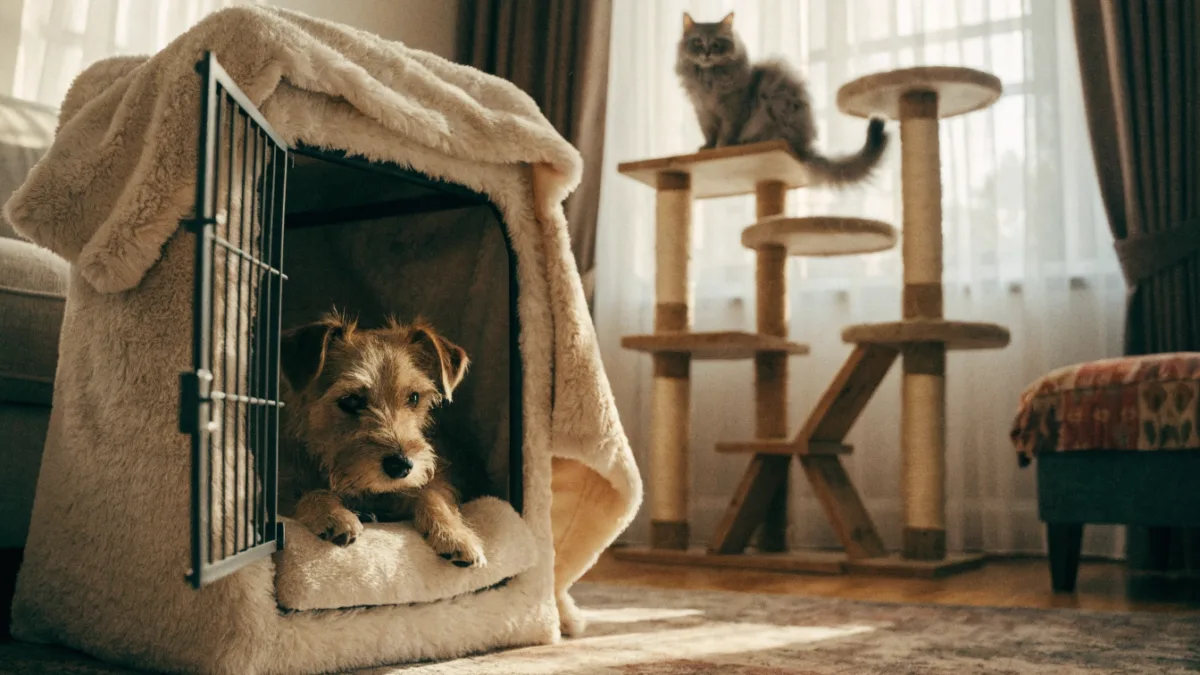
Mochi, my senior tabby, has exactly one opinion about the vacuum cleaner, and it’s loud. The second that motor whirs to life, she transforms from a dignified lap cat into a beige blur streaking toward the top of her six-foot cat tree, where she presses herself flat against the ceiling like a fuzzy gargoyle. Meanwhile, my sister’s terrier mix, Biscuit, handles the same vacuum by trotting calmly into his crate and lying down with a huff, like a little businessman retreating to his office. Same stressor. Two completely different safe zones. And honestly? Neither one of them is wrong.
Why Anxious Pets Need a “Room of Their Own”
Here’s something I find endlessly fascinating: our pets’ anxiety responses are hardwired into their evolutionary history. We tend to think of nervous behavior as a quirk — oh, Mochi’s just dramatic, Biscuit’s just sensitive — but the drive to seek shelter when threatened is survival instinct, pure and simple.,[1] dogs possess a natural denning instinct. In the wild, a small, enclosed space means protection from predators and the elements. Their brains are literally wired to feel calmer in a cozy, enclosed den.
Cats, on the other hand, evolved as solitary hunters who were also prey for larger animals. Their survival strategy came down to two options: hide somewhere a predator can’t reach, or get higher than the predator can jump. That’s why a cat who feels threatened will either wedge herself into a box that’s three sizes too small or materialize on top of the refrigerator. Both responses — concealment and verticality — are hardwired feline stress responses, not personality flaws.
When we create dedicated safe zones for anxious pets, we’re essentially speaking their neurological language. We’re giving their brains the environmental input that says “you are not about to be eaten,” which, it turns out, is a surprisingly difficult message to convey through treat-based positive reinforcement alone.
The Crate: A Dog’s Den (When Done Right)
Let’s talk about the controversy first, because there is one, and it matters. Crates have become a flashpoint in the pet community, and honestly, I understand why. A crate used poorly isn’t a safe zone — it’s a prison. If you’re using a crate for punishment, or leaving your dog locked inside for eight hours while you’re at work, or forcing an unacclimated dog inside and latching the door, you’ve created a trauma box. That’s not a hot take; it’s just reality.
But here’s the thing: when introduced properly, a crate taps directly into that denning instinct I mentioned. I’ve watched dogs who were nervous wrecks in open rooms settle into their crates with visible relief, the way you might feel when you finally close your bedroom door after a long, overstimulating day.
Making the Crate Actually Feel Safe
A bare crate with a thin pad isn’t going to fool anyone’s brainstem. The goal is to create a den, not a holding pen:
- Cover it. Drape a blanket over the top and three sides to create that dark, enclosed feeling. Just make sure there’s still airflow.
- Location matters. A crate in the middle of a high-traffic hallway isn’t a retreat; it’s a fishbowl. Find a quieter corner.
- Padding is non-negotiable. A comfortable bed or mat makes the space inviting rather than clinical.
- Keep the door open initially. Your dog should feel free to enter and leave, which builds positive association rather than trapping anxiety.
And if your dog hasn’t been crated in a while — maybe you used a crate during puppyhood and then phased it out — you can’t just reintroduce it during a thunderstorm and expect magic. Gradual reacclimation is key. Toss treats inside. Feed meals near the crate, then inside it. Let your dog discover the space on their own terms before you ever need to rely on it during a stressful event. (For the actual training protocol,,[2] have excellent guidance, and Jake could talk for hours about crate conditioning — that’s his wheelhouse, not mine.)
The Cat Tree: Vertical Territory as Therapy
Okay, let’s get to my favorite topic, because cat logic around safe spaces is genuinely brilliant once you stop imposing human reasoning on it.
Cats don’t want a crate. A crate, to a cat, is a trap. What cats want is height. When Mochi bolts to the top of her tree during a vacuum attack, she’s not being dramatic — she’s executing a survival strategy that’s been refined over millions of years. High ground means she can see threats coming. It means most predators can’t reach her. It means she’s in control of the situation, even if the situation is just a Dyson running in the living room.
A good cat tree serves multiple psychological functions beyond just “tall thing to sit on”:
- Surveillance. Cats feel safest when they can observe their territory from above. A tall tree near a window is basically feline Netflix with a security camera function.
- Escape routes. A multi-level tree gives cats options — up, down, sideways. Options equal control, and control equals reduced anxiety.
- Territorial confidence. In multi-cat households, vertical space reduces conflict because it gives each cat their own “zone” without competing for the same floor-level real estate.
But verticality isn’t the only feline answer. Cardboard boxes are famous stress-reducers for cats — there’s actual research showing that shelter cats with boxes adapt to their environments faster and show fewer stress behaviors than cats without them. [3] closet cubbies, covered cat caves — all of these work because they offer concealment, which is the other half of the feline anxiety toolkit.
The ideal cat safe zone, honestly, offers both: height and hiding. Mochi’s tree has a covered condo section at the base. She uses the top for vacuum emergencies and the bottom cubby for when she’s feeling socially overwhelmed but doesn’t want to fully leave the room. Cats are complex little survival machines, and giving them options respects that complexity.
Everyday Triggers: What You’re Actually Protecting Them From
We tend to think of pet anxiety in terms of major events: fireworks, thunderstorms, the doorbell ringing on Halloween. And yes, those are real triggers. But the everyday stuff matters too, and it’s easy to underestimate how stressful normal household life can be for an animal whose senses are significantly more acute than ours.
Think about it: a dog’s hearing range extends to frequencies we can’t even detect. The vacuum, the dishwasher, the garbage disposal, construction down the street, the delivery driver dropping a package on the porch — these aren’t minor annoyances to a sensitive dog. They’re potential threats. And for cats, who are both predators and prey, a suddenly rearranged living room or a new piece of furniture can trigger territorial anxiety that lasts for days.
Safe zones give pets a consistent, predictable retreat from sensory overload. The world outside might be loud and confusing and full of Things That Smell Wrong, but the crate is quiet, and the cat tree is familiar, and that consistency is genuinely therapeutic. It’s not coddling. It’s environmental enrichment that acknowledges the reality of how our pets experience the spaces we share with them.
Design and Function: You Don’t Have to Live in a Pet Store
Here’s where I’ll get slightly opinionated: the idea that accommodating your pet’s anxiety means sacrificing your home’s aesthetic is outdated and a little silly. There’s been a real shift in how pet manufacturers and interior designers approach this stuff, and the options now are genuinely better than they were even five years ago.
Modern cat trees don’t have to look like carpeted telephone poles. You can find designs with clean lines, wood finishes, and neutral fabrics that actually complement a room rather than dominating it. Crates come in furniture-style designs that double as side tables. Covered cat beds look like decorative cushions. The functionality — enclosed space for a dog, elevated perch for a cat — stays the same, but the execution has caught up with the reality that most people don’t want their living room to look like a kennel.
When I replaced Mochi’s old tree (which was genuinely hideous — beige carpet tubes, she loved it, I did not) with a more streamlined version, she took to it immediately because the important features — height, a covered cubby, a stable base — were all there. The fact that it now looks like something I chose on purpose rather than something I tolerated was just a bonus.
The Bottom Line
Creating safe zones for anxious pets isn’t about spoiling them or accommodating bad behavior. It’s about recognizing that our animals come with deep, species-specific instincts, and working with those instincts rather than against them. Dogs need dens. Cats need height and hiding spots. When we provide those things — thoughtfully, patiently, without forcing the issue — we’re not just reducing anxiety. We’re communicating to our pets that we understand them, that their needs matter, and that home is a place where they can feel genuinely safe. And honestly, watching a stressed animal finally settle into a space that’s designed for them, sigh, and close their eyes? That’s one of the best feelings in the world.
Sources
- As behavior experts note — chewy.com
- folks who work with rescues — facebook.com
- Under-bed hiding spots — facebook.com