

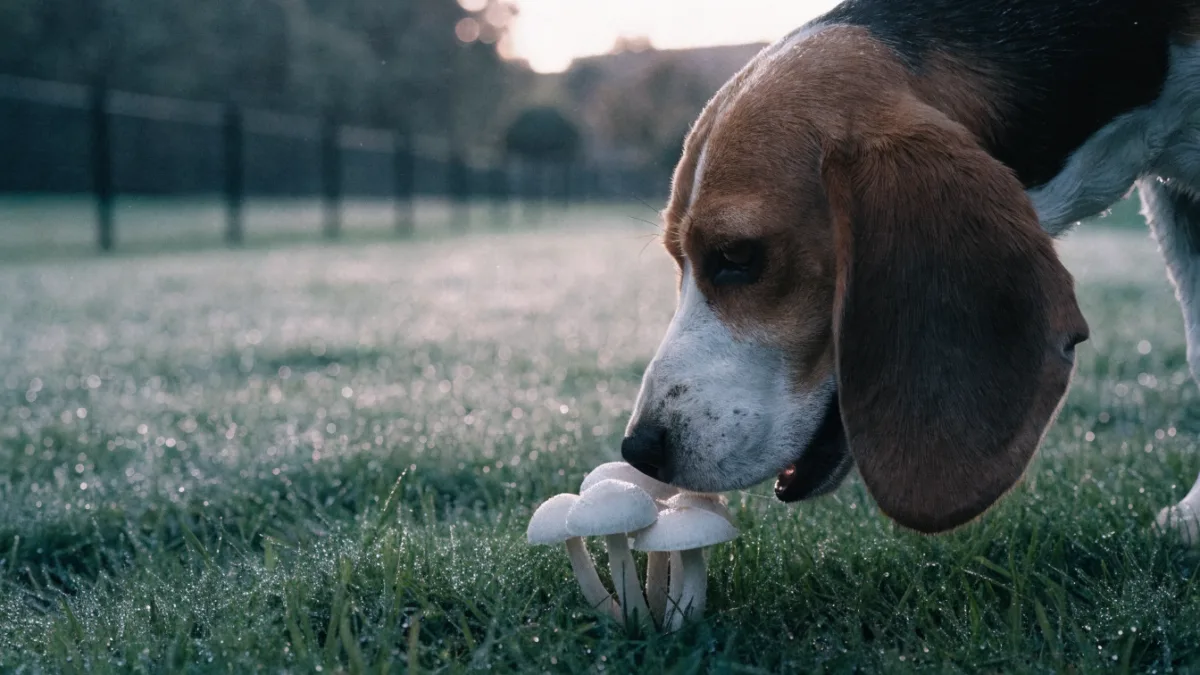
It’s a phone call pattern you could set a watch by. Rain moves through on a Thursday, the lawn mushrooms by Saturday, and by Monday someone is on the line saying, “He threw up all night, but honestly, he seems better now.” Last October, that call was about Luna, a three-year-old shepherd mix who’d snacked on small white mushrooms along a fence line. She vomited Sunday evening, looked dull Monday morning, then perked up by Monday afternoon — so her owner reasonably assumed the worst had passed. By Wednesday she couldn’t stand, and by Thursday her gums had a yellowish tinge that was genuinely worrying.
“She was totally back to normal on Tuesday — that’s why we waited.” — Luna’s owner, and honestly, I would have thought the same thing before veterinary school.
That comfortable Tuesday was the cruelest part of Luna’s case, because it was a lie her liver was telling her. And it’s the single most important thing I can teach you about mushroom toxicity in dogs: the deadliest mushrooms don’t announce themselves quickly.
The False Recovery Trap: Why “He Seems Fine” Worries Me Most
The mushrooms that kill dogs produce compounds called amatoxins. The main one, alpha-amanitin, blocks an enzyme called RNA polymerase II — picture someone cutting the power to your liver’s protein factory. The liver can’t repair itself, can’t do its job, and quietly falls apart over several days.
Here’s the classic timeline, and it’s worth memorizing:
- 6–24 hours after the bite: vomiting, often bloody diarrhea. Owners see a “stomach bug.”
- Roughly 12–24 hours later: apparent recovery. The dog eats, wags, acts normal. This window is a biochemical decoy.
- Days 2–4: jaundice, lethargy, collapse — liver and sometimes kidney failure.
- Days 3–7: without early treatment, this is frequently fatal.
There is no true antidote for amatoxins. What saves dogs is early decontamination — getting the mushroom out and binding what’s left, often with repeated doses of activated charcoal, because the toxin recirculates between the liver, bile, and gut like a bus on a loop. Every hour you wait shrinks the window.
I’ll admit something here: early in my career, I’d reassure owners that most lawn mushrooms are harmless — which is statistically true. Luna changed my mind. Now my advice is simpler and less cozy: treat every unknown mushroom as the bad one until a professional tells you otherwise. Luna survived, by the way. Five days of aggressive hospital care, and bloodwork that told the story for months afterward. Her owner’s quick call once things went sideways is a big part of why.
The Deadliest Ones Are the Boring White Ones
Most people picture [1] as the red-capped, white-dotted toadstool from fairy tales. The reality is duller and more dangerous: the mushrooms that cause most fatal [2] are plain white or greenish-white. According to the Pet Poison Helpline, the majority of fatal pet cases come from just three groups: Amanita, Galerina, and Lepiota.
- The destroying angel (Amanita bisporigera and relatives) — pure white, elegant, and utterly lethal.
- Deadly Lepiota species — small, unremarkable white lawn mushrooms you’d step on without noticing.
- Galerina marginata — little brown mushrooms that grow on wood mulch and chips, exactly the kind used in landscaping beds.
The infamous death cap, Amanita phalloides, is responsible for roughly 90% of human mushroom-poisoning deaths worldwide — one medium cap can kill an adult human, so a dog needs far less. It’s also a fascinating ecological footnote: it’s not native to North America. It arrived on the rootballs of imported ornamental trees, took hold on the West Coast, and is now documented in urban areas and the East Coast. The backyard mushroom danger zone is expanding.
You can’t reliably identify mushrooms from a photo or a memory — even experts argue over specimens. But there are three features that should raise your hackles, and you’ll only see the last one if you dig the mushroom up whole:
- White gills underneath the cap
- A ring or “skirt” on the stalk
- A bulbous cup (called a volva) at the base, sometimes buried
And please, let go of two myths right now. Brightly colored does not mean dangerous — the deadliest species are white. And “the squirrels were eating them, so they must be safe” is flatly false; wildlife metabolism and instincts don’t transfer to your dog.
What Poisonous Mushrooms Actually Do: A Cheat Sheet
Not all toxic mushrooms work the same way, and oddly enough, the fast-acting ones are usually the least dangerous. Here’s the version of the chart I keep taped inside a clinic cabinet:
| Toxin | Typical mushrooms | First signs | Severity |
|---|---|---|---|
| Amatoxins | Death cap, destroying angels, Galerina, Lepiota | Delayed 6–24 hrs: vomiting, bloody diarrhea, then false recovery, then jaundice and liver failure | Most lethal |
| Muscarine | Inocybe, Clitocybe | 30 min–2 hrs: drooling, tearing, pinpoint pupils, slow heart rate | Moderate–severe |
| Ibotenic acid/muscimol | Fly agaric, panther cap | 30 min–2 hrs: drunken staggering, tremors, seizures | Moderate |
| Gyromitrin | False morels | 6–12 hrs: GI signs, then seizures | Severe |
| Psilocybin | “Magic” mushrooms | 30–90 min: dilated pupils, wobbling, bizarre behavior | Rarely fatal |
| GI irritants | Many common lawn species | 15 min–2 hrs: vomiting, diarrhea | Usually mild |
For contrast to Luna’s slow-motion disaster: Herbert, a nine-year-old pug, once came in fountain-drooling with pinpoint pupils an hour after rooting under an oak. Classic muscarine signs from an Inocybe. Dramatic? Very. But he was home by morning after fluids and monitoring. The pattern I want you to internalize: fast and showy usually means treatable; quiet and delayed means dangerous.
If Your Dog Eats a Mushroom: The ER Checklist
First, the numbers. Save these in your phone today, not during the emergency:
- ASPCA Animal Poison Control Center: (888) 426-4435
- Pet Poison Helpline: (855) 764-7661
Both charge a consultation fee (typically $75–95), and both are worth every penny. If you’re outside the US, search for your national animal poison line now and bookmark it.
Then, in this order:
- Call before doing anything else — don’t wait for symptoms. Remember the false-recovery trap.
- Dig up the entire mushroom, base and all. That volva can be the identifying feature, and yanking off just the cap is like handing someone a crime scene photo with the suspect cropped out.
- Photograph everything: top, side, underside with the gills, a cut-in-half cross-section, and where it was growing.
- Wrap specimens in a paper towel or paper bag — never plastic. Plastic turns mushrooms to mush and destroys the details labs need.
- Bring a sample of vomit if it contains mushroom fragments.
- Write down the timeline: when it was eaten, roughly how many, and every symptom with its clock time.
One caution on home remedies: I know the internet loves hydrogen peroxide for inducing vomiting in dogs, and poison control does sometimes recommend it. But dosing errors, aspiration into the lungs, and certain dogs — flat-faced breeds like pugs and bulldogs, any dog already showing symptoms, and cats essentially always — make this risky. Only induce vomiting under professional guidance from poison control or your veterinarian. Calling first costs you nothing but minutes, and minutes are survivable. Guessing isn’t.
Mushroom Patrol: Making Your Yard Boring Again
Prevention is genuinely simple, just not effortless. The routine that works:
- Patrol after every rain and before letting the dog out. Mushrooms can appear overnight; that’s the whole point of them.
- Pick by hand with gloves, discard in the trash — not the compost.
- Manage the source: remove buried wood, old stumps, and broken-down mulch, and ease up on overwatering. Fungi need damp, decaying material.
- Don’t rely on the mower. The mushroom is just the fruit; the real organism — the mycelium — lives underground year-round. Mowing over mushrooms is like picking one apple and expecting the tree to be gone.
- Train a rock-solid “leave it” and “drop it,” leash your dog in wooded areas, and supervise known grazers. Some dogs are repeat offenders — I have a beagle patient, Winston, who treats his backyard like a salad bar and gets a daily mushroom sweep because of it.
A quick word on cats: [3] because they rarely graze the way dogs do. But exposure is possible and just as serious, and the same protocol applies — call, collect, photograph.
And a hopeful note for the science-minded: researchers identified a promising amatoxin antidote candidate — a dye compound called indocyanine green — in a 2023 study. It’s early, mouse-stage work with no veterinary use yet, but it’s a reminder that this field is moving.
Here’s my final thought, and it’s not a scare. Fungi are magnificent. They’re the decomposers that recycle every fallen leaf and buried stump, they build the soil your grass grows in, and the death cap’s spread across a new continent is a genuinely gripping ecological story. The goal isn’t a fungus-free world — it’s a fungus-free fetch route. Walk your fence line after the next rain, keep those two phone numbers saved, and if the worst happens, trust the timeline over the tail wag. Luna’s owner did, eventually, and that’s why Luna greeted me at the door last week, tail going like a metronome.
Sources
- poisonous mushrooms — instagram.com
- poisonings in dogs and cats — facebook.com
- outdoor cats are much lower risk — goodheart.vet