

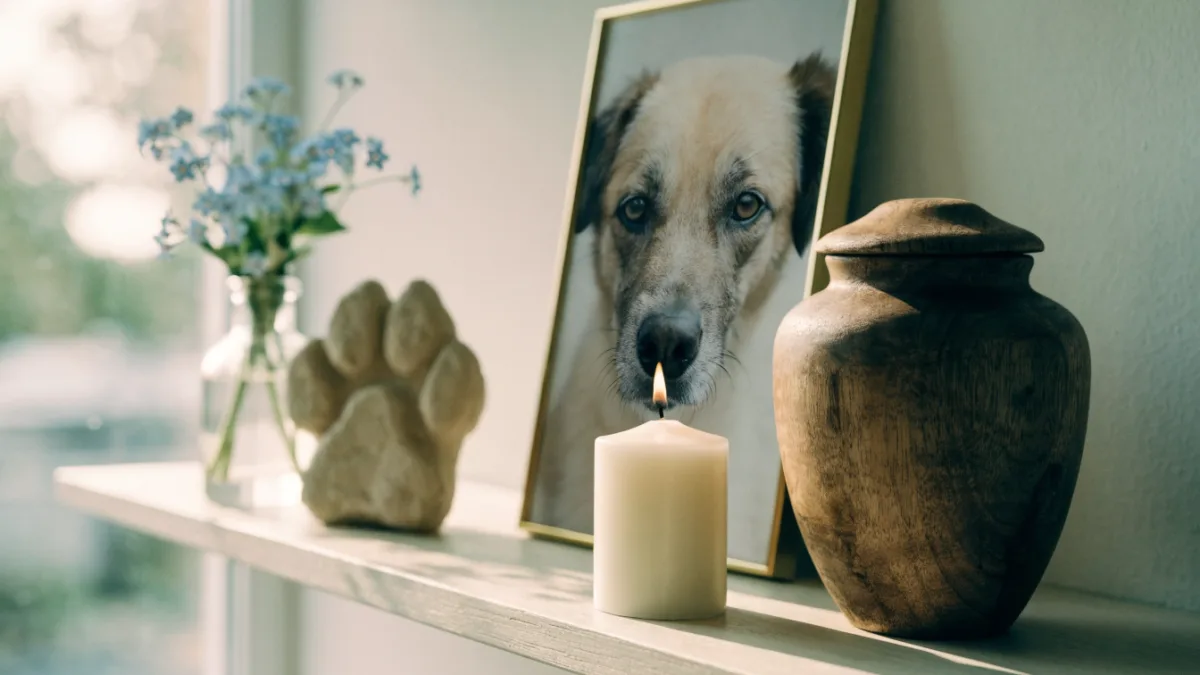
If you’re reading this in the raw first days after losing a pet — or watching a beloved old friend slow down and quietly getting your paperwork in order — I’m sorry, and I’m glad you’re here. The strange truth about pet loss is that the logistics arrive almost immediately: someone at the clinic, very kindly, starts asking questions about aftercare at the exact moment your brain is least available to answer them. So here’s a map. What your options actually are, what’s legally allowed in your backyard, and how to build a goodbye that feels like it honors the animal who just spent a decade or more being your whole routine.
The First Few Days: Nothing Has to Be Decided in the Room
Here’s the thing almost nobody tells you: most veterinary clinics will hold your pet’s body for several days. You do not have to stand in that exam room, still shaking, and make permanent decisions. “A few days” is enough time to go home, sit somewhere quiet, and think — and taking that time is one of the kindest things you can do for yourself.
What matters in those first days is simply choosing a direction: cremation, burial, or letting the clinic handle arrangements. [1] tend to make it sound like a smooth menu, but in practice it’s a handful of honest conversations — with your vet, with a crematory or cemetery, and with whoever shares your grief. That’s it. The rest can wait until you can breathe.
Pet Cremation Options, Without the Euphemisms
The three types, plainly
- Communal (commingled) cremation. Your pet is cremated with other animals and the ashes are not returned. It’s the least expensive option, usually $30–$100, and for many people it’s exactly right — a shared, dignified departure.
- Partitioned (semi-private) cremation. Multiple pets are cremated at once with physical separation, and you receive ashes back — with the caveat that trace co-mingling is possible. Typically $100–$200.
- Private (individual) cremation. Your pet is cremated alone, and the ashes are guaranteed to be only theirs. Usually $150–$300+, and large dogs can run $350–$400. “Witnessed” cremations, where you’re present, cost more.
One reassurance worth stating plainly: cremated remains are sterile and pose no health risk. Whatever you decide to do with them — keep them, scatter them, divide them among family — you have time. Years, honestly.
Aquamation: the newer option
Alkaline hydrolysis — sometimes called water cremation — uses water, gentle heat, and alkali instead of flame. It returns about 20–30% more remains, uses significantly less energy, and has a lower carbon footprint. Availability has expanded quickly since 2020, and cost is usually comparable to or slightly above flame cremation. If sustainability matters to you, it’s worth asking whether anyone near you offers it.
How to choose a crematory you can trust
This is the uncomfortable part. Investigations have exposed providers returning commingled — or occasionally outright incorrect — ashes, and the industry is lightly regulated in most states. So ask hard questions, kindly:
- What tracking or ID system do they use, and does it follow your pet through every step?
- Are they certified (look for the [2] or Pet Loss Professionals Alliance)?
- Can you witness the cremation?
- What, exactly, is returned to you, and how is it verified?
A good crematory answers these without bristling. The best ones are proud of their tracking systems.
Backyard Burial: What’s Actually Legal
People bury pets in their yards all the time — and a surprising number do it without realizing their local rules. In most U.S. states, home burial is legal on property you own, but it sits under a patchwork of state statutes, county and city ordinances, and HOA rules. If you’re outside the U.S., assume the picture is different again and check locally. Work through it in order:
- Do you own the property? Renters generally cannot bury pets, even in a yard they’ve cared for for years. [3] describes taking her cat home from the clinic precisely because she couldn’t bury him at her rental — a dilemma far more common than anyone admits.
- Check state law. Some states restrict burial entirely; others allow it with conditions.
- Check local ordinances and your HOA. Cities can be stricter than states — New York City, for example, generally prohibits home pet burial under its health code.
- Check the ground itself. Where burial is allowed, typical requirements are a depth of 2–4 feet (below scavenger dig depth) and setbacks of 50–200 feet from wells, waterways, and property lines. Avoid wetlands, flood zones, and high water tables.
That depth requirement isn’t bureaucracy for its own sake. Euthanasia solution — pentobarbital — remains in the body after death and is lethal to scavengers. Bald eagles, vultures, and coyotes have genuinely died from feeding on pets buried too shallowly. Deep burial is a wildlife-safety issue as much as a legal one. And if your pet died of a contagious illness like parvovirus, ask your vet whether cremation is the safer choice — often it is.
If home burial isn’t possible or right, pet cemeteries exist in far greater numbers than people expect — over 600 in the U.S. alone. Plots typically run $400–$1,500+, with opening and closing fees of $250–$1,000 and perpetual-care fees around $50–$200. Not cheap, but for some families, a place to visit matters enormously.
Meaningful Memorials: What Actually Helps
There’s no wrong memorial, but there are a few categories worth knowing about. The [4] is enormous, so here’s the honest core of it:
- Things you can hold: urns (including biodegradable ones), cremation jewelry, clay or ink paw prints taken at the clinic, fur clippings, engraved garden stones, a commissioned portrait.
- Living memorials: a tree or a garden bed planted in their name. One chemistry warning here — cremated ashes are high in pH and sodium and can actually harm plants unless mixed with one of the special soil additives made to neutralize them. If you want a memorial tree to thrive, plan for that.
- Acts of remembrance: a donation to a shelter or rescue in your pet’s name, sponsoring a kennel, volunteering your time. For a lot of grieving people, this is the one that helps most — turning loss into something that keeps working.
Rituals help too, more than they get credit for. A small family service, a shared meal, a favorite walk one last time. There are even dates on the calendar now — National Pet Memorial Day (the second Sunday of September) and Rainbow Bridge Remembrance Day (August 28) — if having an annual moment to return to sounds comforting rather than painful.
The Grief Is Not Too Big. It Never Was.
Grief researchers have a term for what happens when you lose a pet: disenfranchised grief, coined by grief researcher Kenneth Doka to describe loss that —
is not openly acknowledged, socially sanctioned, or publicly mourned.
In other words: the grief is real, but society keeps forgetting to treat it that way. Research from 2020 and since suggests grief after pet loss can be comparable in intensity and duration to losing a close human relative, often lasting six months to a year. Meanwhile, only about 5% of U.S. employers offer pet bereavement leave. Your grief is not oversized. The container around it is undersized.
Two more things, gently. First: when someone tells you to “just get another one,” you’re allowed to ignore them. Grief counselors consistently advise against rushing a new adoption — not because a new pet is wrong, but because grief needs to be felt first, not replaced. Second: dedicated support exists. Veterinary schools including Cornell and Tufts operate pet loss hotlines, and the [5] offers counseling and chat support. Books help too — Wallace Sife’s The Loss of a Pet has steadied people for decades. And if there are children in the house, include them: small rituals and honest language do far more good than vague explanations.
Planning Ahead: A Gift to Your Future Self
The aftercare section of my vet’s price list lives at the very bottom of the page, in small print — communal cremation, private cremation, prices, just sitting there on the wall. I read it properly for the first time while waiting for Benny’s rabies booster, with Benny asleep against my leg, and I stood there a lot longer than the situation required. Nothing was wrong. I just realized I’d never once thought about any of it, and someday, eventually, I would need to.
If your pet is aging, that’s not morbid — that’s the work. Pre-planning and prepaid aftercare packages exist precisely so you’re never making permanent decisions in acute grief. Write your wishes down. Talk with family so nobody is guessing. Set a rough budget. And if you’re a senior whose pet is your primary companion, be extra gentle with yourself now and later — the silence after can be its own loss, and it deserves the same support.
One last thought. The way we say goodbye ripples outward in ways most of us never see: a shallow grave can poison an eagle, a thoughtfully chosen aquamation cuts emissions, a memorial tree cools a yard for decades. The goodbye is one more act of care — for them, for you, and occasionally for the wild world that never met them but shares the ground. Do it at whatever pace you can manage, and let the size of the love be the only thing that’s non-negotiable. In my experience, the size of the animal has never once matched the size of the goodbye.
Sources
- Guides to pet burial and cremation — heavenlyacresforpets.com
- IAOPCC — iaopcc.com
- One cat owner in a pet loss discussion group — facebook.com
- full range of memorial ideas — memorials.com
- Association for Pet Loss and Bereavement — aplb.org