

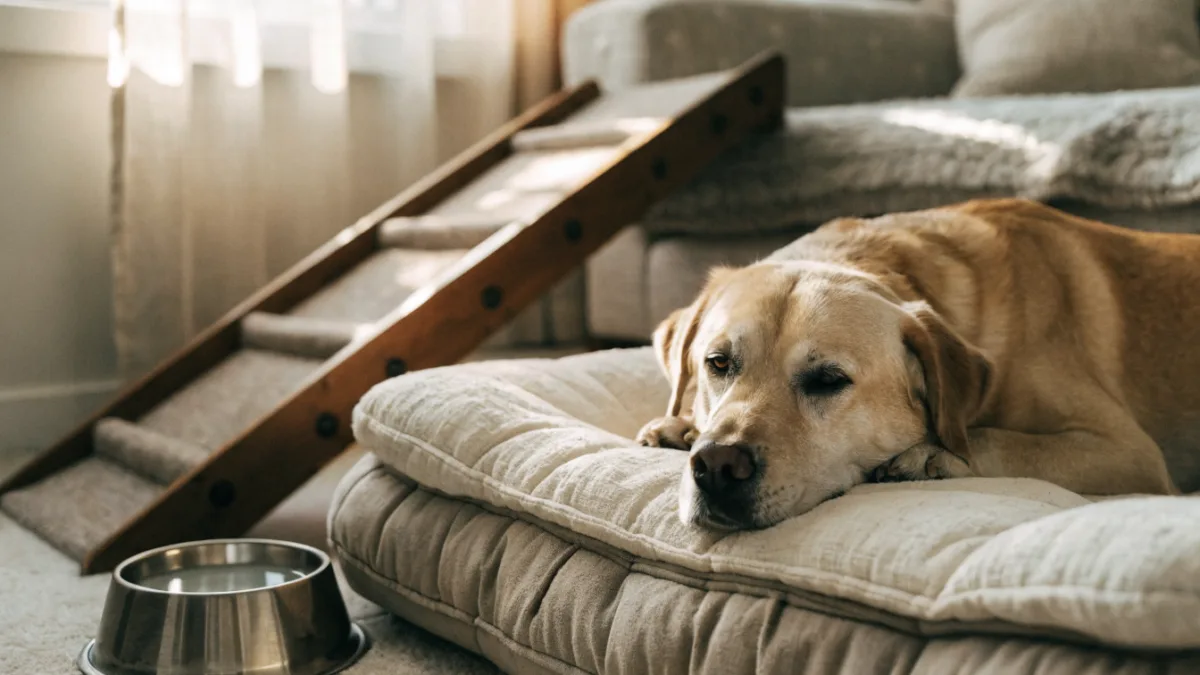
Mochi turned fourteen last March, and for the first time, I watched her hesitate at the edge of the couch. Not the dramatic, theatrical hesitation she does when she wants me to turn on the faucet before she’ll drink — this was different. Her back legs trembled slightly. She looked at the cushion, looked at me, and then just sat down on the floor instead. That tiny moment sent me down a rabbit hole of research about senior pet mobility that I wish I’d started a year earlier.
Here’s what I learned: our homes are basically obstacle courses designed for young, springy animals. Hardwood floors become ice rinks. Couches might as well be mountains. And that cozy elevated cat bed Mochi used to launch herself onto? Forget it. The good news is that a few thoughtful modifications can completely transform your senior pet’s daily life — and the changes don’t have to turn your living room into a hospital ward.
What “Aging in Place” Really Means for Pets
The concept of “aging in place” comes from human gerontology — the idea that people do better, physically and emotionally, when they can stay in familiar surroundings as they grow older rather than moving to care facilities. The same principle applies to pets. A senior dog or cat who has spent years learning the geography of your home, the sunny spots on the rug, the schedule of the household — that animal thrives on continuity. Uprooting them causes stress that can actually worsen health outcomes.
Veterinarians note that [1] is one of the most impactful things you can do for their quality of life. And it makes sense when you think about what aging actually does to a body. Osteoarthritis affects roughly 80% of dogs over age eight and a similarly high percentage of cats in the same bracket. Joints stiffen. Muscles thin. Vision dims. The environment that worked perfectly for a six-year-old animal becomes genuinely hazardous for a thirteen-year-old one.
The goal isn’t to wrap your pet in bubble wrap. It’s to remove the obstacles that create unnecessary pain or risk while preserving their independence.
The Orthopedic Bed Question: Why Memory Foam Actually Matters
I used to think “orthopedic bed” was marketing nonsense. Then I watched my sister’s arthritic Labrador, Biscuit, sink into a memory foam bed and let out a groan of relief that I’m pretty sure my sister’s husband has never heard from her. The difference was immediate and obvious.
What Makes a Bed “Orthopedic” (And Not Just Expensive)
Standard pet beds — the fluffy, stuffed kind — compress under weight. They feel soft to us, but for an animal with joint pain, they offer almost no support. It’s like sleeping on a pile of pillows: comfortable for ten minutes, then your hips start aching.
True orthopedic beds use dense foam that maintains its shape while conforming to the body. [2] are considered the gold standard because they distribute weight evenly and relieve pressure on sore joints. The egg-crate texture creates peaks and valleys that promote airflow (good for temperature regulation) while providing consistent support across the entire surface.
For cats specifically, I’ll add something the product descriptions rarely mention: the bed needs to have low sides or a low entry point. Mochi has a gorgeous orthopedic bed that she refused to use for weeks because the rim was too high for her to step over comfortably. I ended up cutting one section down — problem solved. Look for beds designed with accessibility in mind, or be prepared to get crafty.
The Heated Bed Debate
Heat therapy can be wonderful for arthritic joints. It increases blood flow, reduces stiffness, and just feels good. But heated beds come with genuine risks for senior pets. Thinning skin and reduced mobility mean some animals can’t easily shift away if the temperature becomes uncomfortable. Electric cords present chewing hazards. And any cat owner will tell you that the phrase “my cat would never chew on a cord” is a famous last word.
If you want warmth, self-heating pads (which reflect body heat rather than generating their own) are generally safer than plug-in options. And whatever you choose, talk to your vet about what’s appropriate for your specific animal’s condition and mobility level.
Ramps, Stairs, and the Great Accessibility Debate
This is where things get surprisingly controversial in the pet mobility world. You’d think “help your pet reach the couch” would be straightforward. It is not.
Ramps vs. Stairs: The Ongoing Argument
[3] serve the same basic function: getting your animal onto elevated surfaces without jumping. But they work differently, and pet physical therapists have strong opinions about which is better.
The argument for ramps: they require less joint flexion than steps. An animal with elbow dysplasia or advanced hip dysplasia might find the stepping motion of stairs painful. A ramp lets them walk up at a gradual incline, which is biomechanically easier.
The argument against ramps: they take up significantly more floor space, and some dogs are genuinely terrified of walking on an incline. I’ve seen videos of big, brave dogs freezing halfway up a ramp like they’re on a ski slope. Training helps, but it’s a real consideration.
The argument for stairs: they’re compact, many pets use them intuitively, and they work well for animals whose joints are stiff but not severely compromised.
My take? It depends on your pet and your space. For dogs with diagnosed joint conditions, talk to your vet or a canine rehabilitation specialist about which option is biomechanically appropriate. For cats — and I say this with love — many of them will ignore whatever you buy and find their own route. Provide options and see what they actually use.
Where You Actually Need Them
The three critical zones are: couch access, bed access, and vehicle entry. Car ramps especially — if your dog still rides along on errands or vet visits, lifting a large arthritic dog into an SUV is hard on both of you, and jumping down is terrible for aging shoulders and wrists.
Flooring: The Invisible Hazard
This one sneaks up on people. That gorgeous hardwood you installed when your dog was three? It’s now a slip-and-fall risk. Tile and laminate are worse.
Senior pets lose muscle mass in their hindquarters, which means their back legs can’t compensate when they slip. A minor skid that a younger animal would catch automatically can send an older pet sliding into a wall or piece of furniture. And for cats, a bad fall can cause injuries that cascade into serious health problems.
The solution doesn’t require ripping up floors. Strategic placement of area rugs, carpet runners, and traction mats creates “pathways” through high-traffic areas. Focus on the routes your pet uses most: bed to water bowl, couch to back door, food dish to favorite sunbeam. Non-slip stair treads are essential if you have steps in your home. And if your pet needs to cross a particularly slippery stretch, there are paw-safe grip waxes and even booties — though good luck getting those on a cat.
Smart Design: When Function Meets Aesthetics
The pet product industry has finally caught up to the reality that people don’t want their homes to look like veterinary clinics. Recent trends include ramps and stairs designed to blend with home furnishings — wood finishes, upholstered surfaces, profiles that read as modern furniture rather than mobility aids. Orthopedic beds now come in fabrics and colors that complement your existing décor.
There’s also exciting movement toward sustainable materials. Some manufacturers now offer orthopedic foams made from recycled plastics or plant-based sources. And “smart” beds with temperature regulation — cooling gels to reduce joint inflammation, gentle warming for morning stiffness — represent a genuine innovation for pets with specific therapeutic needs.
Of course, you don’t have to buy anything. DIY ramps can be built from basic lumber and carpet remnants. The key measurements: a gentle slope (roughly 18-20 degrees for dogs, steeper is okay for confident cats), a non-slip surface, and side rails for safety. If you’re handy, this is a weekend project that costs a fraction of retail options.
The Real Investment
Here’s what I want you to take away from all of this: modifying your home for a senior pet isn’t about spending a fortune or restructuring your life. It’s about paying attention. Watching where they struggle. Noticing when they stop doing things they used to love. And then making small, practical changes that give them back their comfort and dignity.
Mochi’s couch ramp took me twenty minutes to build from stuff I had in the garage. She uses it every single day now, and the first time she walked up it and settled onto her cushion without that trembling hesitation, I actually cried. Not because it was dramatic — because it was so simple and it mattered so much.
Our pets give us their whole lives. The least we can do is move a few rugs and buy decent foam.
Sources
- preparing your home for a senior pet — indianpeaksvet.com
- Memory foam and egg-crate style beds — mobilecatanddogvet.com
- Both ramps and shallow pet stairs — greymuzzle.org