

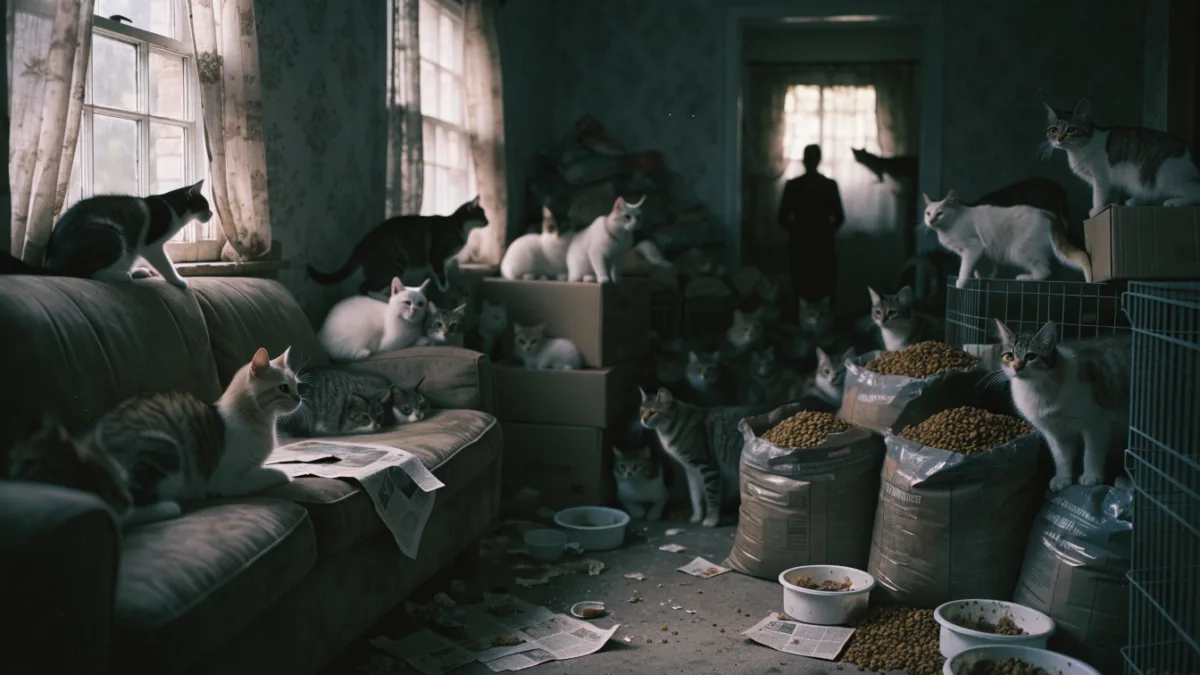
My cat Mochi came from a situation that was, frankly, bad. Before she landed at the shelter where I found her huddled in the back of a kennel, she’d been living in a one-bedroom apartment with thirty-one other cats. Thirty-one. The volunteer who told me this said it matter-of-factly, like she was describing the weather, but I couldn’t stop thinking about it for weeks. How does that even happen? Nobody wakes up one morning and decides to collect three dozen cats. Except that’s exactly the problem — they don’t decide it. It creeps up. And the people doing it almost always believe they’re saving these animals.
Animal hoarding is one of the most misunderstood crises in animal welfare. It looks like cruelty from the outside, but from the inside, the person doing it often feels like a saint running a rescue mission. That disconnect — between what’s actually happening and what the hoarder believes is happening — is what makes this issue so devastating and so difficult to solve.
It’s Not About Having Too Many Pets
Let’s get the definition straight, because this matters. Animal hoarding isn’t determined by a number. There’s no magic threshold where seven cats is fine but twelve makes you a hoarder. The clinical definition, as outlined in,[1] is the accumulation of animals that overwhelms a person’s ability to provide minimum standards of care — nutrition, sanitation, adequate shelter, and veterinary attention.
Someone with fifteen cats who has them all spayed, vaccinated, fed quality food, and living in a clean environment with space to move? That’s a dedicated caretaker. Someone with eight animals living in their own waste, starving, sick, and untreated? That’s hoarding. The number is almost irrelevant. What matters is whether the animals’ basic needs are being met and whether the person can recognize it when they’re not.
And here’s the part that’s hard to wrap your head around: they usually can’t.
The “Toxic Love” Paradox
This is the hallmark trait that separates animal hoarding from other forms of neglect or cruelty. A dog fighter knows what they’re doing is wrong. A puppy mill operator is running a business, however unethical. But an animal hoarder? They genuinely, deeply believe they are loving and protecting these animals. They’ll look at a cat covered in mats and dripping with upper respiratory infection and tell you she’s “just a little shy” or “always been small for her age.”
Their self-perception as a rescuer is unshakable, even when the evidence surrounding them tells a horrifically different story. And that’s what makes intervention so complicated. You’re not just removing animals — you’re confronting someone’s entire identity.
Noah’s Syndrome: A Psychiatric Condition, Not a Choice
In 2022, researcher Z. Nadal and colleagues published a [2] that solidified what mental health professionals had been arguing for years. Animal Hoarding Disorder — sometimes called “Noah’s Syndrome” — is now recognized as a specific manifestation of Hoarding Disorder. It is a psychiatric condition.
This isn’t a hobby that got out of hand. It’s not someone who “just couldn’t say no” to another stray. The research shows it’s a complex interplay of trauma, attachment disorders, and executive dysfunction — meaning the parts of the brain responsible for planning, organizing, and recognizing cause-and-effect simply aren’t working the way they should. Many hoarders have experienced significant loss, abuse, or social isolation. The animals become their entire emotional world, and the idea of letting even one go feels like an unbearable loss.
Understanding this doesn’t excuse the suffering happening in these homes. But it does explain why yelling at someone, shaming them, or even confiscating their animals rarely fixes the underlying problem.
What’s Actually Happening Inside These Homes
I want to be honest about what this looks like, because the clinical language can feel distant. When authorities enter a hoarding situation, they typically find animals living in conditions that are hard to describe without sounding sensational.
- Feces and urine covering floors, furniture, and sometimes walls — the ammonia smell alone can cause respiratory damage
- Animals who are severely underweight or, paradoxically, competing so aggressively for food that some are obese while others starve
- Untreated infections, injuries, dental disease, and parasitic infestations
- Dead animals that the hoarder hasn’t removed, sometimes for weeks or months
- Animals showing severe behavioral issues — extreme fear, aggression, self-mutilation — from chronic overcrowding and lack of socialization
- Structural damage to the home itself — rotted floors, broken windows, non-functional plumbing
Dogs and cats are the most frequent victims, simply because they’re the most accessible, but cases involving horses, birds, rabbits, reptiles, and even farm animals do occur. Mochi’s teeth were so rotten when I got her that three had to be extracted immediately. The vet said it was years of neglect. Whoever had her before probably pet her every day and thought they were taking great care of her.
Why Veterinarians Are on the Front Lines
Here’s something I hadn’t considered until I started researching this: veterinarians are often the only outside contact a hoarder has with the world. An isolated person who won’t let neighbors inside will still occasionally bring a single sick animal to a clinic — and that vet becomes a critical intervention point.
The [3] its role in identifying hoarding situations. New training programs and workshops are being developed to help vets spot the red flags: an animal presenting with advanced, untreated conditions; a client who’s vague about how many animals they have; someone who becomes defensive or emotional when asked basic husbandry questions; a pet whose condition clearly indicates long-term neglect that the owner doesn’t seem to register as concerning.
But this puts veterinarians in a brutal position. They’re bound by patient confidentiality, yet they’re confronting a mental health crisis they’re not equipped to treat. Push too hard, and the hoarder disappears — back to a home full of suffering animals with no oversight. Say nothing, and the neglect continues. There are no easy answers here, and the veterinary profession is still developing ethical frameworks for how to handle these encounters.
The Debate: Crime or Crisis?
This is where things get genuinely contentious. Animal hoarding sits at an uncomfortable intersection of animal cruelty law and mental health policy, and the two systems don’t communicate well.
On one side, prosecutors argue that animal suffering is animal suffering regardless of the perpetrator’s mental state. Dead and dying animals deserve justice, and without legal consequences, there’s no mechanism to prevent someone from immediately restocking.
On the other side, mental health advocates point out that punitive measures — fines, brief jail sentences, probation — demonstrably fail. The recidivism rate for animal hoarding without treatment approaches 100%. People who’ve been prosecuted simply move, change their patterns, and start accumulating again. Without addressing the psychiatric root, you’re playing whack-a-mole with living creatures’ lives.
The emerging consensus among experts is that both approaches are needed: legal authority to remove animals and restrict future ownership, paired with mandatory psychological intervention. But mandatory treatment requires infrastructure, funding, and legal frameworks that most jurisdictions simply don’t have. It’s an unsolved problem.
Recognizing the Signs
If you’re worried about someone in your life — a neighbor, a family member, a friend — here are the warning signs that tend to accompany animal hoarding. None of these alone prove anything, but clusters of these indicators warrant attention.
Observable Signs
- A persistent, strong odor of ammonia or feces coming from the home or yard
- Windows that are always covered, curtains always drawn, or visible deterioration of the home’s exterior
- The person isolates socially, rarely invites anyone inside, and becomes defensive when asked about their animals
- They describe themselves as a “rescue” or “sanctuary” despite no organizational affiliation or capacity
- Animals visible through windows or in the yard appear underweight, unkempt, or lethargic
- The person claims all their animals are “happy and healthy” even when confronted with obvious evidence to the contrary
- They continue acquiring animals despite being unable to care for the ones they already have
What To Do
If you suspect animal hoarding, don’t confront the person directly. That approach almost always backfires — they’ll close ranks, hide the evidence, and cut you off. Instead, contact your local animal control agency or humane society and report what you’ve observed. Be specific and factual. Let professionals with training in both animal welfare and mental health crisis response handle the intervention.
If you’re outside the United States, the specific agency will differ — look for your country’s equivalent of animal protection services or a local SPCA-style organization. The important thing is making the report.
Where We Go From Here
Animal hoarding will keep happening as long as we treat it as either purely a crime or purely a joke. The “crazy cat lady” punchline isn’t just tired — it actively prevents people from recognizing a mental health crisis in progress. Every time someone chuckles about a neighbor with “way too many cats,” there’s a chance that behind those cats is a person who needs psychiatric help and dozens of animals who are suffering in silence.
The animals who survive these situations — cats like Mochi, dogs who’ve never walked on grass, pets who flinch at human touch — can often be rehabilitated. It takes patience, veterinary care, and a willingness to let them learn trust at their own pace. Mochi spent her first three months with me living under the couch. She came out on her own terms, and now she sleeps on my chest every night. But she’s one of the lucky ones. For every animal who makes it out, many more never do.
If we want to change that, we have to stop seeing animal hoarding as a character flaw and start treating it as what the evidence shows it is: a serious psychiatric condition that requires professional intervention, ongoing support, and a coordinated response between animal welfare and mental health systems. The animals deserve that. And honestly, the people suffering from this disorder deserve it too.
Sources
- animal welfare research — dogslandingco.com
- systematic review in the CABI Digital Library — cabidigitallibrary.org
- veterinary community has increasingly recognized — youtube.com