

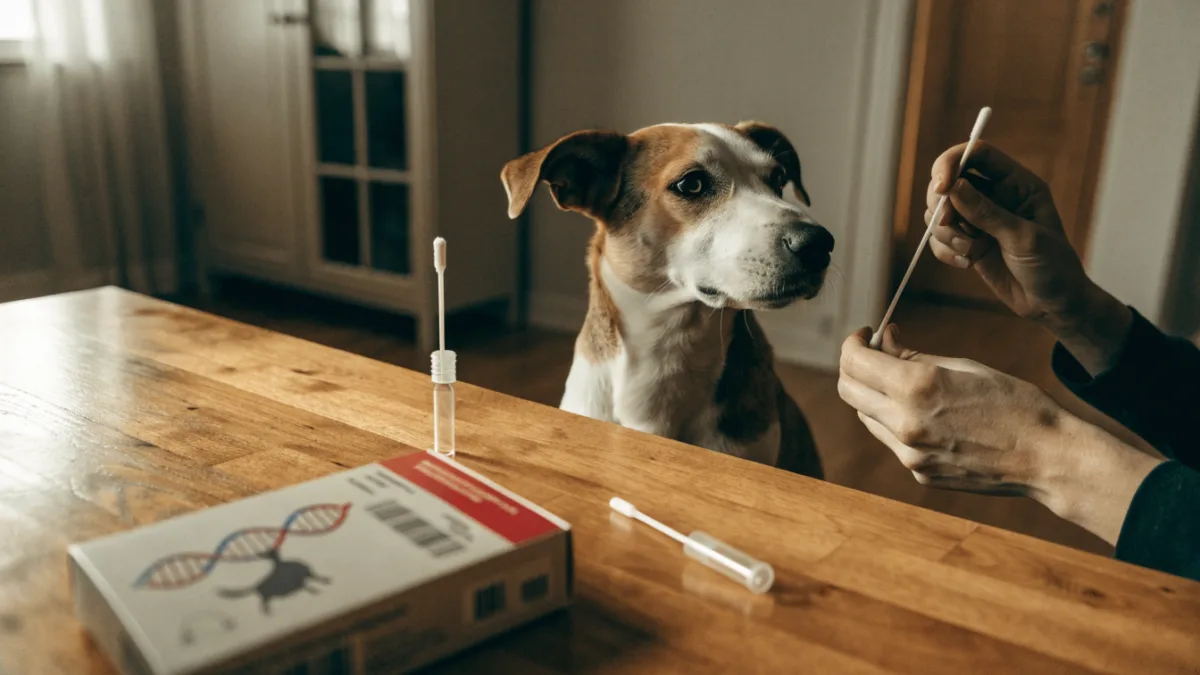
I once fostered a forty-pound mystery dog named Buster who looked like someone had thrown a German Shepherd, a Border Collie, and a fuzzy throw rug into a blender. He herded my other dogs around the living room, barked at lawn mowers with terrifying intensity, and had one blue eye and one brown. For three years, I told everyone he was a unique mutt. Then I swabbed his cheek, mailed the tube to a lab, and found out he was exactly what he looked like—but with a twist of Australian Cattle Dog I never saw coming.
The commercial pet DNA test industry has exploded over the last decade. Ten years ago, figuring out a mixed-breed dog’s ancestry meant asking a vet for their best guess. Today, you can order a kit online, swirl a swab in your pet’s mouth, and get a detailed breed breakdown emailed to you in three weeks. But as much as I love digging into the genetic history of our companion animals, I’ll be the first to tell you that these tests are diagnostic tools, not magic crystal balls. If you’re going to spend the money, you need to know exactly what that swab can—and absolutely cannot—tell you.
Spit, Swabs, and Fur Plucks
If you’ve ever used a human DNA test, you know the drill: you spit into a tube until you reach a designated line, which feels like a gallon of saliva. Human tests require a large volume of saliva because human genetics labs have optimized their processes for this specific collection method..[1] You don’t need your dog or cat to drool into a vial.
Most canine tests rely on a simple, non-invasive cheek swab. You firmly rub a small, bristled brush against the inside of your dog’s cheek for about fifteen seconds to collect skin cells. No blood draws, no vet trips, no trauma.
Cats, however, present a unique challenge. If you have ever tried to hold a cat still while shoving a small plastic wand into their mouth, you understand why feline genetics lagged behind canine genetics for years. Fortunately, the industry has recently made a massive leap forward. Pioneering feline DNA tests now sequence DNA directly from hair follicles. You just pluck a small tuft of fur—making sure the root is attached—and mail it in. It is a completely stress-free, non-invasive alternative that bypasses the impossible task of getting a cat to hold still for a cheek swab.
Cracking the Breed Code
The number one reason people test their pets is simple curiosity. We want to know why our dogs are shaped the way they are. We want to explain their weird behavioral quirks. When you get those results back, the test is comparing your pet’s genetic markers against a massive reference database of purebred animals.
This comparison is highly effective at identifying exact breed makeup by percentage. If your rescue comes back as 25% Boston Terrier and 12% Chihuahua, it explains the giant ears and the shivering. This data helps owners predict physical traits and anticipate breed-specific drives. A dog with a high percentage of scent hound in its lineage is going to follow its nose straight out of an unfenced yard. A dog with heavy working breed ancestry is going to need a job, or it will invent one—usually involving the destruction of your couch cushions.
But here is where the limits of the database come into play. There is a very real debate among pet owners and veterinarians about the,[2] especially for dogs adopted internationally. I’ve looked at results for dogs rescued from Russia, Mexico, and Taiwan that came back with a bizarre patchwork of rare American show breeds. That doesn’t make sense historically. If a test says your street dog from Moscow is 40% purebred Carolina Dog, the database is simply making an educated guess based on a lack of regional street dog reference panels. The results are only as good as the purebred database the company has access to.
The Human Ancestry Prank
Because people approach consumer genetics with a healthy dose of skepticism—and a sense of humor—there is a well-documented cultural trend where owners submit their pet’s DNA to human genealogy websites just to see what happens. It’s a hilarious prank that highlights our sometimes-skeptical relationship with consumer genetics. If you submit a dog’s DNA to a human ancestry site, the human-specific algorithms will try to force the canine genetic data into human geographic populations.
These prank submissions have resulted in completely absurd reports telling.[3] It proves a fundamental point about how these algorithms work: they are designed to spit out a result based on whatever data you feed them, even if the data belongs to a completely different species.
Health Markers and Wellness Planning
Beyond satisfying curiosity, DNA testing has serious medical value. This is why I actually recommend testing mixed-breed pets. Knowing your dog’s breed breakdown allows you to anticipate future health issues and tailor their diet and exercise routines to their specific biological needs.
Genes dictate physical limits. If you find out your mutt is heavily mixed with deep-chested breeds like Great Danes or German Shepherds, you and your vet can be hyper-vigilant about Gastric Dilatation-Volvulus (bloat). If your dog carries the MDR1 gene mutation—common in herding breeds like Collies and Australian Shepherds—your vet needs to know immediately, because certain common medications will cause fatal neurological toxicity in dogs with this mutation. Identifying a genetic predisposition to hip dysplasia allows you to start joint supplements early and keep the dog lean to protect the joints.
Reviews for the “Best Dog DNA Tests of 2026” indicate the industry is pushing hard into highly specialized health screening. The technology is moving away from just finding out what breeds make up your dog, and toward identifying exact genetic risks for everything from degenerative myelopathy to specific heart defects. These larger reference databases are giving owners the power to be proactive rather than reactive when it comes to veterinary care.
Predictions, Not Prophecies
This is where I see owners get frustrated. They test their dog, find out it is 50% Siberian Husky, and get angry when the dog refuses to pull a sled or howls at the mail carrier. Conversely, they find out the dog is a purebred Golden Retriever and expect it to instantly love every stranger it meets.
Genes are not destiny. They are a blueprint, not a finished house.
A DNA test is a predictive tool, but genes cannot explain everything about a pet’s unique personality or overall health outcomes. Environmental factors, training, socialization, and individual variation play massive roles in who that animal becomes. A dog can carry the genetic markers for a severe behavioral trait or a terminal illness and never express it, simply because the environmental triggers never flipped that genetic switch. A dog with zero genetic predisposition for anxiety can still develop severe separation anxiety if it was poorly socialized as a puppy.
Treat the DNA results as a roadmap, not a rulebook. If the test says your dog has the genetic markers for early-onset cataracts, don’t panic. Just commit to annual eye exams with your vet. If the test says your dog is 20% Belgian Malinois, you better sign up for obedience classes, because that dog is going to have an intense work drive that you need to manage constructively.
Testing your pet—whether by swabbing a cheek or plucking a tuft of fur—is a fantastic way to peek under the hood of your companion animal. It connects you to the deep, complex history of domestication that brought that specific dog or cat onto your couch. But at the end of the day, whether your mutt is a mashup of ten rare European breeds or a completely untraceable village dog, their worth isn’t in their genetic purity. We are facing an overpopulation crisis in shelters worldwide, and the mixed-breed dog is the ultimate survivor. DNA testing doesn’t elevate a dog’s status; it just gives us the information we need to be better advocates for their health, their training, and their individual quirks. Buster didn’t care that he was part Cattle Dog, but knowing it made me a vastly better owner.
Sources
- Pet DNA tests operate differently — aspcapetinsurance.com
- accuracy of commercial pet DNA tests — vcahospitals.com
- dogs they are 30% Neanderthal or 15% Sub-Saharan African — facebook.com