

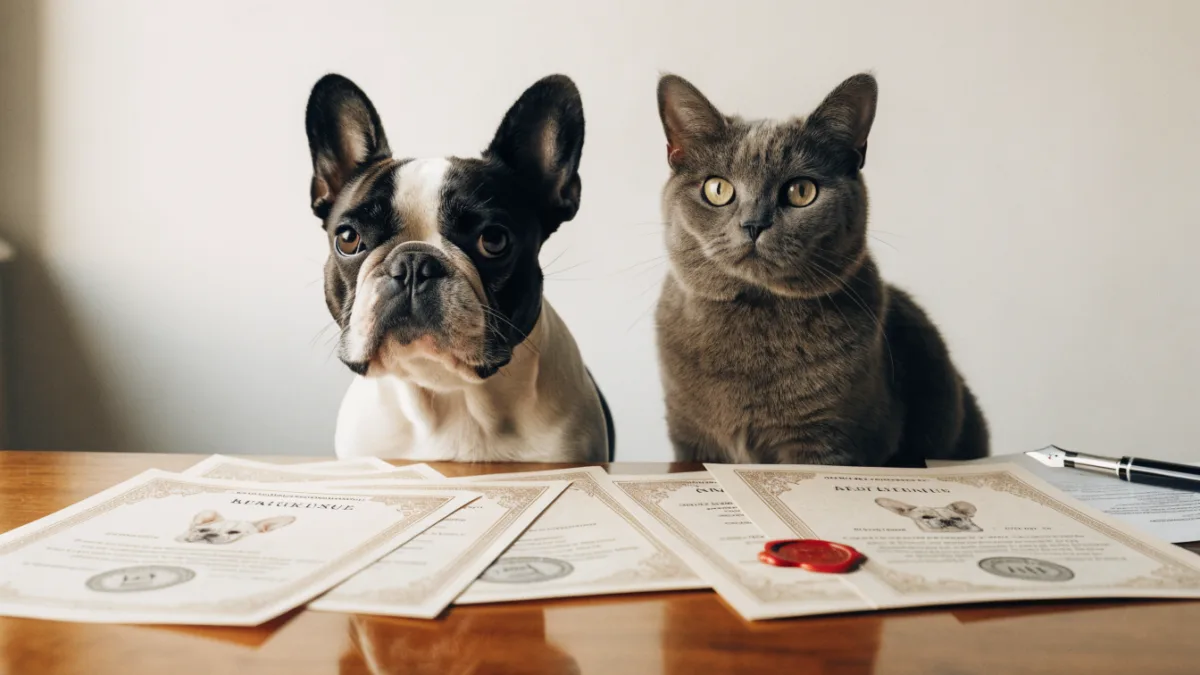
I was looking over a friend’s new Maine Coon kitten recently, and they were completely baffled by the stack of documents the breeder handed them. To most pet owners, official pedigree papers look like bureaucratic clutter—a fancy, overly formal receipt for an expensive animal. But if you know how to read them, those documents are genetic roadmaps. A pedigree certificate is.[1] It is proof of verified lineage, accountable breeding practices, and breed authenticity. To understand why these certifications matter so much for predicting a pet’s size, temperament, and genetic health, it helps to look at the gold standard of animal registries. France maintains two of the most rigorous tracking systems in the world: the L.O.F. for dogs and the L.O.O.F. for cats. They offer a perfect blueprint for understanding exactly what you are buying when you pay for a purebred animal.
The French Blueprint: L.O.F. and L.O.O.F.
If you want to understand how animal traceability is supposed to work, look at the French system. They run two separate, highly regulated national studbooks that bridge the gap between canine and feline accreditation.
For dogs, there is the L.O.F. (Livre des Origines Français). Recognized by the French Ministry of Agriculture, it is the official national studbook for purebred dogs. For cats, there is the L.O.O.F. (Livre Officiel des Origines Félines). Created in 1995, this registry was designed to standardize feline breeding and traceability, bringing the same level of scrutiny to cats that dogs had enjoyed for decades.
Within these systems, purebred pets require.[2] The first is a standard Certificate of Registration, which proves current ownership and basic breed registration. The second is the Certified Pedigree. This is the actual multi-generational family tree, showing three to five or more generations of ancestors. Anyone can hand you a piece of paper saying a dog is a Labrador. A certified pedigree gives you the names, titles, and registration numbers of its great-great-grandparents.
Predicting the Future: Size, Coat, and Temperament
Why do we care about five generations of ancestors? Because predictability is the entire point of a purebred animal. I don’t rank breeds as “best” or “worst,” but I care deeply about fit. If you live in a tiny apartment and work twelve hours a day, you need to know exactly how big a puppy will get and what its energy levels will be like. L.O.F. and L.O.O.F. registrations serve as predictive tools, offering buyers insight into the pet’s expected adult size, weight, and behavioral traits specific to the breed standard.
Without these papers, you are rolling the dice. A dog marketed as a purebred Mastiff might only hit sixty pounds instead of a hundred and twenty. A supposedly purebred Ragdoll cat might lack the docile, limp-body temperament the breed is famous for. When a registry certifies an animal, they are vouching for the genetics behind that animal.
More importantly, these certifications allow owners and veterinarians to trace genetic health history. According to recent academic studies (Morel et al., 2024), pedigree registration provides breeders with access to critical data on the health of individual animals, as well as genetic tools to help manage the breed population. A responsible breeder looks at a certified ancestry tree before mating two animals. If a line of dogs carries a known hereditary condition—like progressive retinal atrophy or breed-specific heart defects—the breeder sees it on the pedigree and removes those animals from their breeding program, prioritizing the health of the lineage.
Earning the Paper: The Confirmation Process
A massive misconception among buyers is that if both parents are registered, the babies are automatically certified. That is not how rigorous systems work. [3] requires jumping through several hoops. Both parents must be registered, and the litter must be officially declared to the registry at birth.
But the real test happens at adulthood. The individual animal has to pass a physical “confirmation”—an assessment by a certified judge or expert to ensure it actually meets strict breed standards.
I love watching these evaluations at dog shows. A judge will run their hands over a dog’s skull, check the bite, measure the angulation of the shoulders, and evaluate the gait. If an animal has a glaring physical fault—say, a unacceptable coat color, or an overshot jaw that deviates from the standard—it fails. It gets a basic registration, but it does not get the fully certified pedigree required to produce registered offspring. This prevents breeders from passing off substandard or unhealthy animals as premium breeding stock.
The Paper Mill Smokescreen
Here is where I get annoyed. People assume that official registration papers automatically equate to ethical breeding. They don’t. “Puppy mill” operators and backyard breeders still sell pets with basic registration papers, using them as a smokescreen to trick buyers into thinking they are buying a well-bred, health-tested animal.
A buyer has to understand the difference between a basic registration and a fully certified, health-tested pedigree. Modern registries are actively trying to close this gap. Both the L.O.F. and L.O.O.F. have begun integrating or strongly recommending mandatory genetic and health screenings—such as tests for hip dysplasia or breed-specific heart defects—before an animal can be fully confirmed and allowed to produce registered offspring. If a breeder cannot show you the actual health clearances for the parents, alongside their certified pedigree, walk away.
There is also a darker side to strict adherence to breed standards. Recent 2024 research by E. Morel highlights a major debate within the purebred community: the prioritization of physical appearance over health and temperament. When registries reward extreme aesthetic traits, they inadvertently encourage the breeding of animals with compromised welfare. We see this clearly in the brachycephalic snouts of French Bulldogs and the extreme flat faces of Persian cats. When we breed dogs and cats to the point where they cannot breathe or eat properly just to win a ribbon, the system is broken. The health of the animal has to come first.
Digital Ledgers and Domestic Biodiversity
Fortunately, registries are modernizing to combat fraud and improve transparency. Following global trends, organizations are moving away from easily forged paper certificates and are utilizing centralized digital databases. It is becoming standard practice for veterinarians and prospective buyers to scan an animal’s microchip and instantly pull up a verified L.O.F. or L.O.O.F. pedigree and health history online.
This digital push isn’t just about catching scammers. It is a vital tool for conservation. While domestic dogs and cats are not endangered, purebred registries play a crucial role in maintaining domestic biodiversity. Without meticulously maintained studbooks, rare and heritage breeds would be bred out of existence.
I’ve spent time with the Berger Picard, a scruffy, intensely loyal French herding dog. Without the L.O.F. tracking their lineage, they would have easily dissolved into the generic mutt population decades ago. The same goes for the Chartreux cat, a robust blue-coated feline that nearly went extinct after World War II. These registries are not just vanity projects; they are genetic libraries that preserve the unique traits and histories of these animals.
When you hold a certified pedigree in your hand, you are holding the culmination of a century of selective, documented breeding. Those papers won’t tell you if your dog will be the smartest in the world, or if your cat will actually sit in your lap, but they give you the structural and genetic history you need to make an informed decision. They are the only guarantee you have that the breeder actually knows what they are doing, and that the animal in your arms is exactly what it claims to be.
Sources
- more than just a piece of paper — facebook.com
- two distinct documents — facebook.com
- Achieving L.O.F. or L.O.O.F. certification — purina.co.uk