

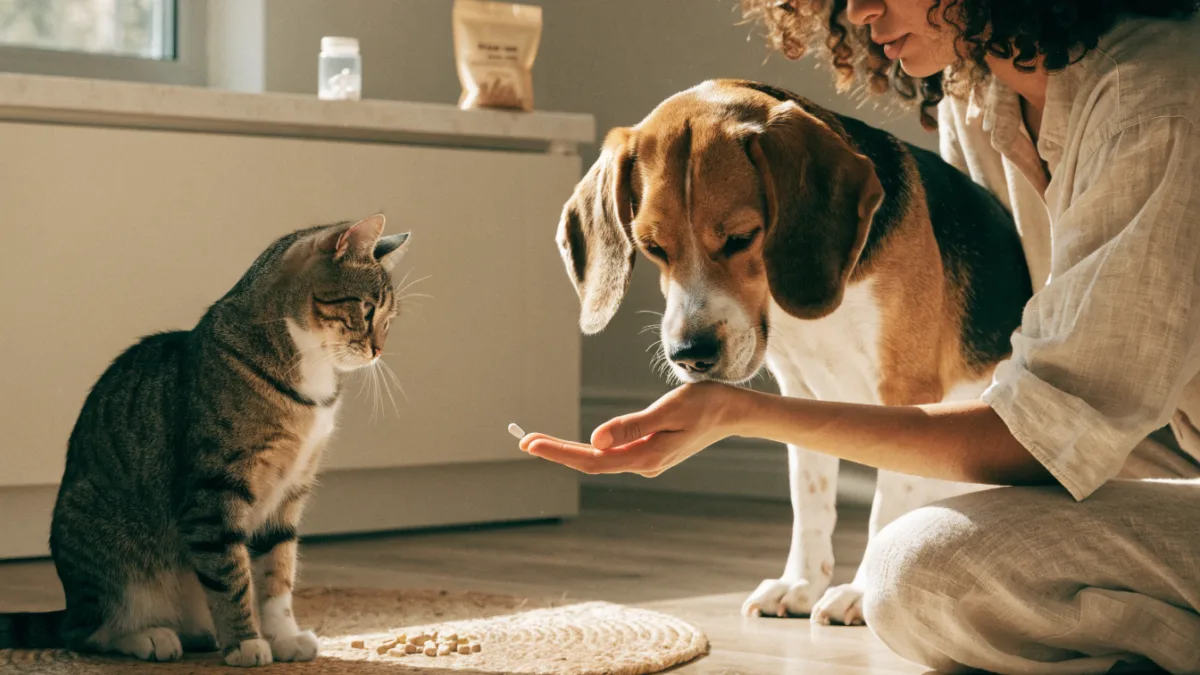
Let’s be honest. Pilling a pet usually sucks. You’re sweating, the dog is giving you the side-eye, and the cat has vanished under the bed. I used to rely entirely on the old sneak-attack method. I’d bury a pill in a wad of deli meat, cross my fingers, and hope for the best. Then I had a client with an anxious rescue Border Collie who needed a course of antibiotics. The meat trick worked for exactly two days. On day three, the dog bit into the pill, tasted the bitterness, and decided he was never eating anything from my hand again. We lost a high-value reward and still had to get the medicine down.
There is a better way. We don’t have to trick our pets, and we definitely don’t need to tackle them. Modern animal training has shifted heavily toward cooperative care. Instead of fighting your pet, you can teach them to willingly participate in their own medical care. Here is how you build that trust and get your dog or cat to take their medication without a wrestling match.
The Trap of the Sneak Attack
Relying entirely on deception eventually backfires. Pets have incredibly sensitive noses. When you hide a bitter pill inside a chunk of their favorite food, they can often smell the medicine right through it. They’ll delicately eat the cheese or the liverwurst, and spit the pill right back out onto the floor.
Worse, if you use their absolute favorite food—like a specific high-value meat—to hide a foul-tasting medication, you risk poisoning that reward. Your dog or cat might develop a lasting aversion to that food because they no longer trust it. Instead of treating our pets like they’re easily fooled, we need to transition to a system built on transparency.
Start Before You Actually Need It
If you wait until your pet is sick to start training them to accept medication, you are already fighting an uphill battle. Illness and injury naturally suppress a pet’s appetite. When a dog or cat feels terrible, they aren’t motivated by food, and they certainly don’t have the patience to learn a new behavior.
The absolute best time to teach a pet to accept medication is when they are completely healthy. You do this by using “fake pills.” You can use empty gel caps, a plain piece of kibble, or just a tiny morsel of food wrapped in a commercial pill paste. You practice your medication routine every single day while they feel good. By proactively conditioning a healthy pet to associate the pilling process with amazing outcomes, you create a seamless transition for when actual medicine is eventually required.
Making the Routine Work for Everyone
Predictability is your best friend. Give this fake pill at the exact same time every day. When your pet knows exactly when and where the medication routine happens, it removes the anxiety of the unexpected.
The Multi-Cat Equity Rule
If you have a multi-cat household, you need to know about the equity rule. Cats are highly observant of social dynamics. If you pull one cat aside and give them a special treat, the other cats will notice. Suspicion will immediately set in, and the targeted cat might feel cornered or stressed. To maintain household trust, the treat or fake pill routine must be given to all the cats simultaneously. Everyone gets a piece of cheese, and everyone gets a follow-up reward. Nobody feels singled out.
Moving Toward True Cooperative Care
This is where we move past the pill pocket entirely. The goal of cooperative care is an environment where the animal voluntarily participates. Even for cats—which are notoriously difficult to medicate—it is entirely possible to train them to willingly take oral medications without any restraint.
You start by teaching an explicit cue, like “Take your medicine.” You show the pet the exposed pill. They take it willingly out of your hand, and you immediately follow it up with a high-value reward. This could be a quick lick of liverwurst, a spoonful of sticky wet food, or a small piece of cheese. The high-value wrapping options are just there to mask the taste and act as the paycheck.
You are essentially making a trade. They swallow the pill, and they get something amazing right after. Eventually, swallowing the pill becomes the cue to get the liverwurst. It turns medication time into an engaging mental enrichment game rather than a chore.
What to Do When You Have to Manually Pill
Let’s get real for a second. Sometimes you get back from the vet’s office with an urgent medication, and you don’t have two weeks to condition a cooperative behavior. You have to give the pill right now.
If you have to do it manually, forget the old-school methods. Prying a cat’s mouth open, shoving a pill down their throat, and chasing it with water is a recipe for disaster. Forced restraint breaks trust, spikes stress hormones, and makes medicating them tomorrow exponentially harder. Instead, you need to use gentle, low-stress techniques where the goal is to use the least amount of restraint necessary.
- Make sure your pet is in a comfortable, secure position. Sitting beside them is often better than looming over them.
- Gently grasp your pet’s upper jaw right behind their canine teeth (the big fangs).
- Tilt their nose up slightly toward the ceiling. When a dog or cat’s head is tilted back, their lower jaw naturally drops open a bit.
- Use your other hand to place the pill as far back on the center of the tongue as possible.
- Close their mouth, keep their head tilted up slightly, and gently stroke their throat in a downward motion. You can lightly blow on their nose. This action triggers a natural swallowing reflex.
Always, always follow this manual method with a massive party. Give them their favorite treat immediately. You want their brain to connect the uncomfortable few seconds of manual pilling with an immediate, guaranteed payoff.
Know When to Call an Audible
If you are both ending up in tears, stop. You haven’t failed. You just need a different route. The veterinary industry has seen a massive boom in customized compounding pharmacies. If a pet absolutely cannot be trained to take a pill willingly, pharmacies can now easily alter the formulation, flavor, or delivery method. You can get medications turned into chicken or marshmallow flavored liquids, transdermal gels that absorb right through the skin of the ear, or flavored chewables that remove the stress of pilling altogether.
The Big Picture
The idea of cooperative care isn’t just a trendy pet training buzzword. These concepts originated in wildlife conservation, zoo animal husbandry, and exotic animal rehabilitation. Zookeepers and researchers use positive reinforcement to teach wild tigers to present their tails for blood draws, and rhinos to step onto scales voluntarily. The ethos is simple: the animal’s emotional well-being matters just as much as their physical health. If a wild leopard can be trained to willingly accept a medical procedure, your house cat can learn to swallow a pill. It just takes patience, consistency, and a willingness to trade the wrestling match for a partnership.