

Last spring, a client named Marsha brought her eight-year-old tabby, Pepper, into the clinic. Pepper had been vomiting off and on for three weeks, and Marsha was convinced it was something serious — maybe even kidney disease, given Pepper’s age. We ran bloodwork, did an ultrasound, checked everything. All normal. Then I asked the question I ask almost every day: “Tell me about Pepper’s water situation.” Marsha described the lovely fountain she’d bought six months earlier, how Pepper loved it, how she topped it off every morning and rinsed the bowl out when she thought of it. When I asked when she’d last taken the whole thing apart and scrubbed it, there was a long pause. “I rinse it,” she said. That pause told me everything.
That Slime Has a Name: Biofilm
That slippery, slightly creepy coating you feel when you reach into your pet’s water fountain? It’s not just “gross water residue.” It has a scientific name: biofilm. And once you understand what it actually is, you’ll never look at a neglected fountain the same way.
Biofilm is a complex, living community of microorganisms — bacteria, fungi, sometimes algae — that attach to wet surfaces and build themselves a protective housing structure. Think of it as a microscopic city. The individual bacteria secrete a glue-like substance (that’s the slime you feel) that anchors them to plastic, ceramic, or stainless steel and shields them from the outside world. Inside that slime city, the microbes communicate with each other, share nutrients, and multiply. It’s genuinely fascinating biology. It’s also genuinely problematic when it’s growing in the thing your dog or cat drinks from every day.
What makes biofilm so tenacious is that it’s not free-floating. You can’t just flush it away with fresh water. The organisms are physically adhered to the surface, and some of them are quite good at surviving in environments that would kill ordinary bacteria — including the low levels of chlorine in tap water. This is why simply “topping off” the fountain, which so many of us do, doesn’t solve the problem. You’re adding clean water on top of an established colony.
Why It Matters for Your Pet’s Health
Let me be clear about something: I’m not in the business of scaring people. Most pets with biofilm in their fountain won’t end up in the emergency room. But I’ve seen enough cases like Pepper’s to know that this isn’t a cosmetic issue.
When your dog or cat drinks, their tongue does something remarkable — it scoops water backward in a motion that also deposits saliva, food particles, and debris from their mouth into the water. That organic material becomes food for the biofilm colony. It’s a feedback loop: the more they drink, the more nutrients they provide, the more the biofilm grows. Some pets are drinking from a fountain that’s essentially a mild bacterial soup.
Ingesting bacteria from established biofilm can contribute to several health issues. Gastrointestinal upset — vomiting, diarrhea, decreased appetite — is the most common connection I see clinically. I’ve also treated cats with recurrent urinary tract infections where the fountain was a suspected contributing factor, and dogs with mild, persistent kidney inflammation that resolved once we addressed their water source. Pepper’s vomiting stopped completely within four days of Marsha doing a proper deep clean and establishing a weekly routine.
Behavioral Clues You Might Miss
Sometimes the sign isn’t illness — it’s behavior. If your pet suddenly loses interest in their fountain, starts drinking from the bathtub faucet, or visits the toilet bowl (yes, this happens more than you’d think), they may be telling you the water is unappealing. Animals have far more sensitive olfactory systems than we do. What smells “fine” to you might smell off to them. I had a client whose Golden Retriever, Cooper, started refusing his fountain entirely. The owner thought the pump was broken. The pump was fine. The biofilm, however, was extensive enough that Cooper simply said, “No thank you.”
The Deep Clean: Step by Step
Here’s where I see the most confusion. Many pet owners are doing something to maintain their fountain, but they’re missing critical steps. Let me walk you through what a proper weekly clean actually looks like.
Step 1: Full Disassembly
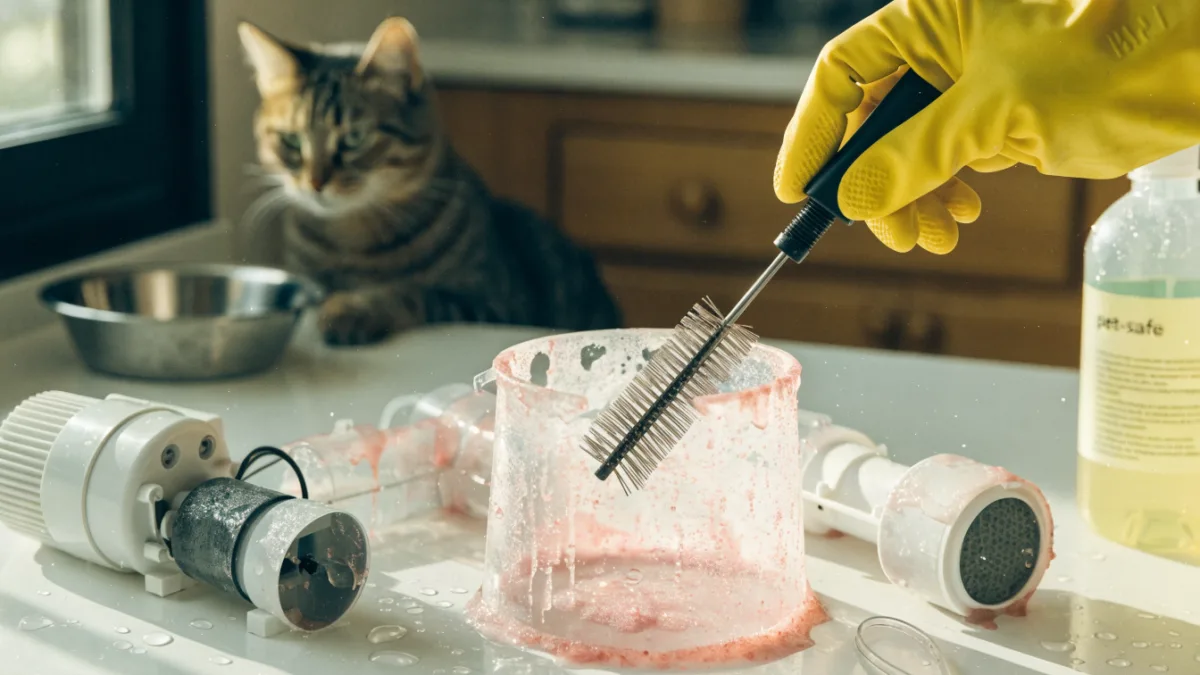
This is the step people skip most often, and it’s the most important. You cannot adequately clean a fountain while it’s partially assembled. Take everything apart — the lid, the reservoir, any flow rings or nozzles, and critically, the pump. The pump housing typically has a small cover that pops off or unscrews. Inside, you’ll find an impeller (a small spinning magnet) that lifts out. I’ve found chunks of biofilm, pet hair, and even small insects trapped in pump housings. If you’re not opening the pump, you’re not cleaning the fountain.
Step 2: Break Down the Buildup
For routine weekly cleaning, I recommend natural acid-based cleaners — specifically white vinegar or lemon juice. These are effective at dissolving hard water mineral deposits and breaking down organic sludge, and they’re safe if trace amounts remain. Fill the basin with a solution of roughly one part vinegar to three parts warm water and let it soak for 15 to 20 minutes. Use a bottle brush or an old toothbrush to scrub every surface, paying special attention to corners, seams, and any textured areas where biofilm loves to settle.
If you live in an area with hard water, you may notice white chalky deposits — that’s calcium and magnesium. Vinegar handles these beautifully. For stubborn spots, a paste of baking soda and water provides gentle abrasion without scratching the surface.
Step 3: When You Need Something Stronger
If a fountain has been neglected for weeks or months — and I’ve seen some that genuinely horrified me — a mild bleach solution may be necessary to truly sanitize it. Use one tablespoon of unscented household bleach per gallon of water, soak for 10 to 15 minutes, and then rinse exhaustively. When I say exhaustively, I mean rinse until you cannot smell even a trace of bleach, then rinse again. Chemical toxicity from cleaning residue is a real risk, particularly for cats, who are small and metabolically sensitive. If you use bleach, you must be willing to commit to thorough rinsing.
Step 4: Filter Replacement
Simply rinsing a filter does nothing. The carbon and mechanical filtration media become saturated and biologically active over time — they can actually become part of the biofilm problem rather than the solution. Most manufacturers recommend replacement every two to four weeks depending on the number of pets using the fountain. I’ve changed my mind on this over the years. I used to tell people they could stretch filter changes to save money. After seeing how quickly biofilm colonizes spent filter media under a microscope (yes, I actually looked), I now tell people to follow the replacement schedule honestly.
Step 5: Reassembly and Fresh Water
Reassemble everything while the parts are still slightly damp — it’s easier — and fill with completely fresh water. Never top off existing water during your weekly clean. The old water may carry bacterial loads you can’t see. Start completely fresh.
Materials Matter More Than You Think
There’s an ongoing debate in the veterinary community and among pet enthusiasts about fountain materials, and I’ll share where I’ve landed after years of clinical observation.
Plastic fountains are affordable and widely available, but they develop microscopic scratches over time — from scrubbing, from pets’ claws, from normal wear. Those scratches become hiding places for bacteria, making plastic fountains significantly harder to truly sanitize. I’ve also seen a clear correlation between plastic fountains and feline chin acne, a frustrating condition where cats develop blackheads and inflamed bumps on their chin. The exact mechanism isn’t fully understood, but plastic seems to play a role, possibly through both bacterial harboring and contact sensitivity.
Stainless steel and ceramic fountains are generally easier to keep clean. They don’t scratch as easily, they tolerate more aggressive cleaning methods, and they don’t develop the microscopic real estate that plastic does. If you’re in the market for a fountain, look for stainless steel or ceramic construction. The pump and some internal components will still be plastic — that’s largely unavoidable — but the primary water-contact surfaces being non-porous makes a meaningful difference.
New Technology: Helpful, Not a Replacement
In recent years, we’ve seen the arrival of fountains with built-in UV-C sterilization, which uses ultraviolet light to kill bacteria and viruses at the microscopic level. This technology can genuinely slow biofilm growth, and I think it’s a promising development. However — and this is important — UV-C light only treats water that passes through the sterilization chamber. It doesn’t eliminate biofilm that’s already established on surfaces. You still need to clean.
Similarly, some newer fountains connect to your phone via Wi-Fi and track water quality, sending alerts when it’s time to change water or filters. I think this is genuinely useful for people who struggle with consistency. If an app notification is what gets you to clean the fountain, I’m all for it. But the technology is an aid, not a substitute for the hands-on work of disassembly and scrubbing.
And please, whatever you do, don’t put the pump or filter in the dishwasher. I’ve had clients arrive in tears because their $150 fountain was destroyed in one cycle. The heat warps plastic, melts components, and destroys pump motors. Hand-washing only, every time.
The Bottom Line
Water is the most important nutrient your pet consumes. They can survive for days without food, but without water, organ damage begins quickly. When we provide a fountain — which I genuinely believe encourages better hydration, especially in cats — we’re taking on a responsibility to keep that water source clean. A fountain that’s growing biofilm isn’t just failing to help your pet. It may be actively working against their health.
Pepper is doing wonderfully now. Marsha set a recurring phone reminder for Sunday mornings, takes the whole fountain apart while she’s making coffee, and Pepper hasn’t had a single episode of vomiting since. It took about twenty minutes of effort per week. Your pet’s kidneys, gut, and immune system are worth the same investment.
And here’s the broader takeaway I’d offer: the principles of clean water access don’t just apply to our companion animals. Wildlife around the world faces increasing challenges from contaminated water sources — from agricultural runoff, from pollution, from habitat degradation that concentrates animals around shrinking water supplies. When we learn to think critically about water quality for the animals in our own homes, we develop a sensitivity to water as a resource that extends outward. Support conservation organizations working to protect clean watersheds and wetlands. The health of every species — domestic and wild — depends on it.