

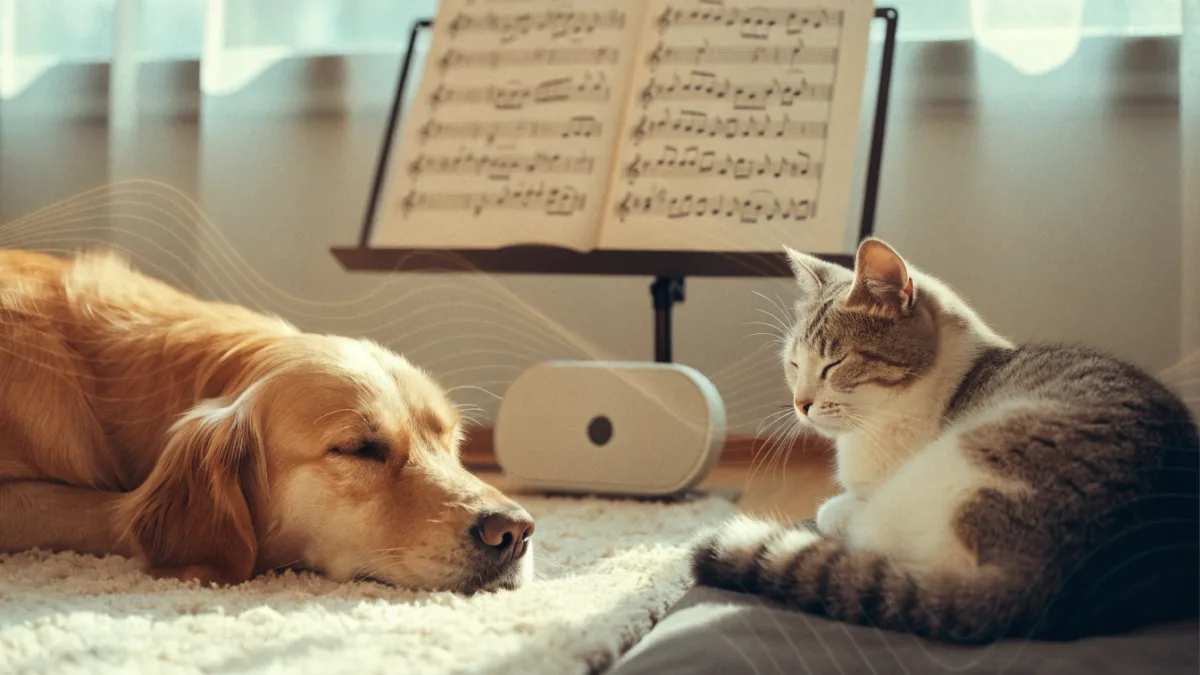
There was a period last summer when I was convinced my dog, Barnaby, was going to vibrate right through the floorboards. He’s a sensitive soul who handles the daily mailman routine with dignified restraint, but the afternoon construction crew next door? Absolute disaster. I tried everything to drown out the noise, eventually leaving my Bluetooth speaker blasting a top-40 pop station on the counter. Let’s just say that was a spectacular failure. Barnaby paced, whined, and my cats shot me looks of absolute betrayal. It turns out, I was doing it entirely backward. Pet music therapy isn’t just about turning up the volume to mask scary sounds; it’s a clinically proven science that requires a bit more nuance than my default playlist.
The Science Behind the Sound
I used to think leaving the radio on for my pets was just about providing background chatter so the house didn’t feel empty. But researchers have actually studied this extensively, and the biological mechanics behind it are fascinating. Sound has a direct, measurable impact on an animal’s autonomic nervous system—the part of the body that controls involuntary functions like heart rate and digestion.
When an animal is stressed, whether from separation anxiety, a thunderstorm, or the chaotic noise of a kennel, their sympathetic nervous system kicks into overdrive. Their heart rate spikes, and stress hormones like cortisol flood their bloodstream. But slow, rhythmic acoustic enrichment directly impacts this system, nudging the parasympathetic nervous system—our “rest and digest” mode—to take over.
Research by animal behaviorist Dr. Deborah Wells established that dogs exposed to classical music spend significantly more time resting and quiet, and less time barking or pacing.
The secret lies entirely in the tempo. For us humans, a normal resting heart rate is around 60 to 100 beats per minute (BPM). For dogs, it’s similar—around 60 to 80 BPM. When an animal hears music with a tempo that matches its own resting heart rate, a phenomenon called “entrainment” occurs. Their body naturally synchronizes with the external rhythm. Clinical observations show that playing tailored music can measurably lower cortisol levels and decrease elevated heart rates in both dogs and cats within just 10 to 15 minutes of exposure.
Curating the Perfect Music for Dogs
If you’re dealing with a dog with noise phobias, you can’t just play anything and expect a calm pup. Dr. Wells’s research showed that while classical music lowers heart rates and reduces anxiety, dogs actually have distinct genre preferences.
Interestingly, studies conducted in kennel environments showed that soft rock and reggae yielded the highest levels of calm behavior. The consistent, rhythmic beats of a mellow reggae track seem to hit a sweet spot for the canine brain. I now play a soft rock playlist for Barnaby when I leave the house, and the difference in his greeting—relaxed instead of frantic—tells me all I need to know.
If you are looking for music for dogs, here is what you should prioritize:
- Classical music: Think slow, sweeping symphonies. Avoid the dramatic, crashing cymbals of heavier classical pieces.
- Soft rock and reggae: Look for steady, predictable rhythms around 60-80 BPM.
- Avoid chaos: Heavy metal and fast-paced electronic music have been clinically shown to increase body shaking and barking in dogs. Keep the heavy stuff for your headphones.
Why Your Cat Ignores Mozart
Now, let’s talk about the felines in the room. My cat, Mochi, has never once cared about my Spotify playlists. I used to think she was just being her usual, discerning self, but it turns out there’s a very real biological reason for it. Cats do not process human music the same way dogs do.
A cat’s normal resting heart rate is much higher than ours—between 120 and 140 BPM—but they don’t naturally respond to human beats. To a cat, a human piano concerto just sounds like random, unconnected noise. To actually soothe a stressed cat, you need species-specific cat calming sounds.
Instead of standard tempos, feline-friendly tracks are composed using frequencies that mimic the rhythm of a cat’s purr—typically around 25 to 50 Hz. They also incorporate sounds similar to the suckling noise kittens make when nursing. When researchers played these species-specific tracks for stressed shelter cats, the results were undeniable. The cats actively approached the speakers, rubbed against them, and showed measurable decreases in respiratory rates and stress behaviors. They recognized the frequencies as their own.
If you have a cat that hides during fireworks or gets stressed when you travel, look for music specifically composed for felines. There are even specialized speaker toys designed to emit these exact purring frequencies, tricking their brain into feeling safe.
The “One-Size-Fits-All” Myth
Before you blast Bob Marley all day for your pup, there is an ongoing debate in animal behavior circles that we need to talk about. Does human music actually sound “good” to animals, or are they just relieved by the absence of sudden, loud noises? Some experts argue that animals only truly respond to frequencies that mimic their own vocalizations, making human music a poor substitute for true acoustic enrichment.
Furthermore, pet music therapy does not work on every animal. Just like humans, individual pets have unique tastes. A sound that calms one dog might agitate another. I’ve fostered dogs who fall asleep to soft rock and others who seem to prefer absolute dead silence.
And while acoustic enrichment is a fantastic tool, it should never be used as a bandage for severe separation anxiety. If your dog is destroying doors or your cat is pulling out their fur from stress, music alone won’t fix the underlying issue. I leave the behavioral modification plans to the experts—seriously, talk to your vet or a certified dog trainer like my friend Jake—but music can absolutely be a supportive piece of a larger behavioral puzzle.
Practical Tips for Pet Owners and Shelter Volunteers
Whether you’re trying to soothe your anxious pup at home or you’re volunteering at a local rescue, integrating sound therapy is surprisingly easy. More animal shelters are moving away from keeping facilities dead-silent or playing arbitrary top-40 radio. Instead, they are adopting formal acoustic enrichment schedules—like playing reggae in the morning and classical in the afternoon. This isn’t just to keep the dogs quiet; chronic stress suppresses the immune system, so reducing anxiety through music literally helps prevent the spread of illness in rescue populations.
Here is how you can apply this science at home or in a shelter environment:
- Start slow: Introduce the music when your pet is already calm, not in the middle of a panic attack. This helps them build a positive association with the sound.
- Keep the volume reasonable: The music should be a comforting backdrop, not a wall of sound. Pets have incredibly sensitive hearing.
- Be consistent: Put the music on 15 minutes before you leave the house so the animal has time to acclimate to the calming rhythm before the stress of your departure begins.
- Use streaming services smartly: Major platforms like Spotify and Apple Music now have dedicated “Pet Playlists.” Just make sure you’re choosing the right species profile!
The Bigger Picture: Conservation and Captive Welfare
The popularity of this research has led to some incredible innovations. We now have wearable calming devices, like collars that emit species-specific frequencies, designed for dogs with severe noise phobias. But the implications go far beyond our living rooms.
While domestic dogs and cats aren’t exactly endangered, research into how sound affects captive animals—like zoo elephants, shelter pets, and even marine mammals—plays a major role in the broader study of animal welfare and conservation psychology. By understanding exactly what frequencies calm an anxious brain, we are learning how to provide better, more humane environments for animals living under human care. If a simple reggae beat can lower a shelter dog’s heart rate, imagine what targeted acoustic enrichment can do for a captive endangered species struggling to breed.
At the end of the day, our pets rely on us to interpret their world for them. Recognizing that Barnaby needs a steady rock beat to get through a thunderstorm, or that Mochi needs the sound of a purr to feel safe, is just another way of speaking their language. It might not solve every behavioral issue, but sometimes, the right melody is exactly what bridges the gap between panic and peace.