

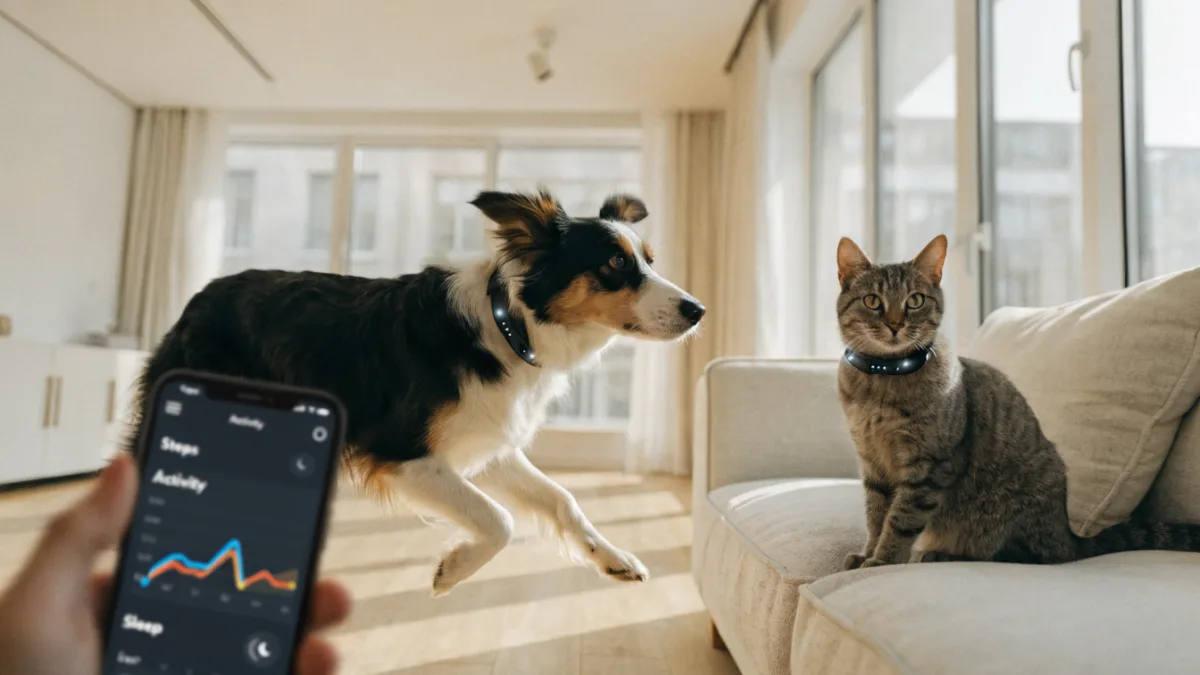
Mochi, my tabby, has what I can only describe as a suspicious amount of energy for a creature who sleeps 18 hours a day. Every night around 2:47 AM — and I’ve checked, it’s remarkably consistent — she transforms from a puddle of fur on the sofa into a small, very determined projectile ricocheting off my hallway walls. For years I wondered whether this was normal cat behavior or a sign she needed more stimulation during daylight hours. Turns out, I wasn’t the only pet owner asking these questions, and technology has arrived with answers — sort of.
What Pet Trackers Actually Measure (And What They Don’t)
Here’s the thing that surprised me when I started digging into pet wearables: they’re not really “step counters” in the way your smartwatch counts steps. Most modern devices — whether you’re looking at something like the [1] or the Fi Series 3 — use accelerometers to measure movement intensity, duration, and patterns. Then they run that raw data through algorithms to translate it into something humans can understand.
The translation part is where it gets interesting. Some trackers convert your pet’s movement into “human equivalent” steps or calories burned. So when Mochi does her nightly sprint, the app might tell me she’s logged the feline equivalent of 4,000 human steps. Is that scientifically precise? Absolutely not. Does it give me a rough sense of whether she’s been active enough? Kind of, yeah.
What I appreciate about the better devices on the market is that they’ve moved beyond raw numbers. The leading options now track sleep quality, create daily activity goals based on your pet’s breed and age, and — this is the part that actually matters to me — flag changes over time. If your dog suddenly starts sleeping more or moving less, that’s often the first sign something’s off health-wise. [2] note that this shift toward preventative health monitoring is where pet tech is genuinely getting useful, not just gimmicky.
The Problem With Counting “Steps” on Four Legs
Okay, so here’s where I get opinionated. The entire concept of “step counting” for pets has a fundamental flaw: humans walk on two legs with a fairly predictable gait. Our wrist-based trackers can reasonably detect when we take a step. Pets have four legs, and their movement is far more complicated.
An accelerometer can detect movement, but distinguishing between a step, a full-body shake, an enthusiastic scratch, and a wiggle of pure joy? That’s genuinely difficult — and no algorithm has perfected it yet.
This means the “step count” your pet’s tracker reports is really more of a movement score. It’s useful for comparing day-to-day or week-to-week trends, but I wouldn’t obsess over the absolute number. If your dog’s activity drops 40% over a week, that’s meaningful information worth paying attention to. Whether the app says he took 8,000 or 12,000 “steps” matters less than the direction the trend is moving.
The GPS vs. Fitness Tug-of-War
There’s an ongoing debate in pet tech circles that I find genuinely fascinating: should a smart collar prioritize safety (GPS location tracking) or fitness data? Because here’s the trade-off — the more your device uses GPS and cellular networks to pinpoint your pet’s location in real time, the faster the battery drains.
Some owners love [1] that lean heavily into health metrics and sleep analysis. Others prioritize GPS because they have escape artists or live near busy roads. Tractive gets consistent praise for location tracking but catches some criticism for less granular fitness data. The Fi Series 3 has pushed hard on improving battery life while maintaining solid step-counting for daily walks. Whistle attempts to do both and generally succeeds, though you’re paying for that versatility.
My take? Figure out your actual priority before buying. If your pet is an indoor cat who never goes outside — like Mochi — GPS is overkill. You don’t need to locate an animal who’s almost certainly under the bed. If you have a dog who’s figured out how to open the garden gate, GPS might genuinely save you a frantic afternoon of driving around the neighborhood with a bag of treats.
Cats and Dogs: Completely Different Tracking Challenges
I cannot emphasize this enough: tracking a cat is not the same as tracking a dog, and most pet wearables were designed with dogs in mind first.
Dogs are relatively straightforward subjects. They wear collars without much fuss. Their activity comes in sustained, predictable blocks — walks, play sessions, training. A 30-minute morning walk is a clear, trackable unit of exercise that translates neatly into data.
Cats? Cats are chaos. Their activity comes in short, intense bursts: the 90-second zoom around the living room, the ambush on the feather wand, the vertical sprint up the cat tree that ends with a disorienting landing on the kitchen counter. Cat movement is vertical, unpredictable, and often involves acrobatic maneuvers that would make a parkour enthusiast jealous. Tracking that with a device designed for linear, horizontal dog walks is… an imperfect science, at best.
Then there’s the size issue. Many popular trackers have weight minimums — the Fi, for instance, requires a dog to weigh at least 5 pounds and needs a minimum collar diameter of 9.5 inches. That rules out some tiny breeds and many cats. Devices explicitly designed for both species, like FitBark, tend to work better for felines because they’re smaller and lighter. But you still need to check the specs carefully. A tracker that’s perfectly reasonable on a 60-pound Labrador might be absurd on a 7-pound cat who already acts like the collar is a personal insult.
What to Actually Look For
Since I’m not going to tell you which specific brand to buy — that depends entirely on your pet, your budget, and what you actually need — here’s what I’d focus on when comparing options:
- Weight and size: The device shouldn’t exceed roughly 1-2% of your pet’s body weight. For cats, lighter is always better. If it looks like it’ll drag your cat’s head down, skip it.
- Battery life: Look for devices that offer at least several days between charges for activity-only mode. GPS-heavy use will cut that significantly — sometimes down to a day or two.
- App quality and data presentation: The information is only useful if you can actually understand it. Look for long-term trend tracking, not just daily snapshots. Being able to compare this week to last month is where real health insights live.
- Health alerting features: The best devices now flag unusual changes in activity or sleep patterns. I’d prioritize this over step-count accuracy any day of the week.
- Subscription requirements: Almost every GPS-enabled tracker requires a monthly or annual subscription to access cellular network features. Factor this into your budget — that “$100 device” might actually cost $100 plus $10 every month for as long as you use it.
The Subscription Reality Check
Let’s talk about the thing nobody wants to think about when they’re buying a cute gadget for their pet: ongoing costs. If you want GPS tracking with real-time location updates, you’ll need a subscription. This isn’t a money grab — it’s because GPS location requires connecting to cellular networks, and that infrastructure costs money to maintain.
Subscription fees typically range from around $5 to $15 per month depending on the brand and whether you pay annually or monthly. Some owners resent this; others find it worthwhile for peace of mind. My view: if you’re paying for GPS because your pet is an actual flight risk, the subscription is insurance. If you mainly want fitness data and your pet stays indoors, look for activity-only devices that don’t require ongoing fees — they do exist.
Where This Is All Heading
The industry is moving fast. What started as basic pedometers for pets has evolved into genuine health monitoring tools in just a few years. Recent software updates across brands like Whistle and FitBark now focus heavily on detecting early warning signs of illness — changes in sleep duration, decreased activity, shifts in behavioral patterns that might indicate pain or discomfort.
[3] show people increasingly using this data when talking to their veterinarians. That’s the sweet spot, in my opinion — not replacing professional medical advice, but giving you and your vet better information to work with. If you can tell your vet that your dog’s activity has dropped 30% over two weeks, that’s a concrete data point that might prompt earlier investigation. Talk to your vet about any concerns — they can help you interpret what the data might mean.
Looking ahead, the trend is clearly toward AI integration that can analyze behavior patterns more sophisticatedly — potentially distinguishing between types of movement, predicting health issues earlier, and creating personalized activity recommendations based on breed, age, and an individual baseline. The Wirecutter’s coverage already references upcoming 2026 tech, which tells you how quickly this space is iterating.
The Bigger Picture
While we’re counting our pets’ steps and tracking their sleep cycles, it’s worth zooming out for a second. Pet wearable technology has implications beyond our living rooms and back gardens. These same tools are increasingly used in broader animal welfare contexts — monitoring working dogs who assist conservationists in detecting invasive species, tracking the health and activity of livestock guardian dogs protecting endangered wildlife, and helping manage feral cat colonies by identifying individuals who’ve already been through TNR (trap-neuter-return) programs.
The data we collect about our companion animals’ activity, sleep, and behavior is building a broader understanding of what domestic animals actually need to thrive — not just survive. Every step counted, every sleep pattern analyzed, every behavioral trend flagged contributes to a bigger picture of animal welfare that extends well beyond individual pets. When we better understand what “healthy activity” looks like for a domestic cat or dog, we make better decisions for animals everywhere — from shelter dogs awaiting adoption to working dogs serving critical conservation roles.
So if Mochi’s 3 AM sprints show up as a satisfying spike on an activity graph, at least I know she’s getting her cardio. And honestly? There’s something oddly reassuring about having data to confirm what I already suspected: my cat is, in fact, completely ridiculous. But she’s healthy and ridiculous, and that’s what matters.
Sources
- FitBark — fitbark.com
- Recent reviews — nytimes.com
- Conversations in pet owner communities — facebook.com