

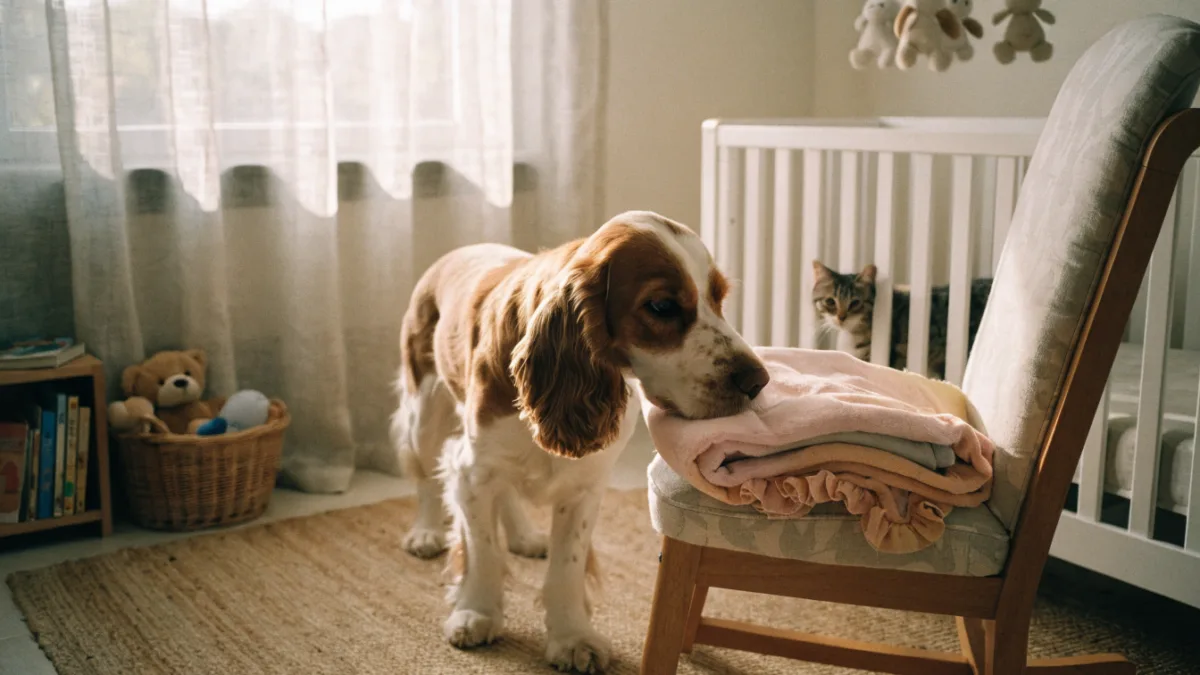
Let me tell you about the time my cat, Barnaby, discovered the brand-new crib. I had spent weeks designing the perfect nursery. I washed the organic cotton sheets, arranged the tiny blankets, and set up a sound machine that mimicked gentle rain. I stepped out for exactly two minutes to grab a load of laundry, and when I returned, Barnaby was sprawled out on the mattress, purring loud enough to vibrate the crib skirt, leaving a layer of orange fur on everything I owned.
Pets don’t care about your Pinterest board. They don’t understand that a tiny, loud human is about to completely dismantle their peaceful routine.
Preparing your dog or cat for a human baby is less about executing a picture-perfect transition and more about managing expectations—mostly your own. It requires patience, a solid sense of humor, and a willingness to look at your home the way your animals do. Here is how to get your furry family members ready for the ultimate household disruption.
The Nursery Scent-orial and the Great Audit
Both dogs and cats experience the world primarily through their noses. Long before they see a baby, they are going to smell one, and the nursery is going to be the epicenter of those strange new odors. Weeks before the baby arrives, start bringing the nursery to life. Open the bottles of baby lotion, dab a little on your wrists, and let your pets sniff you. Wash the baby blankets in the new detergent you plan to use and leave them out for your cat to investigate.
While you are setting up the room, you also need to do a massive safety audit. Cat-proofing and baby-proofing are essentially the exact same job, and toxic risks are hiding in plain sight. Many common household and nursery plants—like lilies, pothos, and peace lilies—are highly toxic to both cats and dogs. If it can hurt a curious toddler, it can absolutely hurt a curious pet. Clear out the dangerous greenery now.
Establishing Boundaries Early
Decide early on what the nursery rules will be. Will the dog be allowed to sleep in the rocking chair? Will the cat have free rein of the crib? If the answer is no, you need to install physical barriers immediately.
Do not wait until the baby is home to suddenly lock your pets out of a room they have always enjoyed. If you do, they will associate the sudden loss of their territory with the arrival of the infant, which is a fast track to behavioral issues. Set up a physical barrier, like a mounted baby gate or a sturdy screen door, months in advance. This allows the cat or dog to still see, hear, and smell what is happening in the nursery without having full access to the space.
The Great Crib Debate: Myths vs. Reality
Let’s address the elephant in the room: the persistent old wives’ tale that cats will intentionally smother babies by sucking their breath. This is entirely a myth. Cats do not have a secret vendetta against human infants, nor do they possess the anatomical desire to steal breath.
However, there is a very real, very valid danger behind the myth. Cats are heat-seeking missiles. They love warm, cozy spots, and a sleeping infant happens to radiate a lot of heat. A cat curling up too close to a sleeping baby’s face poses a severe suffocation risk.
Because of this, keeping cats out of the crib is a non-negotiable safety precaution. Animal behaviorists often debate whether to use strict exclusion (keeping the nursery door closed at all times) or supervised inclusion (allowing the pet to sniff and observe while being closely monitored). I am a firm believer in supervised inclusion during the day, combined with strict crib protection. If you cannot keep the door closed, look into crib nets or tents to keep the cat out while the baby sleeps. Let them investigate the room under your watchful eye so it loses its mysterious appeal, but draw a hard line at the crib.
Desensitizing to the Soundtrack of Chaos
Newborns are incredibly loud. They cry, they shriek, and they make guttural sounds that are surprisingly similar to distressed wildlife. If your pet has lived in a quiet home for the last three years, a screaming baby is going to be a massive shock.
Start desensitizing them now. You can find hours of baby crying audio on YouTube. Play it softly on your phone while giving your dog or cat their favorite treats. Gradually increase the volume over a few weeks. You want them to associate the sound of a wailing infant with high-value rewards—think freeze-dried salmon or tiny bits of plain chicken.
The “Pandemic Pet” Factor
If you adopted a pet during the COVID-19 lockdowns, you might have an extra hurdle. Veterinarians and behaviorists have noted a massive rise in anxiety and territorial behavior from pets adopted during the pandemic. These animals spent their critical early months in a quiet, isolated environment without proper socialization to strangers, chaotic routines, or infants.
If your dog has never seen a toddler, do not assume they will know how to act. There is a growing trend of expectant parents hiring certified trainers who use lifelike baby dolls that cry, move, and smell like real infants to rehearse nursery interactions. If you have a nervous dog, this kind of pre-baby training is worth its weight in gold.
(And just a quick note: if your dog is showing signs of severe anxiety or resource guarding, this is Jake’s department. Do not try to train a reactive dog yourself right before a baby arrives—reach out to a certified professional dog trainer who uses positive reinforcement to help you establish a safe baseline.)
The Two-Person Rule for the First Meeting
When the day finally comes to bring the baby home, the safest introductions require two adults. One person focuses entirely on monitoring and controlling the pet, while the other focuses completely on the baby.
Have the person holding the baby sit down somewhere comfortable and remain as calm as possible. The second person should allow the dog or cat to investigate from a distance. If it is a dog, keep them on a loose leash—do not yank them or tighten up, as tension travels straight down the leash and tells the dog there is something to be worried about. Let them sniff the air, reward calm behavior with treats, and keep the whole interaction incredibly brief.
Managing a Multi-Pet Household
If you have both a dog and a cat, their relationship needs to be stable long before the baby arrives. If you are thinking about bringing a new dog into a cat’s home (or vice versa) while pregnant, please reconsider the timeline. Introductions between predator and prey species must be painfully slow. If you are already,[1] you do not need the added stress of a newborn in the same room.
If you have multiple dogs, they should be introduced to the baby one at a time. Pack mentality is real, and dogs get overly excited when together. Bringing them in one by one prevents them from feeding off each other’s energy and overwhelming the infant—or the parents.
Your Pet Still Needs a Sanctuary
Just as the nursery is a safe zone for your baby, your pet needs a retreat. This is especially true for cats, who view the world vertically and need to escape from grabbing hands and loud noises.
Ensure your cat has a designated safe space equipped with all their essentials: food, water, a litter box, a scratching post, and their favorite toys. Keep this space strictly off-limits to the baby. When the house is loud and chaotic, your cat needs to know they have a sanctuary to retreat to where they will not be disturbed. Resource guarding is a natural stress response; if your cat feels their food or safe spaces are threatened by the new tiny human, they will act out.
Final Thoughts
Bringing a baby home is a massive life event, and it is completely normal for your pets to act a little weird for a few weeks. Give yourself grace, and give your pets patience. Keep their routines as consistent as possible, protect their safe spaces, and remember that this is an adjustment for everyone.
As you navigate this new chapter, don’t forget that our pets rely on us entirely for their welfare. Keeping your pets properly vaccinated, spayed, neutered, and safely contained within the home is vital not just for their health, but for local wildlife conservation. A content, secure pet makes for a much happier household—and a much more peaceful nursery.
Sources
- learning how to introduce a dog and cat — animalhumanesociety.org