

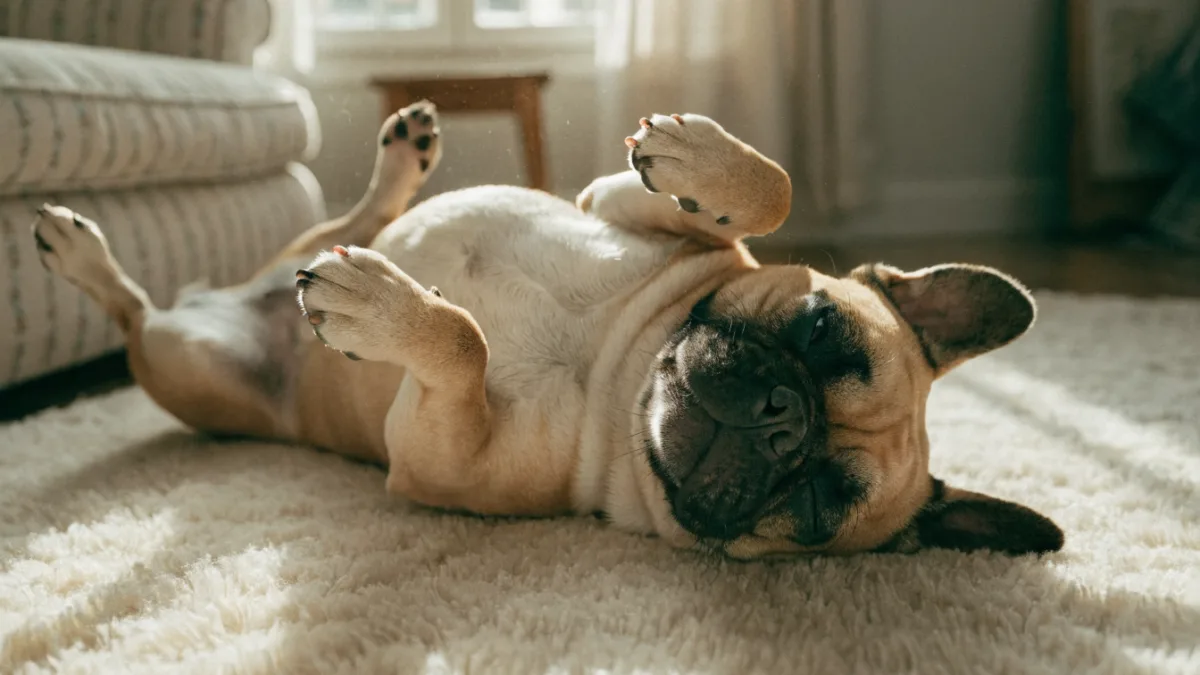
There’s a particular kind of alarm that hits the first time you walk into a room and find your dog asleep on their back, legs splayed in four different directions, tongue lolling sideways out of their mouth. My first thought when my partner’s shepherd mix did this was that he’d somehow broken. He hadn’t. He was, in fact, so profoundly relaxed that he’d decided to display every vulnerable organ he owns to the ceiling fan. It looked absolutely unhinged. It was also, I’d later learn, the highest compliment he could possibly give us.
Dogs spend a significant portion of their lives asleep — anywhere from 12 to 14 hours a day for most adult dogs, and even more for puppies and seniors. That’s a lot of time spent unconscious, and it means that how they choose to do it tells you something real about how they’re feeling. Animal behaviorists have been paying closer attention to sleep postures lately, not because they’ve discovered anything new about canine anatomy, but because there’s a growing push to help owners read their dogs’ body language more accurately. Sleep position happens to be one of the most accessible windows into your dog’s emotional state — no special equipment required, just observation.
The Belly-Up: Maximum Vulnerability, Maximum Trust
The technical term for this position is dorsal recumbency, but let’s be honest — nobody calls it that. It’s the dead-bug pose. The flat-on-their-back, paws-in-the-air, completely exposed look that makes you wonder if your dog understands how ridiculous they appear.
Here’s what’s actually happening: when a dog sleeps on their back, they’re exposing their throat, chest, and stomach. These are the areas where a predator would do the most damage in the wild. A dog who voluntarily sleeps this way is telling you, in no uncertain terms, that they do not consider you or their environment a threat. They feel safe enough to disconnect entirely from their defensive instincts.
There’s also a practical element that often gets overlooked. Dogs don’t sweat the way humans do — they cool themselves primarily through panting and through the pads of their feet. The belly area has less fur than the rest of the body, so sleeping belly-up allows maximum airflow to the skin and helps regulate body temperature. So your dog might be telling you they trust you completely, or they might be telling you the thermostat is set too high. Probably both.
My cat Wicket does a version of this that I find equally flattering and mildly offensive — she flops onto her back in the middle of the hallway, blocking all foot traffic, and dares me to step over her. With cats, the exposed belly is a more complicated signal. It can mean trust, but it can also be a trap. Reach for that belly at your own risk.
The Side Sleeper: Quiet Confidence
This is the position most companion dogs default to — stretched out on one side, legs extended or slightly curled, head resting on the floor or a convenient human limb. It looks comfortable because it is comfortable. The muscles are relaxed, the body is supported, and the dog can enter deeper sleep stages.
Side sleeping still leaves the stomach partially exposed, which means it requires a baseline level of trust. A dog who won’t sleep on their side in a particular environment is a dog who isn’t fully at ease. But side sleeping is less of a dramatic statement than the belly-up — it’s the everyday, settled-in version of “I’m fine here” rather than the full theatrical production.
Dogs who side-sleep tend to be described by their owners as generally easygoing, and that tracks. You don’t stretch out like that if you’re anticipating trouble. It’s the posture of a dog who has settled into their routine and doesn’t feel the need to stay alert.
The Curled Position and the Donut
Not every sleep position is about maximum vulnerability. Many dogs sleep curled in a tight ball, nose tucked under tail, paws gathered close. This conserves body heat and protects the vital organs. It’s the position wild canids use, and it serves a clear evolutionary purpose.
A dog sleeping like this isn’t necessarily anxious or distrustful — and this is where a lot of the online guidance gets things wrong. My partner’s shepherd curls up tight every single night, and he’s one of the most confident dogs I’ve ever met. He just gets cold. Some dogs curl because it’s how they’re built. Greyhounds, whippets, and other deep-chested breeds often find this position structurally comfortable. Older dogs with arthritis may curl because it reduces strain on their joints.
The key is change. If your dog normally sleeps stretched out and suddenly starts curling tight, that’s worth paying attention to. It could indicate pain, illness, or a shift in how secure they feel. That’s a conversation for your vet, not the internet.
Working Dogs Have Different Rules
One thing that gets completely ignored in most discussions of dog sleep positions is that not all dogs have the same job. A companion dog whose primary daily task is keeping the couch warm has different sleep needs than a working or service dog who’s actively on duty.
Service dogs, livestock guardians, and other working dogs often rest in positions that keep them ready to move — sitting upright, head up, one ear oriented toward whatever they’re monitoring. This isn’t a sign of distrust or anxiety. It’s training and instinct doing exactly what they’re supposed to do. A livestock guardian dog who sleeps belly-up in the field isn’t relaxed — they’re negligent.
Jake, who handles all the dog training content around here, has pointed out that working dogs often shift dramatically between on-duty and off-duty postures. The same dog who’s alert and upright while working might turn into a complete puddle of limbs the second their vest comes off. Context matters more than any single position.
What If Your Dog Never Shows Their Belly?
Here’s the thing that needs saying clearly: not every dog who trusts you will sleep on their back. Some never will, and that’s completely fine.
Breed anatomy plays a significant role. Deep-chested breeds like greyhounds and Dobermans often find the belly-up position physically awkward. Long-backed breeds like dachshunds may avoid it because it strains their spine. Senior dogs with joint pain, dogs recovering from surgery, dogs with any kind of musculoskeletal issue — all of these dogs might be deeply bonded to you and still never once sleep belly-up.
Body structure also matters. A muscular, blocky dog carries weight differently than a lean, slender one. What feels comfortable for a Labrador might feel deeply wrong for a Chinese shar-pei. Assuming that every dog should adopt the same posture if they’re happy is a mistake.
If your dog sleeps on their side near you, leans against you, seeks you out when they’re tired, or relaxes their body when you’re around — those are all trust signals. The belly-up position is dramatic and photogenic, but it’s not the only evidence of a strong bond, and its absence doesn’t indicate a problem.
Reading the Whole Dog
Sleep position is one data point, not a complete picture. The growing interest in canine body language education is genuinely valuable — understanding yawning, tail carriage, ear position, and muscle tension gives you a much richer sense of what your dog is experiencing than any single behavior.
What matters most is knowing your dog’s baseline. How do they normally sleep? How do they settle when they’re comfortable versus when something’s off? What changes when you travel, when visitors arrive, when the routine shifts? A dog who sleeps well in your home and poorly elsewhere isn’t broken — they’re just telling you where they feel safe.
The bottom line is that sleep is one of the most vulnerable things any animal does. The fact that our dogs and cats choose to do it next to us, on us, and sometimes sprawled across our pillows with a paw in our faces — that’s not nothing. Whether they’re belly-up or curled tight, the choice to sleep in your presence is its own kind of trust. The ridiculous poses are just a bonus.