

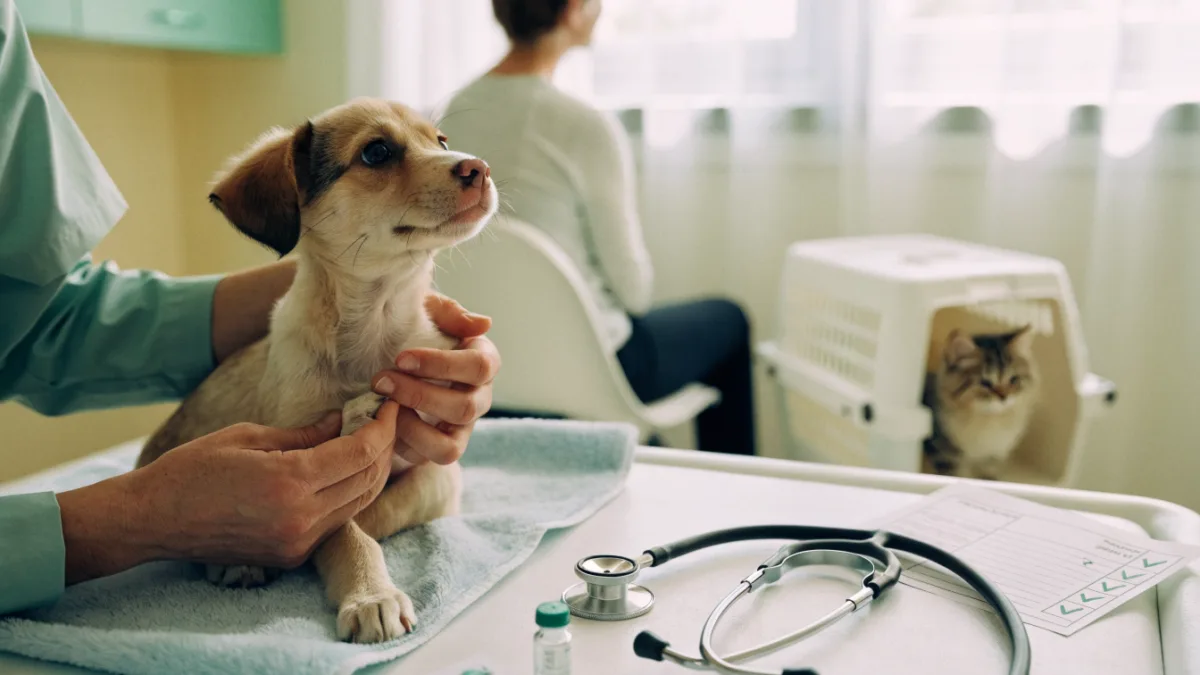
The vaccine handout we give new pet owners at my clinic is a single page long. You wouldn’t know it from the faces people make reading it. Last spring, a first-time client named Dana brought in Moose — an eight-week-old Labradoodle who was roughly forty percent ears — pointed at the paper, and asked, “What on earth is DHPP? It sounds like a radio station.” Fair question. Between the acronyms, the week-by-week timing, and the whole “core versus lifestyle” vocabulary, the puppy shots schedule and the kitten vaccination schedule can feel like they’re written in code. They’re not. Underneath the alphabet soup is a genuinely elegant piece of immunology, and once you understand the logic, the whole plan makes sense.
Why Puppies and Kittens Need a Series, Not One Shot
Nursing puppies and kittens get a head start from their mother’s first milk, called colostrum, which is loaded with her antibodies. That borrowed immunity is wonderful — and completely unpredictable. It fades at a different rate in every animal, typically somewhere between six and sixteen weeks of age. Here’s the catch: while those maternal antibodies are still circulating, they can neutralize a vaccine exactly the same way they’d neutralize a real virus. So during that window, we genuinely can’t tell whether a shot actually trained the puppy’s immune system or simply got swallowed up by Mom’s leftovers.
The series solves this. Giving a shot every three to four weeks is like a relay race — we keep passing the baton until we’re certain the puppy’s or kitten’s own immune system has grabbed it. That’s why the final visit around sixteen weeks is the one you really don’t want to skip. I once treated a parvovirus case in a sweet fourteen-week-old puppy whose family had stopped the series at twelve weeks because “he seemed fine.” He did recover — survival with aggressive treatment runs around eighty-five to ninety percent — but it was a rough, expensive week for everyone. I don’t share that to scare you. I share it because that last visit is doing the heavy lifting.
The Puppy Shots Schedule, Decoded
What DHPP Actually Means
That “radio station” is just a combination vaccine covering the core diseases every dog should be protected against, no matter their lifestyle:
- D — Distemper: a virus that attacks the respiratory, gastrointestinal, and nervous systems
- H (or A/A2) — Adenovirus: type 1 causes infectious canine hepatitis; type 2 contributes to respiratory disease
- P — Parainfluenza: a respiratory virus, part of the kennel cough complex
- P — Parvovirus: the severe gastrointestinal virus every puppy owner fears
Some clinics label it DA2PP because their version includes both adenovirus types. Don’t let the different letters trip you up — it’s essentially the same protection.
The Typical Timeline
- 6–8 weeks: first DHPP
- Every 3–4 weeks after: DHPP boosters, usually at 12 and 16 weeks
- 12–16 weeks: rabies vaccine — in most U.S. states and many other countries, this one is required by law, so timing may be set locally
- Around 1 year: a booster that “locks in” the puppy series
- Adulthood: most core vaccines repeat every three years, per current veterinary guidelines
You’ll find this same framework laid out nicely in.[1] Beyond the core vaccines for pets, there’s the lifestyle list: Bordetella if your dog boards, grooms, or visits dog parks; Lyme vaccine in tick-heavy regions; and canine influenza for daycare and show dogs.
Now, the one I’ve genuinely changed my mind on: leptospirosis. I was taught it was a “lifestyle” vaccine for hunting dogs and farm dogs. Then leptospirosis — a bacteria spread through the urine of rats and wildlife — started showing up in city dogs drinking from puddles, with outbreaks reported in several major metro areas since 2021. The 2022 canine vaccination guidelines reflect this shift, and I now recommend it routinely. Know that classification varies from clinic to clinic, so this is a fair question to ask your vet directly.
The Kitten Vaccination Schedule, Decoded
FVRCP, Translated
Cats have their own acronym: FVRCP. That’s FVR for feline viral rhinotracheitis (the herpesvirus that causes sneezing and eye issues), C for calicivirus (another respiratory bug), and P for panleukopenia — often called “feline distemper,” and a close cousin of canine parvovirus. The series starts at six to eight weeks, repeats every three to four weeks until at least sixteen weeks (some kittens need one more at twenty), with rabies around twelve to sixteen weeks.
On top of that, the feline advisory groups consider FeLV — feline leukemia virus — a core vaccine for all kittens. When I mentioned this to the owner of Peanut, her strictly indoor ragdoll kitten, she looked skeptical. My answer: you don’t yet know who this cat will be at age three. Indoor cats escape, households add new cats, and FeLV is spread through close cat-to-cat contact. Protecting every kitten covers every possible future.
Why We Vaccinate Cats Low on the Leg
Here’s something that surprises first-time cat owners: there’s a rare tumor called a feline injection-site sarcoma, estimated at roughly one in 10,000 to 30,000 cats. Because it’s so rare but traceable, vets vaccinate cats low on a specific leg (or the tail) so that if a reaction ever does develop, we know exactly which vaccine caused it and can treat it effectively. If you want to go a step further, ask your vet whether they use non-adjuvanted recombinant vaccines — many of us have switched to these for cats for exactly this reason. And note that cat and dog protocols don’t overlap much: cats don’t need lepto or Bordetella, and dogs don’t need FeLV.
Titer Testing: When a Blood Test Can Stand In for a Booster
A titer is a blood test that measures whether protective antibodies are still circulating — essentially asking the immune system, “Do you remember this?” Titers run roughly $40–$150 versus $20–$60 for a vaccine dose, though same-day in-clinic tests have made them far more practical than they used to be. They’re a scientifically accepted alternative for canine distemper, parvovirus, and adenovirus, and for panleukopenia in cats.
Two honest caveats. A titer is not legally valid for rabies anywhere I’m aware of — the law wants the actual vaccine. And we don’t have reliable titers for lepto or Bordetella, so those stay on a schedule. The broader booster question — how often is often enough? — has itself evolved, as:[2] the old annual convention has largely given way to three-year protocols, though some clinics still vaccinate yearly, and.[3] If your clinic’s approach differs from a friend’s, that’s a conversation to have with your vet, not a red flag.
Questions I Hear Every Week
“We missed a booster. Do we start over?”
Usually no. The immune system has a memory, so a delayed booster generally picks up where things left off — though with very young puppies who’ve had a long gap, some vets will add doses to be safe. Call and ask; that’s what we’re for.
“Can we split the vaccines for my tiny dog?”
Often, yes. Adverse reactions run about 38–51 per 10,000 doses — under half a percent — but the risk climbs in dogs under ten kilograms and when several vaccines are given at once. For patients like Biscuit, a four-pound Chihuahua who once went wobbly after a full visit, I split his vaccines across two shorter appointments, and he’s done beautifully.
“How risky are vaccines, really?”
Mild sleepiness or a tender spot for a day is common and passes on its own. Serious reactions are rare, and in twenty years of practice, the diseases have frightened me far more than the vaccines ever have. If you’re worried, spreading out vaccines and choosing non-adjuvanted options for cats are both reasonable, evidence-based requests.
One last thought, because it’s the part I find most beautiful about all this. Rabies still circulates in wildlife — raccoons, skunks, bats — and remains nearly one hundred percent fatal once symptoms appear, killing tens of thousands of people worldwide each year, mostly in regions where dog vaccination is out of reach. Every puppy and kitten you vaccinate is a small act of conservation: a firewall that keeps a devastating disease from passing between pets, people, and wild animals. So bring your questions, keep that handout on the fridge, and work with your vet to tailor the timing to your pet — the code isn’t so cryptic once someone walks you through it.
Sources
- Vetco's vaccination schedule overview — vetcoclinics.com
- Best Friends explains — bestfriends.org
- adult boosters still matter even after the cute stage ends — sugarcreekah.com