

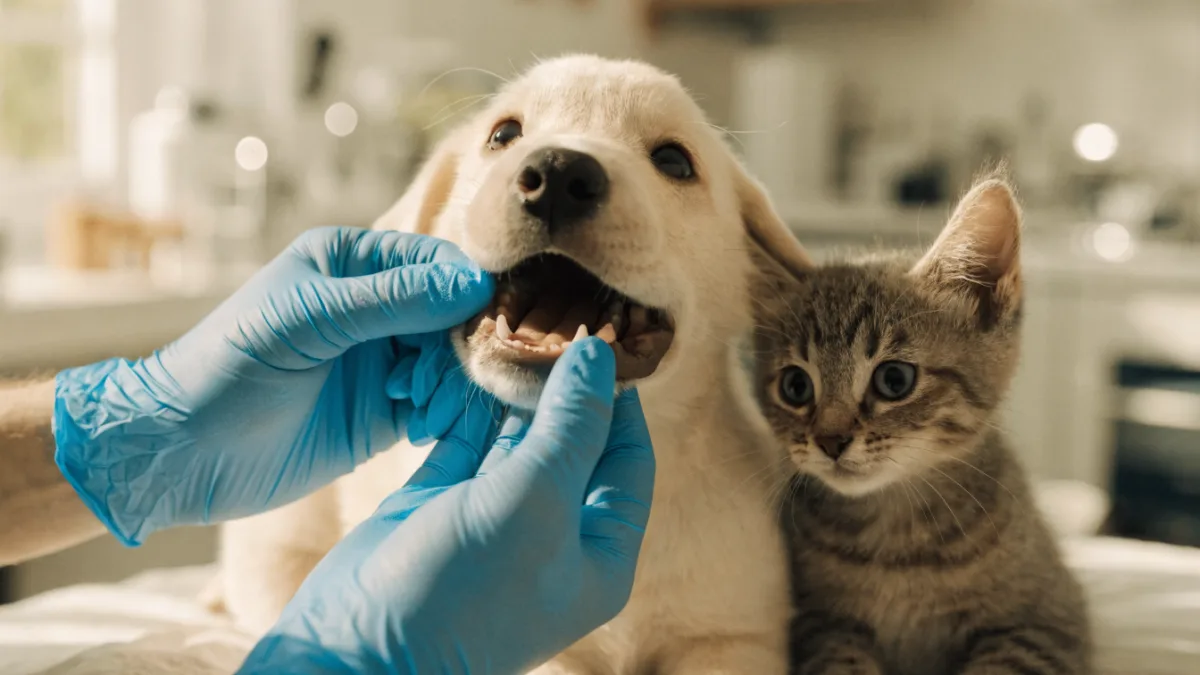
When a new puppy or kitten joins your family, you expect the usual chaos: chewed shoes, 3 a.m. zoomies, and the joy of watching a tiny creature discover the world. What you don’t expect is to find a cluster of strange, cauliflower-like lumps sprouting inside your puppy’s mouth almost overnight, or to watch your new kitten begin drooling and pawing at her face in obvious pain. Clinics see these scenarios constantly — sometimes two or three times in a single week during peak “puppy season.” A frantic owner rushes in, convinced it’s something dire, and nine times out of ten, it’s one of two incredibly common, highly contagious viral infections: canine papillomavirus (puppy warts) or feline calicivirus. Understanding the difference between these two conditions can save you a lot of sleepless nights and help you protect other pets in your community.
The “Bump Check”: What You’re Actually Looking At
Last spring, a family brought in an eight-month-old Golden Doodle named Cooper. His owner had noticed what she described as “a piece of chewed-up pink bubblegum” stuck to his lip during their morning cuddle. When she tried to wipe it off, she realized it was firmly attached — and there were three more just like it clustered along his gumline. “Is it cancer?” she whispered, clearly terrified. I love that she asked, because it gave me the chance to explain what papillomas actually are: benign, virus-driven overgrowths of superficial skin cells. They look alarming, but they’re not malignant.
Puppy Warts: The Cauliflower Culprit
Puppy warts, clinically known as canine viral papillomatosis, are caused by the papillomavirus — a tiny, resilient pathogen that thrives in the warm, micro-abraded environment of a young dog’s mouth. When I say “micro-abrasions,” I’m talking about the invisible little nicks and scratches that naturally occur when puppies do what puppies do: chew on sticks, wrestle with each other, gnaw on shared toys, and explore the world with their mouths. The virus enters through those tiny openings and hijacks the local skin cells, causing them to proliferate into those distinctive fleshy masses.
Visually, papillomas are hard to miss once you know what you’re looking for. They typically appear as pink, white, or flesh-colored lumps with a rough, irregular surface that genuinely does resemble a tiny head of cauliflower. They most commonly crop up on the lips, gums, tongue, inner cheeks, and occasionally the roof of the mouth — classic dog mouth sores that send owners scrambling to Google at midnight. They can appear as single growths or clusters, and while they’re usually painless, they can bleed if bumped or irritated during rough play.
Feline Calicivirus: A Different Beast Entirely
Now let’s talk about the other side of the equation. Around the same time Cooper came in, a six-month-old shelter kitten named Marigold was seen at the same clinic. Her new owner had adopted her just four days earlier, and everything seemed perfect — until Marigold started sneezing violently, drooling excessively, and refusing her food. Inside her mouth there were no warts. Instead, shallow, raw ulcers dotted her tongue and the hard palate at the roof of her mouth. Her nose was crusted with discharge, and she flinched at gentle pressure on her jaw, indicating joint pain. This was textbook feline calicivirus.
Feline calicivirus, or FCV, is one of the heavy hitters of feline medicine. Alongside feline herpesvirus-1, it’s responsible for roughly 80 to 90 percent of all upper respiratory infections in cats. Rather than causing warty growths, FCV initially produces fluid-filled blisters on the tongue, hard palate, and around the nose. Those blisters rupture quickly — often within hours — leaving behind the painful, shallow ulcers I saw in Marigold’s mouth. The sneezing, nasal discharge, and sometimes limping or joint stiffness that accompany the mouth sores make FCV unmistakably different from papillomas once the full clinical picture emerges.
Contagion and the Dog Park Dilemma
Both of these viruses share one deeply inconvenient trait: they are remarkably good at spreading themselves around. If your puppy attends daycare, visits the dog park, or even just says hello to other dogs on the sidewalk, they’re operating in an environment where papillomavirus thrives. The virus transmits through direct dog-to-dog contact — think shared water bowls, communal toys, mouthy play, and yes, enthusiastic face-licking. This is why puppy warts sweep through training classes and daycare facilities like wildfire, infecting multiple puppies before anyone even notices the first case.
FCV is equally ruthless, if not more so. It spreads through nasal and eye discharges from infected cats, but it also lingers in the environment on bedding, food bowls, litter scoops, and even human clothing. Research shows that FCV can survive on contaminated surfaces for up to a month under the right conditions. That means a kitten adopted from a shelter may have been exposed days before you ever brought her home — which is exactly what happened with Marigold. Her incubation period simply outlasted her stay at the shelter.
Both viruses disproportionately affect young animals with immature immune systems. Puppies under two years old and kittens under six months are the highest-risk groups, simply because their immune defenses haven’t yet learned to recognize and fight off these common pathogens.
When to Isolate: The Non-Negotiable Rules
I’m often asked, “Can my dog still go to daycare while the warts are clearing up?” The answer is a firm, uncompromising no. Any puppy showing active papillomas should be kept away from other dogs entirely until every single wart has disappeared and the tissue has healed. This typically takes one to five months, because the papillomas are self-limiting — meaning they eventually resolve on their own as the puppy’s immune system catches up and mounts a proper response. During that window, your dog is contagious, even if the warts look like they’re shrinking.
The isolation principle applies equally to cats with FCV, though the stakes are arguably higher. An infected cat should be separated from all other felines in the household immediately. Shared items — bowls, bedding, litter boxes, grooming tools — must be dedicated to the sick cat and disinfected separately. And here’s something many people overlook: you can inadvertently transport FCV between rooms on your hands and clothing. Washing your hands thoroughly and changing clothes between handling a sick cat and interacting with healthy ones isn’t being overly cautious. It’s being responsible.
Treatment, Patience, and the Limits of Intervention
Managing Puppy Warts
Here’s where I’ve genuinely shifted my approach over the years. Early in my career, I was quick to refer puppies for surgical or laser removal of papillomas because the appearance upset owners so much. But the evidence consistently shows that the vast majority of these growths disappear on their own within one to five months without any intervention. Surgery carries its own risks — anesthesia, infection, tissue damage — and unless the warts are actively bleeding, clearly infected, or so numerous that they interfere with eating or cause the puppy to chew obsessively at his mouth, the best treatment is often simply waiting.
That said, some cases do warrant intervention. For puppies with stubborn or particularly severe papilloma outbreaks, I’ll sometimes discuss an autogenous vaccine with the owner. This involves surgically removing a small piece of the wart tissue, processing it, and creating a customized vaccine that’s injected back into the same dog to stimulate a stronger immune response. The clinical results are mixed — some practitioners swear by it, while others find it no more effective than letting nature take its course. I present it as an option for refractory cases, not a first-line solution, and I’m transparent about the uncertainty surrounding its efficacy.
Treating Feline Calicivirus
FCV requires a more hands-on approach. Because those mouth ulcers are genuinely painful — imagine having multiple canker sores simultaneously — supportive care is essential. This means providing soft, palatable food that doesn’t aggravate the oral lesions, maintaining hydration (sometimes with subcutaneous fluids administered in clinic), managing secondary bacterial infections with appropriate medication, and in severe cases, using pain management protocols that only a veterinarian should determine. Never give a cat over-the-counter pain relievers intended for humans or dogs — many are toxic to felines at even small doses.
The standard FVRCP vaccine, which protects against feline viral rhinotracheitis, calicivirus, and panleukopenia, is a cornerstone of preventive care. However, calicivirus mutates rapidly, and vaccinated cats can still contract milder forms of the virus from mutant strains. I always explain to owners that the vaccine doesn’t guarantee complete immunity — it reduces severity and duration, which is still enormously valuable.
The Disinfection Factor: Cleaner Isn’t Always Clean Enough
One of the most important recent developments in managing both of these viruses involves how we clean. Standard household bleach isn’t as effective as many people believe against FCV or papillomaviruses unless it remains wet on a surface for ten minutes or longer — and let’s be honest, most of us spray and wipe within seconds. Shelter medicine research has driven the adoption of potassium peroxymonosulfate-based disinfectants in veterinary hospitals, rescues, and multi-pet households. Look for products that specifically list effectiveness against non-enveloped viruses on their label, and follow the contact time instructions religiously. For dog bowls and hard toys, running them through a dishwasher with high-heat drying is a practical, effective approach for busy households.
A Rare But Critical Warning
I’d be doing you a disservice if I didn’t mention Virulent Systemic Feline Calicivirus, or VS-FCV. This is a rare but extremely dangerous mutation of standard calicivirus that causes severe, whole-body illness rather than just upper respiratory symptoms. Cats with VS-FCV develop dramatic swelling in the limbs and face, crusting skin lesions, fever, and high mortality rates. Outbreaks have occurred in veterinary clinics and shelters, making rapid isolation and professional veterinary assessment absolutely critical for any cat showing mouth sores combined with lethargy, swelling, or respiratory distress. Don’t wait and see with these symptoms — the window for effective intervention is narrow.
The Bigger Picture
While canine papillomavirus and feline calicivirus don’t pose conservation concerns for wildlife populations in the way that diseases like canine distemper or rabies do, recent research into papillomaviruses has revealed something fascinating and relevant to all of us who care about the natural world. Studies published in 2024 have documented that canine papillomaviruses, while rarely causing cancer in domestic dogs, can cause significant disease in wild carnivores — including snow leopards and wolves. Understanding how these viruses jump between species and behave differently in different hosts isn’t just an academic exercise. It’s a reminder that the health of our domestic pets and the health of wild animal populations are deeply interconnected, and that responsible pet ownership — including vaccination, proper isolation during illness, and informed veterinary care — ripples outward in ways we’re only beginning to fully appreciate.
So the next time you find a strange bump in your puppy’s mouth or notice your kitten drooling more than usual, don’t panic. Do the bump check, take a photo to share with your veterinarian, keep your pet away from others until you know what you’re dealing with, and remember that most of these common viral infections are far more frightening in appearance than they are in prognosis. A little knowledge and a lot of patience will get you through — and your puppy or kitten will be back to causing the usual chaos before you know it.