

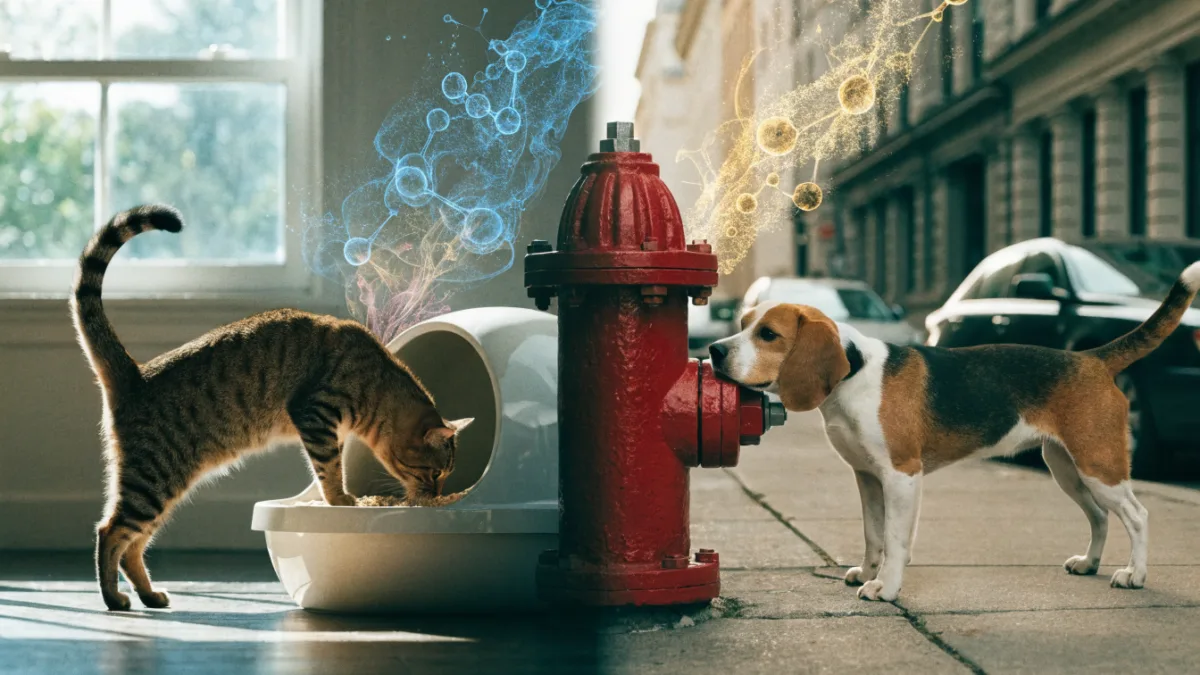
I remember standing in a client’s living room a few years back, looking at a perfectly good leather recliner soaked in cat urine. The owner was furious. She was convinced her seven-year-old tabby, Barnaby, was spraying the chair out of pure spite because she had worked late all week. I get it. When you come home to a puddle on the rug or a wet streak on the curtains, it feels incredibly personal. But here is the no-nonsense truth: your pet is not a tiny, furry saboteur. Whether it is a dog obsessing over a fire hydrant or a cat leaving a calling card on your sofa, scent marking is a complex, chemical communication system. It is an olfactory bulletin board, and your pet is just reading and writing the news.
The Chemistry of the Message Board
To understand why animals mark, you first have to understand that urine and feces are not just waste. When an animal scent marks, their body adds extra communication chemicals to the mix. We are talking about pheromones and volatile organic compounds. These chemicals convey highly specific messages to other animals. They broadcast an animal’s health, reproductive status, diet, and exactly how long ago they were standing in that exact spot.
Think of it like a social media feed. A quick sniff tells an animal who is in the area, who is looking to mate, and who is just passing through. Dogs and cats process this information through a specialized receptor located in the roof of their mouth, called the vomeronasal organ or Jacobson’s organ.
Reading the Invisible Mail
If you have ever seen a dog sniff a tree and then chatter his teeth, or a cat catch a whiff of something and make a weird grimace with her mouth slightly open, you are watching them read their mail. That grimace is called the Flehmen response. They are essentially trapping the scent molecules and funneling them up to the vomeronasal organ, translating raw chemicals into emotional and social data. They are not just smelling another dog’s pee. They are reading a detailed profile.
Fire Hydrants and Vertical Walls
While dogs and cats both mark, their motivations and mechanics look a little different. For dogs, scent marking is a highly normal behavior, particularly prominent in intact males, though females do it too.,[1] vertical objects like fire hydrants, tree trunks, and fence posts are prime real estate. It is not necessarily about claiming the whole block as their exclusive kingdom—a myth that leans heavily on outdated dominance theory. Instead, these vertical waypoints help a dog map out their environment, familiarize themselves with the local canine residents, and navigate their world.
Cats, on the other hand, use scent to build a profound sense of security. In a multi-cat household, scent distribution is vital. They rub their cheeks on furniture, scratch specific surfaces, and sometimes spray urine to establish boundaries and maintain social harmony. When a cat sprays, it is almost always on a vertical surface. They back up to the wall, quiver their tail, and deposit a small, highly concentrated stream of urine.
Here is a fact that surprises a lot of cat owners: if your cat is urine marking, they will almost always,[2] for normal elimination. Marking is a communication tool, not a litter box aversion issue. If your cat is suddenly squatting to pee on your bathmat or eliminating outside the box entirely, you are usually dealing with a different problem—either a dirty box, a medical issue, or a location dispute. True marking is an intentional, purposeful act of communication.
The “Spite” Myth and the Medical Rule
Let’s clear the air on the biggest debate in pet ownership. Owners constantly view indoor marking as spiteful, angry behavior. Behaviorists argue vehemently against this. Animals do not possess the cognitive ability to plot revenge because you went on vacation or brought home a new baby. When a pet marks indoors, it is driven by natural instinct, over-stimulation, or anxiety.
Usually, indoor marking happens because the animal feels their territory is threatened. Maybe your indoor cat saw a stray tomcat lingering outside the living room window. To your cat, that stray is invading their turf, so they ramp up their own scent marking to re-establish boundaries and soothe their own nerves. The same goes for dogs. If you bring a new pet into the house, your resident dog might start marking doorways to reassure himself that this is still his home. [3] scent is their primary language for creating a safe, harmonious environment.
Always Check with the Vet First
Before you assume an indoor accident is behavioral, you have to rule out a medical root. There is an ongoing challenge in veterinary medicine to distinguish between true scent-marking and an underlying physical issue. Bladder stones, urinary tract infections, and gastrointestinal distress can all cause a pet to suddenly empty their bladder in weird places.
I used to tell clients to immediately start behavioral modification the moment an accident happened. I was wrong about that, and it is a mistake that can cost your pet their health. If a dog is urinating frequently in the house, or a cat is leaving puddles in the sink, get them to the vet’s office. You cannot train away a bladder infection. Once the vet gives a clean bill of health, then you can treat the issue as a behavioral marking problem.
Management Over Punishment
So, your pet is healthy, but they are still marking your curtains. What do you do? You manage the environment, not the emotion. Scolding a dog for lifting his leg or spraying a cat with a water bottle for marking a wall does not work. It just adds stress to an already anxious animal, which usually makes them want to mark more to feel secure. And forget about aversive tools. You do not need shock collars or prong collars to fix a potty issue.
Instead, try these steps:
- Block the view: If your cat is marking because of outdoor strays, close the blinds or block access to the window. Remove the visual trigger.
- Clean with enzymes: Standard household cleaners do not break down the uric acid crystals in pet urine. You need a high-quality enzymatic cleaner to completely destroy the scent profile. If they can smell it, they will refresh the mark.
- Provide legal outlets: Modern behavior experts advocate for scent enrichment. Give your cat tall, sturdy scratching posts placed strategically near doors and windows so they can mark legally with the scent glands in their paws. Let your dog sniff freely on walks rather than rushing them past every blade of grass.
- Consider synthetic pheromones: The pet care industry has made massive leaps here. Synthetic pheromone diffusers mimic the natural calming pheromones mother dogs and cats produce. Plugging one in alters the pet’s emotional state, making them feel safe enough that they do not need to spray the wall.
Beyond the Backyard
While we mostly deal with this behavior in our living rooms, scent marking plays a vital role out in the wild. Conservationists rely heavily on understanding how wild carnivores communicate. Tigers, leopards, and wolves use scent to find mates, establish territory, and avoid unnecessary, dangerous conflicts with rivals.
When researchers set up camera traps, they often place them near scent stations—trees or rocks where wild animals naturally leave their chemical signatures. By understanding how a solitary wild cat uses scent to navigate fragmented habitats, scientists can better map breeding populations and design protected corridors that keep these threatened species from disappearing entirely. The chemical language that frustrates you in your living room is the exact same language keeping an entire ecosystem connected.
Scent marking is a deeply ingrained, incredibly sophisticated survival tool. Your dog does not want to dominate your neighborhood, and your cat is not plotting your downfall. They are just trying to read the room and figure out where they fit in. When you approach the problem with a little empathy and a lot of enzymatic cleaner, you will find that keeping the peace is a lot easier than winning a war.
Sources
- As canine behavior experts note — facebook.com
- continue to use their litter box — aspca.org
- As researchers point out — insightfulanimals.substack.com