
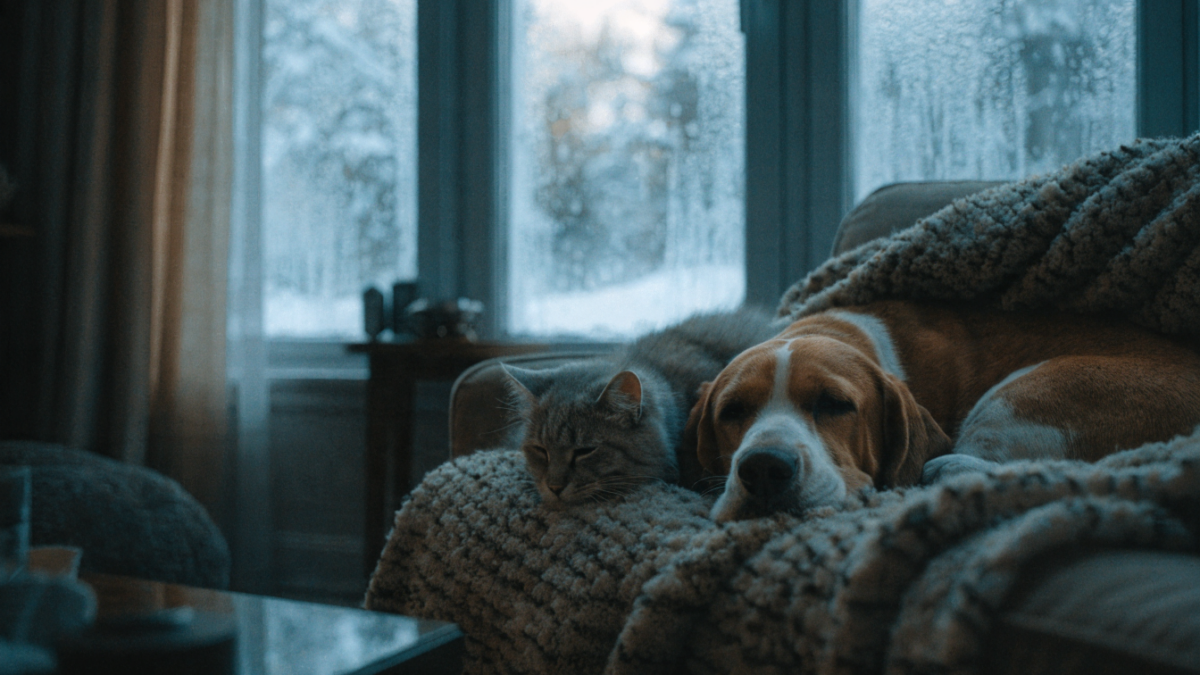
It’s 7:00 AM, the sky is the color of wet concrete, and my cat, Barnaby, is currently a perfectly round loaf of fur burrowed so deeply into his heated blanket that I’m honestly jealous. Meanwhile, my dog, Biscuit, is standing by the front door, looking out at the frost on the grass, and then looking back at me with an expression that clearly communicates, “Absolutely not.”
Every year, right around the time we turn the clocks back, the energy in my house drops by about fifty percent. And honestly? I get it. When it’s dark before dinner time, the urge to hibernate is strong. But as I watch my normally chaotic pets turn into literal couch potatoes, I always find myself wondering the same thing: do dogs and cats get the winter blues? Can they actually get Seasonal Affective Disorder, or SAD?
The short answer is that they definitely get into a winter slump. The longer answer involves a fascinating mix of biology, animal behavior, and our own tendency to project human emotions onto our pets. Let’s talk about what’s actually going on in those furry little heads when the temperature drops.
The Science of the Slump: Is It Really SAD?
Here is the most important thing to understand: right now, there is no formal veterinary diagnosis for Seasonal Affective Disorder in pets. If you take your dog to the vet and say, “I think he has SAD,” your vet won’t find a code for that in their medical charts. But just because there isn’t an official diagnosis doesn’t mean the behavioral shifts aren’t real.
Mammals—including the ones drooling on our sofas—are highly attuned to sunlight. Light exposure regulates our circadian rhythms, which act as our internal body clocks. When the days get shorter and darker in the winter, it messes with the chemical signals in the brain. Specifically, a lack of sunlight causes an increase in melatonin production (the hormone that makes us sleepy and sluggish) and a decrease in serotonin (the hormone that regulates mood and happiness). This exact biological mechanism is what causes SAD in humans, and since our pets share similar baseline brain chemistry, it’s entirely logical that they feel the physical effects of the dark months, too.
There is, however, a pretty healthy debate among animal behaviorists about how we interpret this. Some experts argue that we are heavily anthropomorphizing—meaning we are projecting human emotional complexities onto animals who might just be physically cold. From an evolutionary standpoint, conserving energy during the harsh, barren winter months is a smart survival tactic. Your dog might not be “depressed” in the human psychological sense; they might just be tapping into a deeply hardwired instinct to do as little as possible until the weather improves.
How the Winter Slump Shows Up
Because our pets can’t exactly tell us they’re feeling gloomy, we have to look for behavioral changes. And because I am an unapologetic cat person, I have to say: cats are particularly fascinating to watch during the winter. Cats are already famously enthusiastic about sleeping eighteen hours a day, so how do you know when they’ve crossed over from “normal feline” to “seasonal slump”? And how does it compare to our dogs?
Signs to Watch for in Dogs
Dogs are usually pretty obvious when their routines are disrupted. If your normally eager-to-please pup is experiencing the winter slump, you might notice:
- Reluctance to go outside: This isn’t just “I don’t like the rain.” This is a total refusal to engage with the outdoors, requiring heavy coercion just to do their business.
- Increased lethargy: Sleeping more than usual and showing a noticeable disinterest in their favorite toys or games.
- Changes in appetite: Just like humans who crave carbs when sad or cold, dogs might start begging for more food, their bodies prompting them to consume more calories to conserve energy.
- Withdrawal: Less interest in being petted, following you around, or engaging with the family.
Signs to Watch for in Cats
Cat logic is a universe of its own, and when the winter slump hits, their quirks often go into overdrive. Look out for:
- Grooming changes: Cats use grooming to self-soothe. A depressed or stressed cat might stop grooming entirely, leading to a dull or matted coat. Conversely, they might over-groom, licking themselves bald in spots due to anxiety.
- Vocalization shifts: If your typically quiet cat suddenly won’t stop yowling, or your chatty cat goes completely silent, it’s a sign something is off.
- Litter box avoidance: House-soiling is a massive red flag. Cats will often pee or poop outside the box when they are feeling environmentally stressed or overwhelmed.
- Hiding: Barnaby loves a good cardboard box, but if your social cat suddenly vanishes into the back of the closet for days on end, they are retreating from the world.
What You Can Actually Do About It
When the winter gloom hits, you can’t exactly hand your dog a cup of cocoa and tell them to journal their feelings. But you can make their environment a lot more tolerable. The goal here is to trick their brains into thinking things are normal, even when it’s freezing outside. (And while I’m happy to share how I manage this, always loop in your vet before making major changes to your pet’s routine).
Let There Be Light
Since the root of the slump is a lack of sunlight, the most logical fix is light therapy. Open all your curtains during the day to let in whatever natural light you can get. You can also look into full-spectrum light therapy boxes. These are the same SAD lamps used by humans, and many pet owners have found success by placing them in the rooms where their pets spend the most time. Just make sure the lamp is set up safely and high enough that your pet can’t accidentally burn their nose by staring directly into it.
Bust the Boredom
If your dog won’t go for long walks because the sidewalk is icy, or your cat is climbing the walls because they can’t stalk the birds at the bird feeder, you need to bring the entertainment indoors. Mental stimulation is incredibly effective at combating lethargy.
I rotate Barnaby’s toys so he doesn’t get bored of them, and we rely heavily on puzzle feeders. Snuffle mats, treat-dispensing balls, and indoor agility courses force their brains to work, which naturally boosts those feel-good hormones. For dogs, I highly recommend looking into scent-work games you can play right in your living room—Jake is the expert on canine behavior, so I’ll defer to his training methods, but making a dog use their nose is exhausting in the best way possible.
Hold the Routine Steady
Pets thrive on predictability. When the seasons change, our human schedules tend to get a little messy. We sleep in, we stay out later, we skip the evening walk because it’s too dark. But if you can hold your pet’s routine steady—feeding them at the exact same times, playing at the same times, waking up at the same time—it helps stabilize their circadian rhythm and signals to their bodies that everything is fine, despite the cold.
Rule Out the Sneaky Stuff
Before you write off your pet’s behavior as the winter blues, I cannot stress this enough: talk to your vet.
What looks incredibly like seasonal depression could actually be a hidden medical issue. For example, cold, damp weather makes arthritis flare up in both dogs and cats. If your older dog suddenly refuses to go for a walk or your cat stops jumping onto the couch, they might not be sad—they might be in physical pain. Lethargy and changes in appetite are also vague symptoms of everything from thyroid issues to kidney disease. Always rule out the medical before you treat the behavioral.
It’s also worth noting that the pet care industry has exploded with mood-boosting products lately—from pheromone diffusers to behavioral supplements. While there’s a time and a place for these (and for prescription anxiety medications, in severe year-round cases), environmental management, enrichment, and extra snuggles are usually the best first line of defense for a simple seasonal funk.
A Thought for the Wildlife Outside
While we’re busy turning up the thermostat and setting up full-spectrum lamps for Biscuit and Barnaby, it’s worth taking a moment to remember the animals outside. Domestic dogs and cats might experience a mild winter slump, but they are lucky enough to have central heating, an endless supply of kibble, and humans to complain to.
Wildlife doesn’t have that luxury. For wild animals, winter isn’t a “slump”—it’s a brutal, unforgiving fight for survival that requires every ounce of that biological instinct to conserve energy. While they are navigating the freezing temperatures and scarce food sources, the best thing we can do for them is leave them alone. Keep your dogs leashed on trails so they don’t chase already-stressed wintering wildlife, keep your cats safely indoors where they belong (both for their safety and the safety of local birds), and consider leaving your garden a little messy through the winter to provide shelter for local pollinators and small mammals.
So yes, your pets absolutely feel the winter. They get sluggish, they get moody, and they want to sleep in late. But with a little extra light, a few brain games, and a lot of patience, you can all make it to spring together—hopefully without anyone eating the couch cushions out of sheer boredom.