

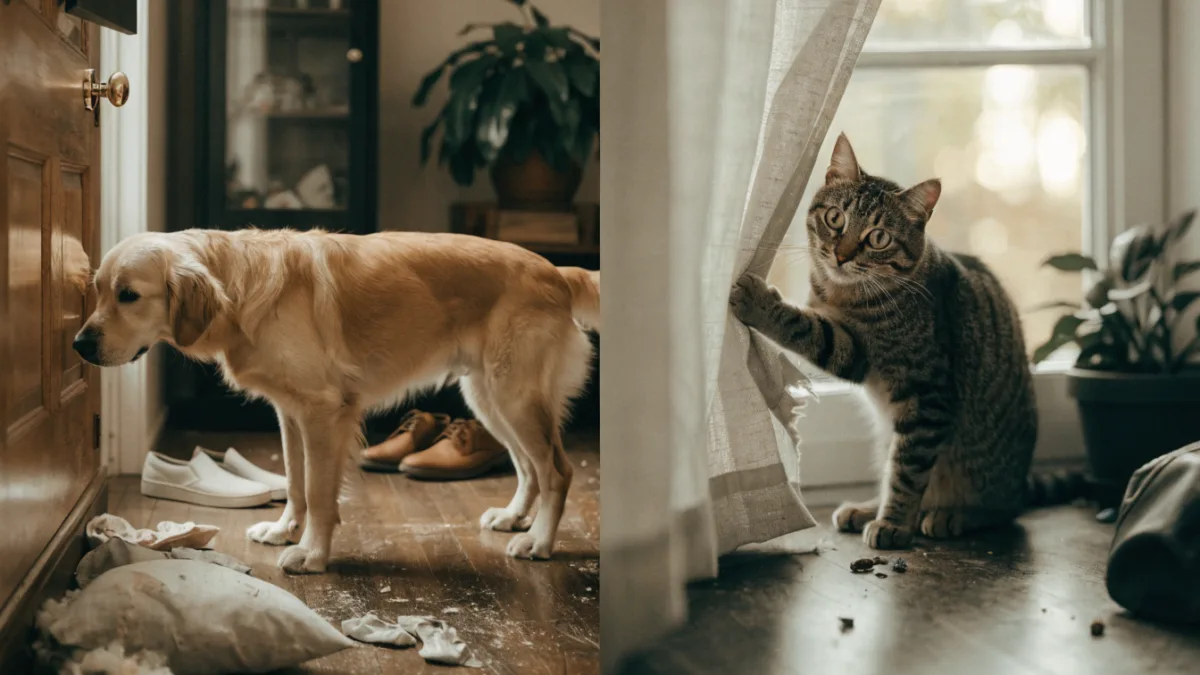
You come home, turn the key, and before the door even swings open, you hear it — the frantic scrabbling of nails on hardwood. You step inside and your living room looks like a crime scene. Couch cushions disemboweled. A shoe chewed open. Maybe a puddle near the back door that definitely wasn’t there when you left. Your first reaction? Probably frustration. Maybe even anger. But here’s what’s really going on: your pet is having the animal equivalent of a full-blown panic attack. And if you got your pet during the pandemic — when you were home 24/7 and they never had to learn how to be alone — you’re far from the only one dealing with this. Vets and behaviorists have been watching separation anxiety cases skyrocket ever since people started heading back to offices, classrooms, and normal life. The “homecoming panic” is real, and it cuts across species lines.
It Starts Faster Than You Think
Here’s something that surprised me the first time I saw it on video. Most pets don’t wait an hour to fall apart. Dogs and cats typically begin showing signs of distress within the first three to seven minutes of their person walking out the door. That’s it. You’re barely down the street and your dog is already pacing, panting, and whining — or your cat has already started pulling fur.
The reason it’s so fast comes down to one core issue: hyper-attachment. This isn’t about your pet being bored in the house. It’s not about them wanting revenge because you left. It’s about a specific, intense emotional bond that has tipped into unhealthy territory. Your pet has not learned that your absence is temporary and survivable. When you leave, their world cracks. Animal behaviorists compare it directly to a,[1] — the same racing heart, the same feeling of being trapped and terrified, the same loss of rational thinking. Nobody chooses to have a panic attack. Your pet isn’t choosing this either.
When Dogs Lose It: The Loud, Messy Panic
Dogs are usually the obvious ones. Their distress is loud, physical, and impossible to ignore. I remember working with a couple who had a rescued Labrador mix named Bess. Sweetest dog you’d ever meet when people were around. But every single morning when they left for work, Bess would throw herself at the front door — not just scratching it, but throwing her full body weight against it. They came home one Tuesday to find she’d actually cracked the door frame. Her gums were scraped raw. Their neighbors had started leaving passive-aggressive notes about the howling.
That’s classic canine separation anxiety. The symptoms typically include:
- Unrelenting vocalization — barking, howling, or whining that goes on for an hour or more. Not the alert bark when someone walks past. Sustained, panicked noise.
- Destructive chewing focused on exit points — doors, doorframes, window sills, blinds. The dog is literally trying to get to you.
- Pacing in fixed patterns — often the same loop, back and forth, for the entire duration of your absence.
- Attempts to escape confinement — cracking crate doors, digging under gates, pushing through screens.
- House soiling — a fully house-trained dog peeing or pooping inside, even though they’d never do it while you’re home.
That last one trips people up constantly. They think the dog is “punishing” them for leaving. I used to think that way too, early on. But here’s the reality: extreme stress triggers the digestive system. The dog isn’t choosing to pee on your rug. Their body is literally emptying because they’re terrified. It’s the same reason a person might get sick before public speaking.
Why Dogs Target Your Stuff
One detail that throws people: the dog that destroys a specific shoe, or tears up the bed where their owner sleeps. It’s not random. Dogs are scent-driven, and your personal items carry the strongest concentration of your smell. When they panic, they gravitate toward that scent — and in their frantic state, chewing becomes a self-soothing behavior. They’re not being spiteful. They’re trying to cope.
When Cats Lose It: The Quiet Panic
Now here’s where things get interesting — and where a lot of people, including some professionals, have historically gotten it wrong. For decades, the conventional wisdom was that cats are solitary, aloof creatures who don’t care whether you’re home. That belief led to a massive blind spot. [2] but it flies under the radar because feline distress looks different. A dog howling for two hours gets your neighbor’s attention. A cat silently over-grooming in a closet? Nobody notices until there’s a bald patch the size of a quarter behind her ear.
Cat separation anxiety tends to show up as:
- Excessive grooming to the point of hair loss — the cat licks and chews at their own fur until they create bald spots or even open sores. This is called psychogenic alopecia, and it’s a stress response, not a skin condition.
- Loud, persistent meowing — especially after you leave or near the door you exited. Some cats will yowl for extended periods.
- Litter box avoidance — urinating on your bed, your clothes, or near the door. Yes, this can also be a medical issue, so rule that out first. But stress-triggered inappropriate elimination in cats is common.
- Hiding and appetite changes — a normally social cat who starts vanishing under the bed, or a food-motivated cat who stops eating when you’re gone.
- Clingy behavior when you’re home — following you room to room, excessive purring, demanding constant contact.
I worked with a Siamese named Kevin — yes, Kevin — who started urinating on his owner’s pillow every single day after she went back to working in-office. The vet checked him out, ran tests, everything came back clean. Turns out Kevin had spent eighteen months with this woman home all day during lockdown. He’d never once been alone for more than a grocery run. When she suddenly disappeared for eight hours at a stretch, he completely unraveled.
The thing about cats is that their anxiety is quieter. A dog will announce their panic to the whole neighborhood. A cat will suffer in silence until the symptoms become impossible to ignore.
The Big Question: Anxiety or Just Boredom?
This is one of the most common debates I hear, and it matters because the answer changes everything about how you respond. Here’s the simplest way I know to tell the difference.
Boredom looks like a dog who finds the trash can interesting and digs through it. Maybe chews up a remote. Does this whether you’re in the shower or at the office. A bored pet will also destroy things when you’re home — they just need something to do. Hand them a puzzle feeder or take them for a walk, and the behavior disappears.
Separation anxiety looks like a dog who is perfectly behaved while you’re in the house — maybe even while you’re in the next room — but completely falls apart the moment you leave. The destruction, the soiling, the vocalizing — it all happens specifically when the attachment figure is absent. Puzzle toys don’t help because the dog is too panicked to eat.
That distinction is why simply giving your dog a Kong stuffed with peanut butter won’t fix true separation anxiety. The issue isn’t a lack of entertainment. It’s a lack of emotional regulation when you’re gone.
What Actually Helps
I’ll be straight with you: there’s no quick fix. I used to hand owners a list of training exercises and act like that was the whole answer. It took me years — and more than a few dogs I couldn’t help — to accept that real progress often requires a layered approach.
Desensitization Training
This is the foundation, and it’s exactly what it sounds like. You teach your pet that your leaving is no big deal by leaving for such a short time that they don’t panic — and you come back before the anxiety kicks in. That might mean stepping outside for thirty seconds. Then a minute. Then two. You build up slowly over days and weeks. The key — and I cannot stress this enough — is staying under the pet’s threshold. If they panic, you’ve gone too fast. Back up. Go slower.
Environmental Management
Set your pet up to succeed. That might mean a safe, comfortable confinement area. It might mean background noise — a TV or radio left on, which can help mask the sounds of your departure and the silence that follows. For dogs, a well-fitted, comfortable harness rather than a collar during training prevents injury if they try to escape. Never use a shock collar, prong collar, or any aversive tool for anxiety — you’re adding pain to an already panicked animal. That makes things worse, not better. Always.
Knowing When to Call the Vet
For severe cases, training alone isn’t enough. And that’s not a failure — it’s like telling someone with clinical depression to just go for more walks. Sometimes the brain needs medical support. [3] can lower the panic enough that learning becomes possible. I’ve seen dogs who were completely stuck make real progress once medication took the edge off — not sedated, just able to think clearly enough to engage with training.
One Thing to Remember
If you take nothing else from this, take this: your pet is not giving you a hard time. They’re having a hard time. The couch cushions, the howling, the pee on your pillow — none of it is personal. None of it is spite. It’s a creature you love trying to cope with a fear they don’t understand and can’t control. The fact that they care this much about your absence tells you something important about the bond between you. Now the job is helping them feel safe — even when you’re not standing right there.
Sources
- human panic attack — goodrx.com
- Separation anxiety in cats is absolutely real — foha.org
- Veterinary-prescribed anxiety medication — sandiaanimalclinic.com