

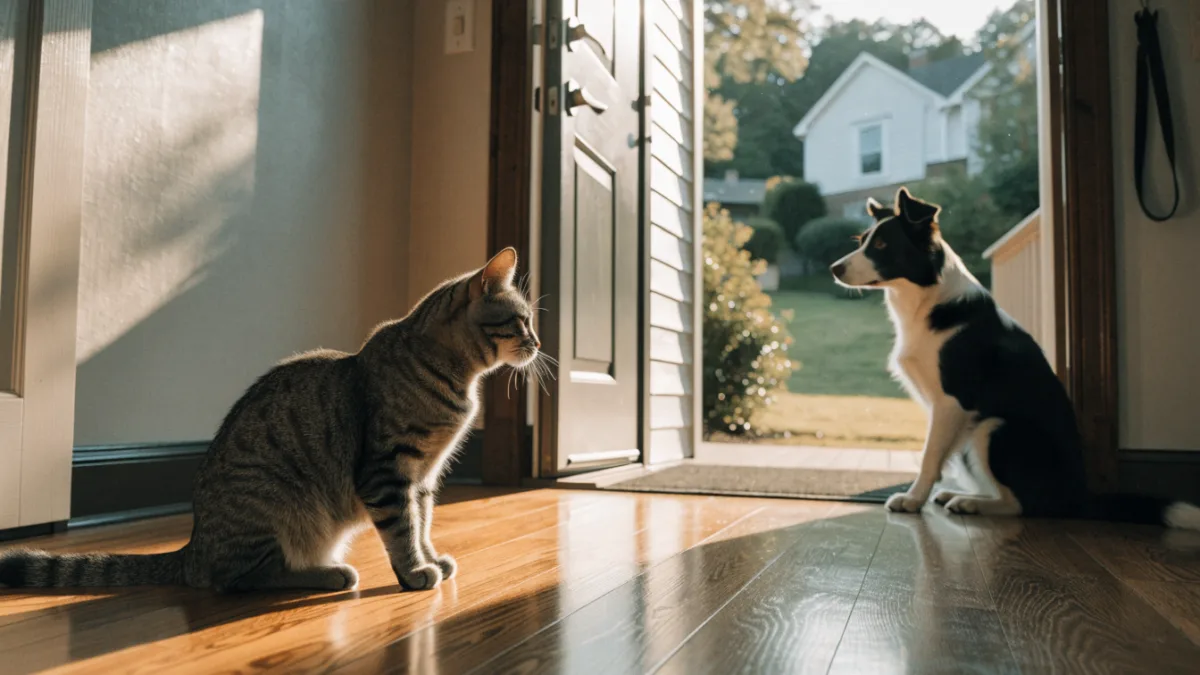
There’s a particular kind of panic that hits when you’re carrying groceries inside and you see a blur of fur shooting past your ankles. Whether it’s your dog making a break for freedom or your cat treating the front door like the starting gate at a racetrack, door dashers are no joke. I’ve worked with plenty of owners who’ve turned their entry routine into some kind of complicated dance — one person blocks the pet while the other slips inside, laundry gets dropped, leashes get tangled. It doesn’t have to be that way.
The good news is that both cats and dogs can learn to respect the doorway. The approach looks a little different for each species, but the underlying principle is the same: you’re not just blocking the exit, you’re teaching your pet that staying inside is actually the better option.
Why Cats Bolt — and How to Shift the Behavior
Let’s start with the feline door dashers, because they’re often the most misunderstood. People tend to assume a cat who runs for the door is desperate to get outside, and sometimes that’s true. But more often, the cat is reacting to the excitement of the moment — the sound, the movement, the shift in their territory’s boundary. For a cat who’s already a little understimulated or living with a dog they’d rather avoid, that open door is an opportunity for anything to happen.
Physical barriers work. I’m not going to tell you they don’t. A baby gate across the hallway or a closed door between your cat and the entryway will absolutely stop the dashing. But it’s a management tool, not a training solution. The moment the barrier comes down — maybe you have a guest over who doesn’t know the system, or you’re just tired and forget — the behavior returns because nothing has actually changed in the cat’s brain.
Building a “Go to Your Spot” Routine
What works better is teaching your cat that good things happen when the door opens, and those good things happen away from the door. Jackson Galaxy has talked about this, and the approach is solid: pick a designated spot — a cat tree, a shelf, a specific perch — and make it the most rewarding place in the house every time someone comes or goes.
Here’s how it looks in practice. You start with the door closed. Lure your cat to the spot, mark it with a click or a verbal “yes,” and give a high-value treat. Repeat. A lot. Once your cat is reliably going to the spot on cue, start adding the door element. Someone touches the doorknob — treat at the spot. Someone cracks the door — treat at the spot. The door opens fully — you guessed it, treat at the spot.
The goal is simple: your cat hears the door and their first instinct is to run to their perch, not away from it. You’re building an automatic response that doesn’t require you to think about it in the moment.
Training Your Dog to Respect the Boundary Line
Dogs are often easier to work with on this because they tend to be more overtly food-motivated and socially engaged with us, but the stakes can be higher. A dog who bolts out the door is a safety risk — traffic, other animals, getting lost. So this one matters.
The most effective approach I’ve used and seen recommended consistently is counterconditioning. That’s a fancy way of saying: teach your dog that an open door means treats happen, and those treats happen in a specific spot that isn’t the doorway.
The “Greeting Spot” Method
Instead of fighting your dog at the door every time, you create a designated greeting spot — a mat, a dog bed, a specific tile on the floor — somewhere outside the foyer area. This becomes the place your dog goes when the door opens.
The training progression looks like this:
- Start with your dog on leash. Have them sit at the greeting spot. Reward.
- Walk toward the door. If your dog stays, return and reward. If they break position, calmly reset them — no scolding, just try again.
- Gradually increase the difficulty: touch the doorknob, crack the door, open it wider, step outside briefly.
- Each successful stay at the spot earns a reward. Each escalation only happens when the previous step is solid.
I worked with a woman who had a young Vizsla — high energy, smart as a whip, and absolutely convinced the front door was his ticket to adventure. The first week, just getting him to hold a sit on his mat while she walked to the door took dozens of repetitions. By week three, he was holding his position while she stepped outside and came back in. The key was consistency and not rushing. Every time she let him “just this once” rush the door, it set the training back.
What Not to Do
Don’t use aversive tools for this. I know some trainers push shock collars or spray bottles for boundary training, but all that does is suppress the behavior through fear. Your dog isn’t learning to stay away from the door because they’ve decided it’s a good choice — they’re staying away because they’re scared. That’s not a reliable fix, and it damages the trust you need for everything else you’ll ever train.
Also, don’t make the mistake of only practicing when you’re actually leaving. If the only time you work on door manners is when you’re running late for work, you’re stressed, and your dog picks up on that energy. Set up practice sessions when nothing’s at stake.
When You’ve Got Both: Managing Multi-Pet Households
If you have cats and dogs under the same roof, door dashing gets more complicated. A cat who’s already on edge because the dog keeps invading their space is going to be more reactive to every environmental change — including the door opening. And a dog who’s cranked up because they spotted the cat is more likely to blow past you when the opportunity arises.
The research and behavior specialists are clear on this one: designated safe zones matter. Your cat needs areas where they can eat, use the litter box, and rest without a canine audience. That might mean installing a kitty door to a room the dog can’t access, or using baby gates the cat can navigate but the dog can’t.
When your cat has a secure retreat space, their overall baseline stress drops. And when their stress drops, they’re less likely to make a desperate run for the front door. It’s all connected. The door dashing isn’t happening in a vacuum — it’s often a symptom of an environment that doesn’t feel fully safe.
The Double Standard We Don’t Talk About
Here’s something that’s been shifting in recent years, and I think it’s worth saying out loud. We accept that dogs need supervised outdoor time — walks, hikes, backyard play. But when someone suggests leash-walking a cat or building a catio, a lot of people look at them like they’re overthinking it. That double standard is starting to crack, and honestly, it should.
Cats who have safe, supervised access to outdoor enrichment — whether that’s a catio, leash walks with a proper harness, or a fully enclosed outdoor run — are often less driven to door-dash. They’re getting their needs met through channels that don’t involve bolting into traffic. And for cats who genuinely seem driven to get outside no matter what you do, giving them a structured way to do that safely can be a game-changer.
I’m not saying every cat needs to go outside. Plenty of indoor-only cats live perfectly happy, fulfilled lives. But if you’re fighting a constant battle with a door-dashing cat, it’s worth asking whether they’re telling you something about what they need.
A Final Word — For the Birds
There’s one more reason this matters, and it goes beyond your pet’s safety. Free-roaming domestic cats are a massive threat to wildlife. We’re talking billions of birds and small mammals killed by outdoor cats every year. That’s not an exaggeration or a guilt trip — it’s the reality of what happens when a highly efficient predator has access to native wildlife populations that didn’t evolve to defend against them.
Training your cat to stay inside isn’t just about keeping them safe. It’s about protecting the ecosystem around your home. Every cat who learns to stay behind that closed door is one less predator in the local food web. And when you combine solid boundary training with enrichment that meets your cat’s needs indoors — or in a safely enclosed outdoor space — everyone wins. Your cat stays stimulated and secure. Your dog learns the door isn’t their business. And the birds outside your window get to keep doing what birds do.
That’s worth the training time. Every repetition, every treat, every moment you spend building a better routine at the door — it adds up. Start small, stay consistent, and don’t be afraid to go back a step if things get shaky. Your pets can learn this. You’ve just got to give them a reason to want to.