

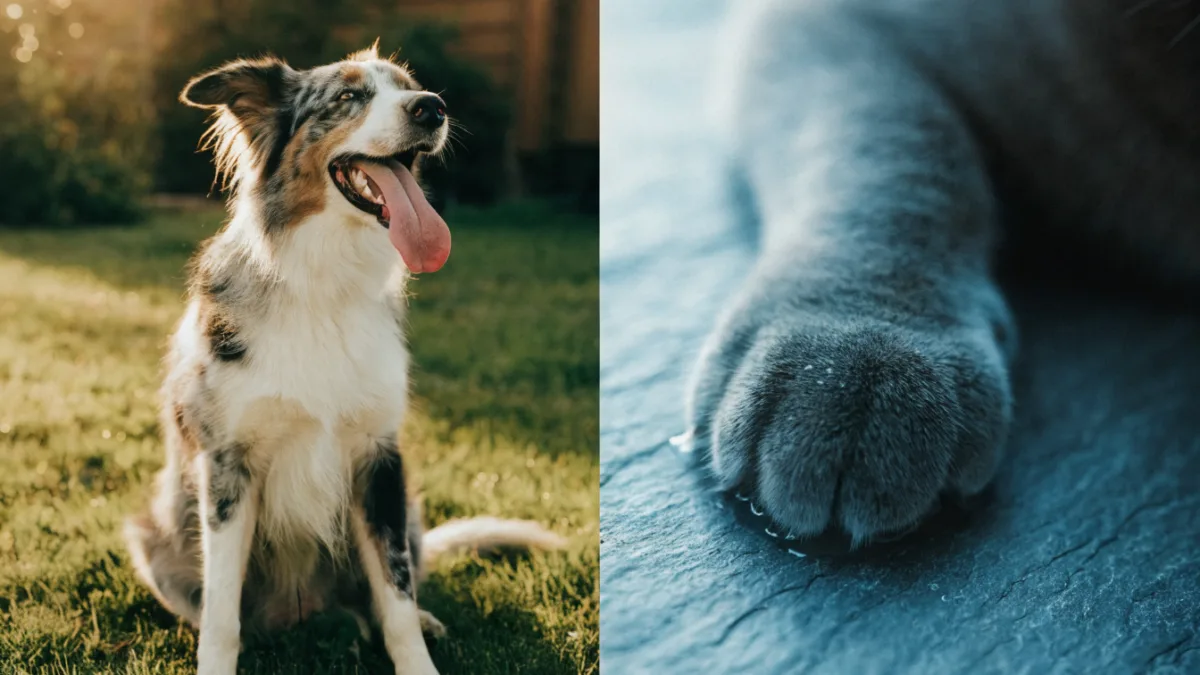
Last summer, a client named Margaret rushed her 11-year-old Maine Coon named Walter into the clinic on a 95-degree afternoon. Walter had been lying on the bathroom tile, mouth open, breathing rapidly with his tongue slightly out. “He’s panting like the neighbor’s Golden Retriever,” Margaret told me, clearly shaken. “I thought that’s just what animals do when it’s hot.” That assumption nearly cost Walter his life. While the neighbor’s Golden Retriever panting in the same heat would be completely normal physiology, Walter was in respiratory distress triggered by severe overheating. We cooled him down with IV fluids, oxygen therapy, and careful body temperature management, and he pulled through. But that afternoon reminded me how many loving pet owners don’t realize that dogs and cats tackle heat in fundamentally different ways. Understanding what I call the thermoregulation divide isn’t just interesting biology. It can genuinely save your pet’s life.
Three Mammals, Three Very Different Cooling Systems
Humans, dogs, and cats are all warm-blooded mammals, which means we all maintain a core body temperature regardless of what’s happening outside. But the mechanical systems we use to shed excess heat evolved quite differently, and those differences shape how we need to care for each species during hot weather.
Humans are the sweatiest mammals on the planet, and I mean that as a compliment. We have eccrine sweat glands distributed across most of our skin surface. When we get hot, those glands release water directly onto bare skin, and as that moisture evaporates, it pulls heat away from our bodies. It’s an remarkably efficient system, which is why humans can run marathons in conditions that would kill most other animals.
Dogs took a completely different evolutionary path. A dog’s primary cooling mechanism is respiratory evaporation. When a dog pants, rapid breathing moves air quickly across the moist surfaces of the tongue, nasal passages, and the lining of the lungs. As that moisture evaporates, it lowers body temperature. Dogs do have some sweat glands, but we’ll get to why those aren’t doing what most people think they’re doing.
Cats, meanwhile, occupy a middle ground that surprises most people. They do sweat, but primarily through their paw pads. And they supplement this with a clever behavioral adaptation: they groom themselves more frequently in hot weather, spreading thin layers of saliva across their fur. As that saliva evaporates, it functions much like human sweat does on bare skin.
Why Dogs Pant Instead of Sweating
I see dogs panting every single day in the exam room, and it’s almost always completely normal. A healthy dog at rest takes about 30 to 40 breaths per minute. When they start panting, that rate can jump to 300 to 400 shallow breaths per minute. That’s not the dog breathing deeply; it’s a very specific pattern where the dog takes rapid, shallow breaths that maximize airflow over moist tissues.
The evaporation that happens during panting works on the same physical principle as sweating. It just happens inside the respiratory tract instead of on the skin surface. Moisture from the tongue, the nasal lining, and the lung surfaces turns from liquid to gas, and that phase change absorbs heat. It’s actually quite effective for most dogs in most conditions.
Where panting runs into trouble is in extreme heat combined with high humidity. Evaporation slows dramatically when the air is already saturated with moisture, which is why humid heat is so much more dangerous for dogs than dry heat. A dog can pant all day in those conditions and still not cool down effectively. I saw this firsthand with a four-year-old French Bulldog named Pierre last August. His owner had taken him for what seemed like a reasonable 20-minute walk at noon. Brachycephalic, or flat-faced, breeds already struggle with airway efficiency, and Pierre went into heat exhaustion despite relatively modest exercise. Bulldogs, Pugs, Boxers, and other short-nosed breeds simply can’t move air across those respiratory surfaces as effectively as longer-nosed breeds.
What About Those Paw Pads?
Here’s where I have to correct a misconception I hear constantly. Clients regularly tell me they know dogs sweat through their paw pads. It’s such common wisdom that I used to repeat it myself early in my career. But the evidence doesn’t support it. Dogs do indeed have glands in their paw pads, but those glands are not wired for thermoregulation. They’re sebaceous-type glands that secrete pheromones, chemical signals used for scent marking and communication with other dogs.
When your dog leaves damp paw prints on a hot day, and they absolutely do, that moisture is more likely from environmental water or from the normal moisture that accumulates between paw pads. The glands themselves are releasing chemical messages, not sweat in the cooling sense. This is one of those areas where popular understanding diverged from the actual veterinary evidence, and I’ve changed how I explain it to clients over the years as the research became clearer.
The Feline Approach: Paws and Persistence
Cats evolved as desert-dwelling predators, and their thermoregulation strategy reflects that heritage. They’re remarkably heat-tolerant compared to dogs, often seeking out warm spots that would make a dog miserable. My own cat, a tabby named Poppy, will happily bake in a sunbeam on an 85-degree day while the dog collapses in front of the fan.
But cats do have functional sweat glands in their paw pads, and these are genuinely wired for cooling. When a cat gets warm, those glands release moisture onto the hairless pad surfaces. Because the paw pads are bare and in constant contact with the ground, evaporation from this area can actually reduce body temperature. You might notice tiny wet paw prints on a dark floor on a hot day. That’s thermoregulation in action.
Cats also have sweat glands distributed across the rest of their body, but here’s the catch: those glands sit beneath a dense fur coat. Fur traps air and creates an insulating layer, which is wonderful for retaining heat in cold weather but counterproductive for evaporative cooling. The sweat produced on furred areas simply can’t evaporate efficiently because it’s trapped against the skin by the coat. So cats adapted by adding that grooming behavior I mentioned. By spreading saliva across their fur with their rough tongues, they create an evaporative surface that works around the insulation problem. It’s essentially sweat on demand, applied externally.
I watched this behavior intensify in a patient named Luna, a domestic shorthair who belonged to a client without air conditioning during a week-long heatwave. Luna groomed almost continuously during the hottest afternoons, her coat taking on a slightly spiky, damp appearance. Her owner was concerned about overgrooming, but Luna’s behavior was actually an appropriate physiological response to environmental stress. Once we got her set up with a cool tiled area, multiple water sources, and a fan, the excessive grooming decreased significantly.
The Warning Signs Every Pet Owner Needs to Recognize
Understanding the thermoregulation divide isn’t just academic. It directly affects how you interpret your pet’s behavior, and misreading the signals can have serious consequences.
For dogs, panting is expected during exercise, excitement, and warm weather. What should concern you is panting that doesn’t slow down when the dog rests in a cool area, panting accompanied by dark red or purplish gums, excessive drooling, wobbliness, or vomiting. These can indicate heat exhaustion or heat stroke, which is a genuine medical emergency. Brachycephalic breeds, heavily coated breeds like Huskies and Malamutes, overweight dogs, and senior dogs are all at elevated risk and deserve extra caution in heat.
For cats, the stakes are different because panting is almost never normal. Unlike dogs, cats do not typically use respiratory evaporation as a cooling strategy. If you see a cat panting, assume something is seriously wrong. It usually indicates severe overheating, acute stress, cardiovascular problems, respiratory disease, or pain. I’d rather a client call me about a panting cat and have it turn out to be nothing than have them wait and watch assuming the cat will settle down. Feline panting warrants immediate veterinary attention, full stop.
Practical Cooling Strategies That Actually Work
For dogs, focus on supporting their natural panting mechanism. Provide constant access to fresh water, offer shade during outdoor time, avoid exercise during the hottest parts of the day, and consider cooling mats that draw heat away from the body. Avoid walking on pavement during peak heat; if the ground is too hot for your bare hand for five seconds, it’s too hot for paw pads. Never leave a dog in a parked car, even with windows cracked, as internal temperatures can reach lethal levels within minutes.
For cats, prioritize cool resting surfaces like tile or stone floors. Maintain comfortable indoor temperatures with fans or air circulation. Ensure multiple fresh water sources throughout the home, and consider a water fountain, as many cats prefer moving water. Brush your cat regularly to remove loose undercoat, which helps that saliva-based cooling work more effectively.
I always tell clients that any specific cooling strategy, especially supplements or new products marketed for heat relief, should be discussed with your veterinarian before use. What works safely for one animal may not be appropriate for another, particularly those with underlying health conditions.
The thermoregulation divide between dogs and cats is a beautiful example of how evolution solves the same problem, how to survive in a warming world, through entirely different mechanisms. Dogs bet on respiratory efficiency. Cats doubled down on behavioral adaptability and specialized paw sweating. Both strategies work beautifully under normal conditions. Where they break down is at the extremes, when temperatures exceed what these systems were designed to handle. That’s where we come in. As our climate warms and heat events become more frequent and severe, understanding how our pets actually cool themselves, not how we assume they do, becomes increasingly critical. The better we understand the biology, the better we can protect the animals who depend on us completely. Your dog’s panting is a feature, not a bug. Your cat’s panting is a red flag. Knowing the difference might be the most important piece of pet health knowledge you carry into the next heatwave.