

Last August, a client named Marcus rushed his three-year-old French Bulldog, Otto, into the clinic after a short afternoon walk turned scary. The pavement had been hot, the air thick with humidity, and within ten minutes Otto had gone from his usual bouncy self to staggering, with thick ropes of drool hanging from his jowls. Marcus had done what most loving owners would do: he’d grabbed a bag of frozen peas from the freezer and pressed them against Otto’s body, then tried to get him to lap up a bowl of ice water. Otto’s gums were brick-red, his breathing was labored, and his core temperature read 41.2°C (106.2°F). We got him cooled down safely, but the visit sparked a conversation I’ve been having with clients ever since — one that goes well beyond the viral debates about whether ice cubes are secretly dangerous.
How Dogs Actually Release Heat (And Why It’s Different From Us)
Before we talk about cooling strategies, it helps to understand what’s happening inside your dog’s body when the mercury rises. Humans are covered in sweat glands — roughly two to four million of them — and when we overheat, evaporation does most of the heavy lifting. Dogs have a completely different system, and understanding it changes everything about how you should help them on a hot day.
Dogs release heat primarily through panting. When a dog pants, rapid breathing moves air over the moist surfaces of the tongue, lungs, and throat, and that evaporation pulls heat away from the body. They also rely on vasodilation — a widening of blood vessels — particularly around the face and ears. If you’ve ever noticed your dog’s ears feel hot and look flushed after exercise, that’s vasodilation in action: the body is pushing warm blood to the surface so it can radiate outward.
Here’s what many people don’t realize: dogs do have sweat glands, but only on their paw pads and a few other localized areas. Those pads matter far more than most owners think, and we’ll come back to them.
The Ice Cube Debate: What Science Actually Says
Every summer, social media lights up with warnings that giving dogs ice water causes dangerous bloating, stomach spasms, or even death. Let me clear this up: there is no credible scientific evidence that offering your dog ice cubes or cool water to drink causes gastric torsion (bloat) in otherwise healthy dogs. Bloat — technically called gastric dilatation-volvulus — is a serious condition most common in deep-chested breeds like Great Danes and Standard Poodles, and it’s linked to factors like eating too quickly, exercising after meals, and genetics. Ice cubes aren’t the villain here.
But the real question isn’t whether ice is dangerous to eat — it’s whether extreme cold is actually the most effective way to cool an overheated dog. And that’s where the science gets genuinely interesting.
The goal isn’t to make your dog cold. It’s to bring their core temperature down to a safe range as efficiently as possible without triggering the body’s defenses.
When Cold Backfires
Here’s what I learned in veterinary school and saw confirmed in practice: applying ice-cold water to a dog’s skin can trigger peripheral vasoconstriction — a narrowing of the blood vessels near the skin’s surface. It’s the same reason your fingers go pale when you hold an ice pack. When those vessels constrict, blood gets shunted away from the skin and back toward the core, which actually traps heat inside the body instead of releasing it. Additionally, extreme cold can cause shivering, and shivering generates heat through muscle activity — the opposite of what you want.
This is why, for years, the standard advice was to use cool — not cold — water for external cooling.
The Twist: When Extreme Cold Actually Works
I’ll be honest: I’ve changed my thinking on this based on newer research. A study on exercising dogs demonstrated that cold-water immersion at temperatures as low as 0.5°C (32.9°F) safely and rapidly cooled them without adverse effects. The key distinction here is context. For a dog who has been exercising vigorously in hot conditions — a working Labrador retrieving in summer heat, a agility competitor finishing a run — cold-water immersion can pull core temperature down fast and effectively. The body doesn’t have time to mount a vasoconstrictive response when the cooling period is brief and targeted.
However — and this is a significant however — if you’re dealing with a dog showing clinical signs of heatstroke (collapse, vomiting, bright red or blue-tinged gums, loss of coordination), the priority is getting them to a veterinary clinic immediately while beginning cooling en route. This is an emergency, and “wait and see” can be fatal.
Targeted Cooling: The Three Areas That Matter Most
Recent veterinary research, including work highlighted by the,[1] and the [2] has shifted toward a more surgical approach to cooling. Instead of haphazardly pouring water over the whole body, focus on three high-impact areas.
1. The Head and Neck
This might be the most underutilized cooling technique in the average dog owner’s toolkit. Dunking your dog’s head into a shallow basin of cool water, or draping a soaked towel over the head and neck, works because major blood vessels supplying the brain run close to the surface in this area. When you cool the blood near the brain and the carotid arteries, you’re lowering the temperature of blood traveling to the hypothalamus — the brain’s thermostat. This can bring core temperature down quickly and is considered one of the most effective field cooling methods available.
I remember explaining this to a client last summer — she had a Golden Retriever named Daisy who loved to overdo it at the dog park. “So you’re telling me to basically give her a head bath?” she asked. Exactly. A few inches of cool water in a wide bowl, gently guide the muzzle in for a few seconds at a time, and keep a wet towel around the neck. It’s simple, it’s fast, and it targets the anatomy that matters.
2. The Paw Pads
Those paw pads aren’t just for traction. They’re one of the few areas where dogs can effectively exchange heat with their environment. Applying isopropyl alcohol (the standard rubbing alcohol you’ll find at any pharmacy) directly to the paw pads leverages evaporative cooling — alcohol evaporates much faster than water, pulling heat away from the tissue rapidly.
Use a cotton pad or cloth to apply it, don’t let your dog lick it, and don’t use it on broken or irritated skin. This is a technique that works beautifully as part of a multi-pronged cooling approach.
3. Full Body Immersion (When Appropriate)
If you have access to a tub, a lake, or even a kiddie pool, full-body immersion in cool water remains one of the fastest ways to reduce core temperature. For post-exercise overheating in an otherwise stable dog, this is gold standard. For a dog in heatstroke crisis, start cooling and get to a vet simultaneously.
Hydration: Necessary but Not Sufficient
One common misconception I hear in the exam room is that keeping a dog well-hydrated will prevent heatstroke on its own. Clean, fresh water is absolutely essential — I always recommend having multiple water sources available during hot weather and bringing water on every walk. But hydration alone won’t save a dog whose body can’t release heat fast enough. A dog can be fully hydrated and still develop life-threatening hyperthermia if the environmental conditions overwhelm their ability to pant and vasodilate.
Think of it this way: hydration keeps the system running, but external cooling is what prevents the engine from overheating.
Cooling From the Inside Out: DIY Frozen Treats
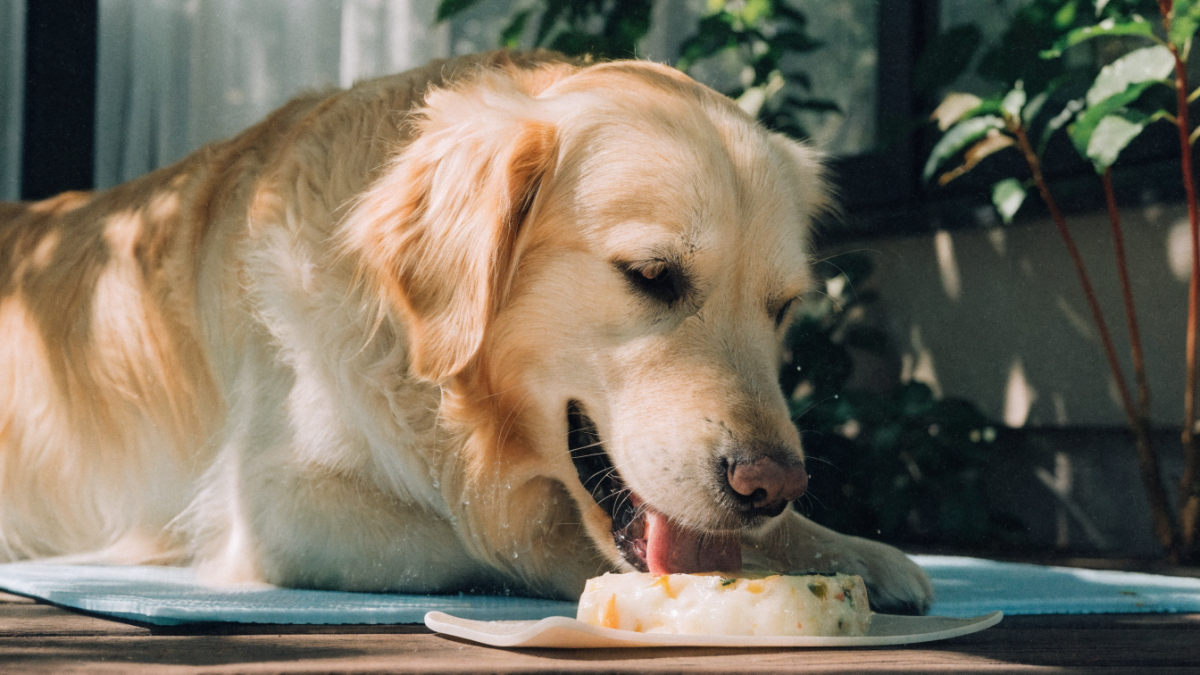
While frozen treats won’t rescue a dog from heatstroke, they’re a wonderful way to help your pup stay comfortable during a heatwave — and they’re far better than handing over a bowl of plain ice cubes, which most dogs crunch and swallow without much thermal benefit.
Here are three simple recipes I recommend to clients regularly. None of these require precise measurements, and you probably have the ingredients already.
Frozen Broth Pupsicles
Pour low-sodium, onion-free bone broth (check the label carefully — onion and garlic are toxic to dogs) into ice cube trays or a silicone mold. For an extra cooling boost, drop a small piece of carrot or blueberry into each compartment before freezing. These provide hydration, a mild thermal cooling effect as they melt, and mental enrichment as your dog works to lick them down.
Watermelon-Mint Bites
Seedless watermelon is about 92% water and naturally rich in electrolytes. Puree chunks with a tiny sprig of fresh mint — which has a naturally cooling sensation — and freeze in small portions. A client of mine makes these for her Border Collie mix every June and told me last year, “He waits by the freezer at noon now. I’ve created a monster.”
Frozen Yogurt Berry Cups
Mix plain, unsweetened yogurt (look for live cultures and no artificial sweeteners — xylitol is extremely toxic to dogs) with a handful of mashed blueberries. Spoon into muffin liners, freeze, and serve outside on a hot afternoon. The probiotics are a bonus for digestive health.
Always introduce new foods gradually and in small quantities, especially if your dog has a sensitive stomach or food allergies. If you’re unsure whether an ingredient is appropriate for your dog’s specific health situation, check with your veterinarian first.
Recognizing the Signs: When Cooling Isn’t Enough
No article on heat safety would be complete without this critical reminder. Know the warning signs of heatstroke:
- Excessive, thick, rope-like drooling
- Bright red, dark red, or pale/blue-tinged gums
- Rapid or labored breathing that doesn’t slow after rest
- Staggering, weakness, or collapse
- Vomiting or diarrhea (sometimes with blood)
- Confusion or unresponsiveness
If you see these signs, begin cooling with the techniques above and head to the nearest veterinary emergency facility immediately. Do not wait to see if your dog improves on their own. Heatstroke causes organ damage that can progress for hours after the body temperature normalizes, so professional monitoring is essential even if your dog seems to recover.
Working With Your Dog’s Biology, Not Against It
The most important shift I want owners to make is this: stop thinking about cooling your dog the way you’d cool yourself. You’re not dealing with a sweaty human who benefits from an ice pack on the back of the neck. You’re working with an animal who relies on panting, facial vasodilation, and those remarkable paw pads to manage internal temperature. When you target those specific biological mechanisms — cool the head to reach the brain’s thermostat, apply alcohol to the pads for rapid evaporation, use full immersion when the situation calls for it — you’re working with your dog’s physiology instead of against it.
And here’s the takeaway I find myself repeating every summer: the dogs most vulnerable to heat — Brachycephalic breeds like Pugs, French Bulldogs, and Boston Terriers; seniors; overweight dogs; and those with heart or respiratory disease — need you to be proactive, not reactive. Plan walks for early morning or late evening. Feel the pavement with the back of your hand before heading out — if you can’t hold it there for five seconds, it’s too hot for paws. Provide shade, provide water, and know the cooling techniques before you need them.
Understanding how your dog’s body actually works is the most powerful tool you have. Not ice. Not panic. Just science, applied with love, at the moment it matters most.
Sources
- AKC Canine Health Foundation — akcchf.org
- Royal Veterinary College — rvc.ac.uk