

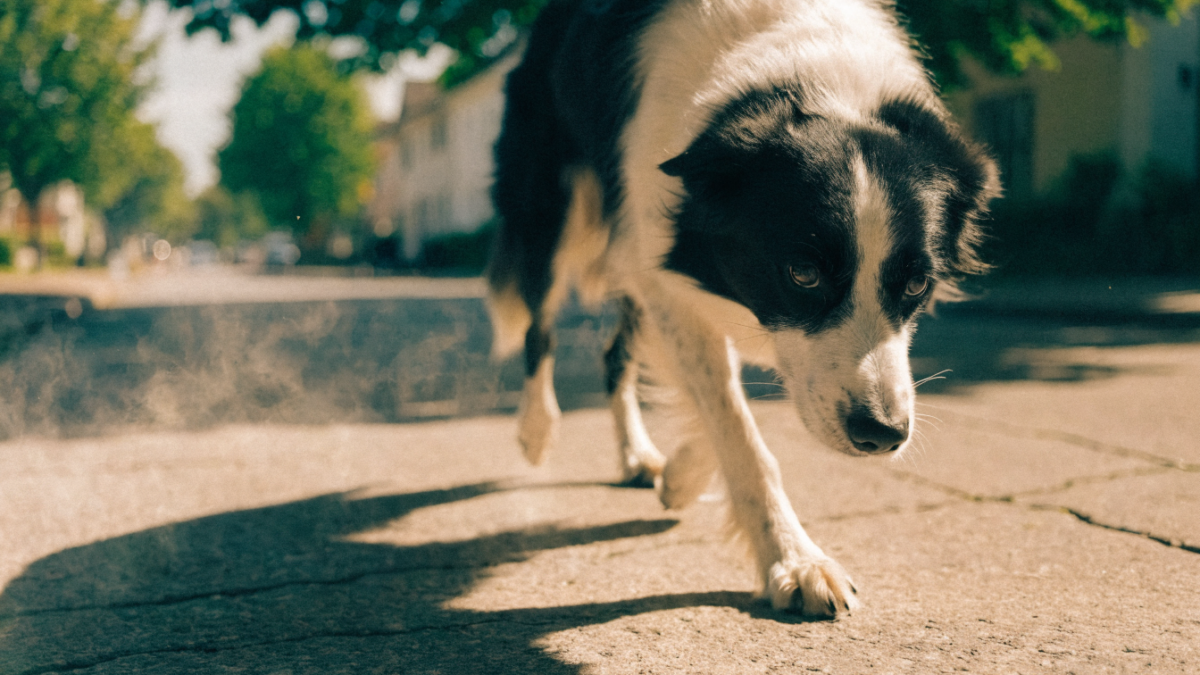
Last July, a family brought their three-year-old French Bulldog, Margot, into the clinic on a Tuesday evening. Margot’s paw pads were raw and blistered, and she was limping so badly she refused to put any weight on her front legs. Her owner, Derek, was devastated. He had only walked her for ten minutes around the block at 4 PM because “it didn’t feel that hot.” But here’s the thing that catches so many loving dog owners off guard: the air temperature told him nothing about what was happening at Margot’s feet.
Summer heat is one of the most underestimated dangers for dogs, and clinics see the consequences every single year. We tend to think about hot pavement as an afterthought — something we handle with booties or paw balm after the fact. But the real solution isn’t reactive. It’s about redesigning your entire approach to summer walks before the heat ever becomes a problem.
The Ground Temperature Illusion
Here’s a fact that still surprises many owners: when the air temperature is a pleasant 77°F (25°C), asphalt pavement can reach a blistering 125°F (52°C). Bump that air temperature up to 86°F (30°C), and the asphalt under your dog’s paws can hit.[1] At those temperatures, paw pad tissue damage and severe burns can occur in just 60 seconds.
Concrete isn’t much better. At around 87°F (30.5°C) air temperature, concrete surfaces can reach 125°F. Even sand at the beach becomes a hidden hazard, reflecting and holding heat long after the sun peaks.
The reason this matters goes beyond just burned paws..[2] You sweat across your entire body surface to shed heat. Your dog can’t do that. They cool themselves primarily through panting, with only a tiny amount of heat loss occurring through sweat glands in their paw pads. When Margot walked across that hot asphalt, she wasn’t just burning her feet — she was absorbing radiant heat from the ground into her body, pushing her core temperature dangerously higher and increasing her risk of heatstroke with every step.
The 7-Second Rule: Your Proactive Heat Test
For years, the canine community relied on what we called the “5-second rule.” Press your hand to the pavement, count to five, and if you can hold it comfortably, it’s safe for your dog. But many veterinarians and animal welfare organizations have shifted toward a more conservative 7-second rule, and I’ll admit — I’ve changed my recommendation on this over the years as the research and clinical evidence evolved.
Those extra two seconds provide a wider margin of safety that accounts for dogs with more sensitive paws. Puppies whose pads haven’t fully calloused, senior dogs with thinner skin, and small breeds closer to the ground all need that buffer.
How to Do It Properly
Here’s where I see people get it wrong. Use the back of your hand, not your palm. The skin on the back of your hand is thinner and more sensitive, which gives you a more accurate read. Press it firmly against whatever surface your dog will be walking on — asphalt, concrete, brick, whatever it is. Start counting. If you cannot comfortably hold it there for a full seven seconds, it’s too hot. Full stop.
And test multiple surfaces along your route. The shaded section of sidewalk might be fine, but the sun-baked stretch around the corner could be forty degrees hotter. I had a client last summer, a woman named Priya with a lively Border Collie named Jasper, who tested the pavement outside her apartment at 7 AM and assumed the whole trail was safe. Jasper ended up with mild burns on his hind paws where the path curved into direct sunlight for a stretch she hadn’t checked.
Reading the Subtle Signs of Paw Discomfort
Dogs are remarkably stoic creatures, and many will push through genuine pain because they want to please you and keep moving. By the time Derek noticed Margot limping, significant damage was already done. Your job is to catch the signals before it reaches that point.
Watch for these subtle indicators during and after walks:
- The “paw dance” — lifting paws alternately while standing or walking, shifting weight from foot to foot
- Sudden stops — refusing to move forward, sitting down in the middle of the path, or pulling toward grass
- Limping or an uneven gait that wasn’t present at the start of the walk
- Excessive licking or chewing at the feet after returning home
- Dark, discolored, or raw patches on the pads, or pads that look shiny and smooth rather than their usual texture
- Missing chunks of pad or visible blisters — this indicates a severe burn requiring immediate veterinary care
If you notice any of these, pick your dog up if you can, carry them to grass or a cool surface, and get them home. Check their pads carefully. Any visible blistering, rawness, or peeling warrants a vet visit — paw pad burns can become infected quickly and often require pain management and bandaging to heal properly.
Redesigning Your Summer Walking Routine
This is where we move beyond temporary fixes and into real prevention. The goal isn’t to protect your dog’s paws from hot pavement — it’s to avoid hot pavement entirely.
Timing Is Everything
Shift your walks to early morning, ideally before 8 AM, or late evening after the sun has fully set. And I mean fully set. Pavement holds heat for hours after the air starts cooling. That 7 PM walk might feel comfortable to you in shorts and a t-shirt, but the asphalt has been baking all day and needs time to release that stored heat. During extreme heatwaves, skip the walk altogether and find other ways to meet your dog’s needs.
Choose Your Surfaces Wisely
Seek out grass, dirt trails, and wooded paths with heavy canopy cover. Avoid asphalt, concrete, and especially artificial turf. Those synthetic grass surfaces have become increasingly popular in yards and public spaces, and they are genuinely dangerous in summer. Made from plastic and infilled with rubber crumb, artificial turf can reach temperatures up to 50 degrees hotter than natural grass. I’ve seen instant contact burns from that material, and I now specifically warn clients to keep their dogs off it during warm weather.
Be mindful of sand, too. Beach walks feel refreshing with the breeze, but dry sand in direct sun can cause burns quickly. Stick to wet sand near the water’s edge, and test it with your hand first.
Let Technology Help
Many weather apps now include pet-specific heat warnings or ground temperature indices alongside the daily forecast. Use these tools proactively. Checking the forecast the night before lets you plan around dangerous conditions rather than discovering them mid-walk.
When It’s Simply Too Hot: Alternative Exercise
Here’s something I tell every client who feels guilty about skipping walks during a heatwave: mental stimulation tires a dog out just as effectively as physical exercise. A fifteen-minute scent-work session in your living room can leave your dog as satisfied as a forty-minute neighborhood walk.
Some alternatives I recommend during extreme heat:
- Scent games — hide treats around the house or scatter kibble in a grassy area of your yard for your dog to sniff out
- Frozen puzzle toys — stuff a Kong-style toy with wet food or plain yogurt and freeze it solid. It provides twenty-plus minutes of engaged, cooling enrichment
- Indoor obstacle courses — use cushions, chairs, and blankets to create a simple agility course
- Short training sessions — teaching a new trick in five-minute bursts throughout the day provides excellent mental exercise
- Swimming — if you have access to a safe, clean body of water or a dog-friendly pool, swimming is excellent low-impact exercise that keeps your dog cool
The Bootie Debate: Protection or Trap?
I want to address this directly because I see conflicting advice online. Dog booties absolutely protect paw pads from surface burns — that’s not in dispute. But there’s a legitimate concern many owners don’t consider.
Remember how I mentioned that dogs release a small amount of body heat through sweat glands in their paw pads? When you encase those pads in rubber, neoprene, or fabric boots, you’re trapping that heat inside. During high temperatures, when your dog is already working hard to stay cool, booties can actually hasten overheating. The consensus among many veterinary behaviorists and sports medicine specialists is straightforward: if it’s hot enough outside that your dog needs boots to walk safely, it’s simply too hot to walk. Save the boots for brief necessities like crossing a hot parking lot on the way to an air-conditioned car, not for exercise.
Paw balms and waxes have a role too, but as maintenance products that keep pads supple and healthy — not as heat shields. A thin layer of balm won’t protect against 135°F asphalt, and believing it will gives a false sense of security.
Climate change means record-breaking summers are becoming our new normal, and veterinary emergency clinics worldwide are seeing a corresponding spike in both severe paw pad burns and canine heatstroke cases. The dogs in our care depend entirely on us to make smart decisions about when and how they exercise. So this summer, before you clip on the leash, press the back of your hand to the ground and count to seven. If you can’t hold it, neither should they. Redesign the routine, embrace the alternatives, and remember that a restless dog is infinitely easier to manage than a hospitalized one. Margot recovered fully after two weeks of bandage changes and cage rest, but Derek now sets a 6 AM alarm all summer long. Sometimes the best treatment is simply showing up earlier.
Sources
- 135°F (57°C) — lordsandlabradors.co.uk
- Dogs don't thermoregulate like we do — wqad.com