

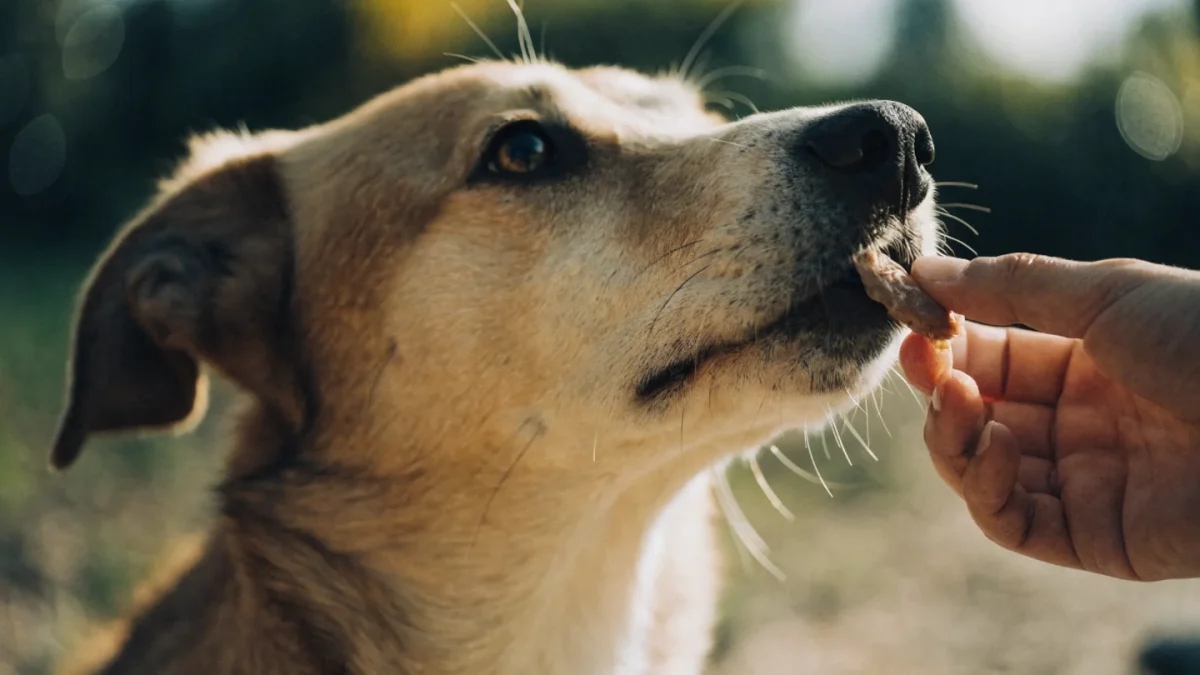
Most people think about clicks and treats as a pair — click, then treat, done. The treat delivery is the afterthought.
But where and how you deliver the treat actually continues to communicate information to the dog after the click. Done sloppily, it undermines the precision the marker was trying to create.
Why Delivery Speed Matters
The click creates a precise time stamp: "that moment was correct." But if it takes you three seconds to fumble the treat out of your pocket, you've got a problem. The dog is no longer in the exact position they were in when they were clicked. They've looked away, shifted, moved their feet.
You're delivering the treat to a different behavior than the one you clicked.
Keep treats accessible — in an open treat pouch, your pocket with the flap open, or in your closed hand before the session starts. The treat should follow the click by one second or less.
Where You Deliver the Treat Shapes the Dog
This one surprises people. The delivery position communicates where the dog's head should be.
Delivering to the dog's nose in their current position: Reinforces staying in that position. Good for stays and stationary behaviors.
Delivering to your left hip: Reinforces the dog moving to heel position. Used to build the heel behavior — every treat reinforces the dog moving to that exact spot.
Throwing the treat away from you: Reinforces the dog moving away from you. Used intentionally in some training to reset the dog's position and create a fresh approach.
Delivering high (above nose level): Makes the dog lift their head and rock back — can inadvertently strengthen a sit.
Delivering low (to the ground): Makes the dog move toward the ground — accidentally reinforces movement toward a down.
This is subtler for simple behaviors where delivery position doesn't matter much. It becomes very important in agility, heel work, position work, and any behavior where precise body mechanics matter.
Treat Selection Matters Too
The treat should be:
- Small enough to eat in one or two seconds (no chewing required)
- High-value enough for the context (challenging environments need better treats)
- Soft enough to eat fast (hard treats slow delivery and create crunching sounds that can interfere with marker clarity)
Carry multiple value tiers: lower value for easy context and known behaviors, higher value for new behaviors, challenging environments, or especially good performance. (See also: dog training tools and equipment.)
The Treat Pouch
A treat pouch is a small bag that clips to your waistband with quick-access opening. They dramatically reduce delivery time compared to pockets. Worth investing in for regular training — the difference in your timing is immediately noticeable.
See timing in dog training for the broader picture of why every fraction of a second in your training mechanics matters.