

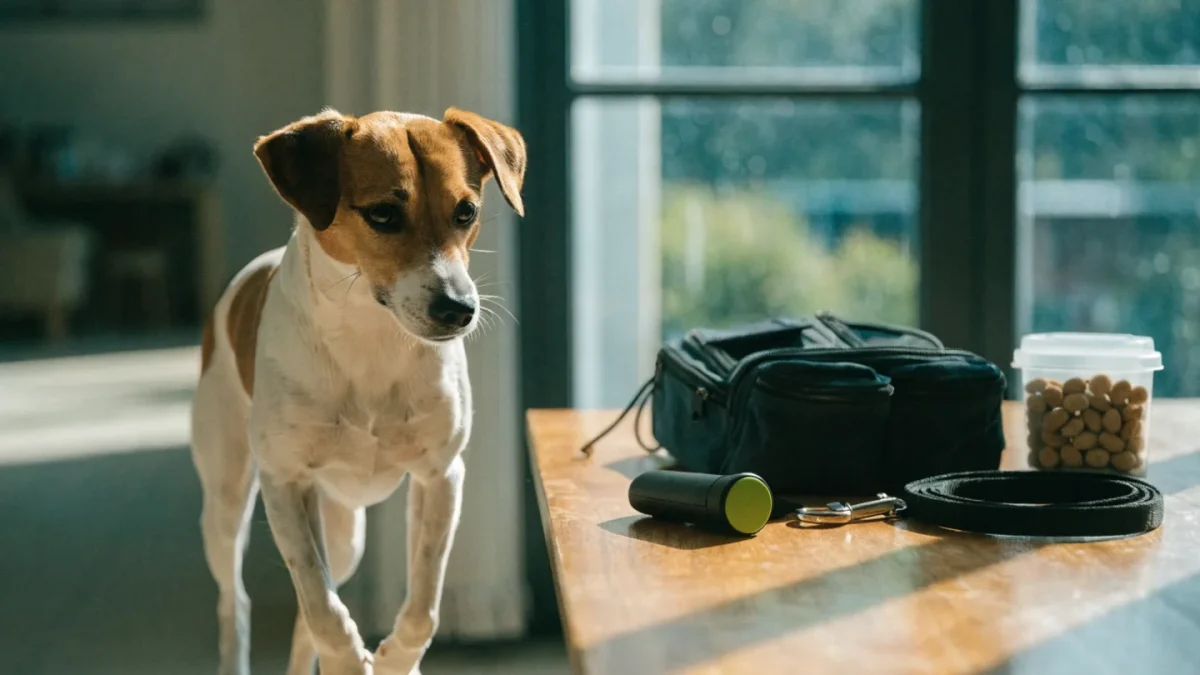
Every few months a new training tool gets marketed as revolutionary. I've seen enough of them come and go to have a fairly pragmatic view: most of what matters in dog training happens in your timing, your consistency, and your relationship with your dog — not in your gear.
That said, the right tools do help. Here's what I actually recommend and why.
The Core Kit (What You Actually Need)
Treat pouch. This matters more than people think. Having treats immediately accessible — not fishing through pockets, not fumbling with a bag — means your reward timing is faster. Timing is where training happens. A basic clip-on pouch that holds treats loosely (easy to get one out quickly) beats an elaborate system every time.
Flat leash, 4-6 feet. Standard, clip-on, appropriate weight for your dog. Nothing elaborate. For loose-leash training, a regular flat leash is the training tool — not a gadget that corrects the pulling for you.
High-value treats. This isn't equipment, but it's where most people underinvest. Small, soft, smelly, and something your dog genuinely finds exciting — not kibble. Treats are your training currency. Low-value currency means the job takes longer.
A marker. Either a clicker or a consistent verbal marker ("yes" said the same way every time). The marker tells your dog precisely which behavior earned the reward. Without a consistent marker, you're hoping the dog figures out what they did right. With one, you're communicating it precisely.
That's it. Those four things cover 90% of what most dogs need to learn.
Next-Level Useful
Long line (15-30 feet). Essential for recall training and outdoor proofing. Allows you to practice in higher-distraction environments while maintaining safety. Not the same as an extending leash — a fixed-length rope or biothane lead.
Back-clip harness. For dogs that pull hard on leash, a back-clip harness reduces neck strain during the process of training loose-leash walking. Not a training tool (doesn't teach the dog anything), but a management tool that makes the training period safer and more comfortable.
Front-clip harness. For dogs that pull very hard, a front-clip harness redirects pulling into a turn toward you, which is mildly self-interrupting. Again, not a training solution on its own — it assists while the actual training happens.
I cover this in more depth in my piece on positive reinforcement dog training.
Target stick. Useful for precision behaviors — touching a specific spot, guiding movement without luring. Not essential for basic training, but genuinely helpful for certain applications.
Mat or platform. A specific mat or raised platform gives the dog a clear "place to be." Essential for place training, which is one of the most practical behaviors a household dog can learn.
What's Not on the List
Extending leashes. These teach dogs to pull in order to get more leash, and remove the handler's ability to respond quickly in a situation. I actively recommend against them for training.
Aversive tools. Shock collars, prong collars, and similar tools are outside the scope of what I recommend — and they're not tools I carry or use.
Most specialized "training collars" marketed at pet stores. The marketing often exceeds the utility. A flat collar and a treat pouch outperform most of them.
Equipment Doesn't Train Your Dog
The most honest thing I can say about training equipment is that it supports training — it doesn't replace it. A dog who pulls on every leash you try isn't a gear problem; it's a training problem. The right equipment helps the training work better and more safely, but there's no piece of gear that substitutes for consistent, patient, well-timed training.
Buy the basics, use them well, and skip the rest until you have a specific need for something more specialized.
FAQ
What's the difference between a clicker and a verbal marker?
Mechanically, nothing major — both are consistent, immediate signals that tell the dog they got it right. Clickers are consistent in tone (you produce the same sound every time), while verbal markers can accidentally vary in pitch and emphasis depending on your emotional state. Either works; the key is consistency. Use whichever you'll actually have available when you need it.
Do I need special training treats, or can I use my dog's food?
You can use regular food for training — it's actually a good foundation because it doesn't add extra calories. But most dogs work significantly harder for high-value treats than for their regular kibble. For challenging behaviors, new environments, or high-distraction situations, high-value treats tip the balance in your favor.
Is a head halter cruel?
Head halters (also called head collars) can cause discomfort if the dog pulls hard against them, and require careful introduction so the dog accepts wearing them. Used correctly with a proper fitting and a gradual introduction, they're an appropriate management tool for dogs that pull strongly. They're not punishment tools — they work by making pulling less mechanically effective.
How do I choose a harness for my dog?
Look for a proper fit — the dog shouldn't be able to back out of it, and straps shouldn't put pressure on the shoulder blades or restrict movement. Back-clip for exercise and management; front-clip if you're working on leash-pulling reduction. No-pull harnesses vary in design; the best one is the one that fits your dog correctly and that you'll actually use consistently.