
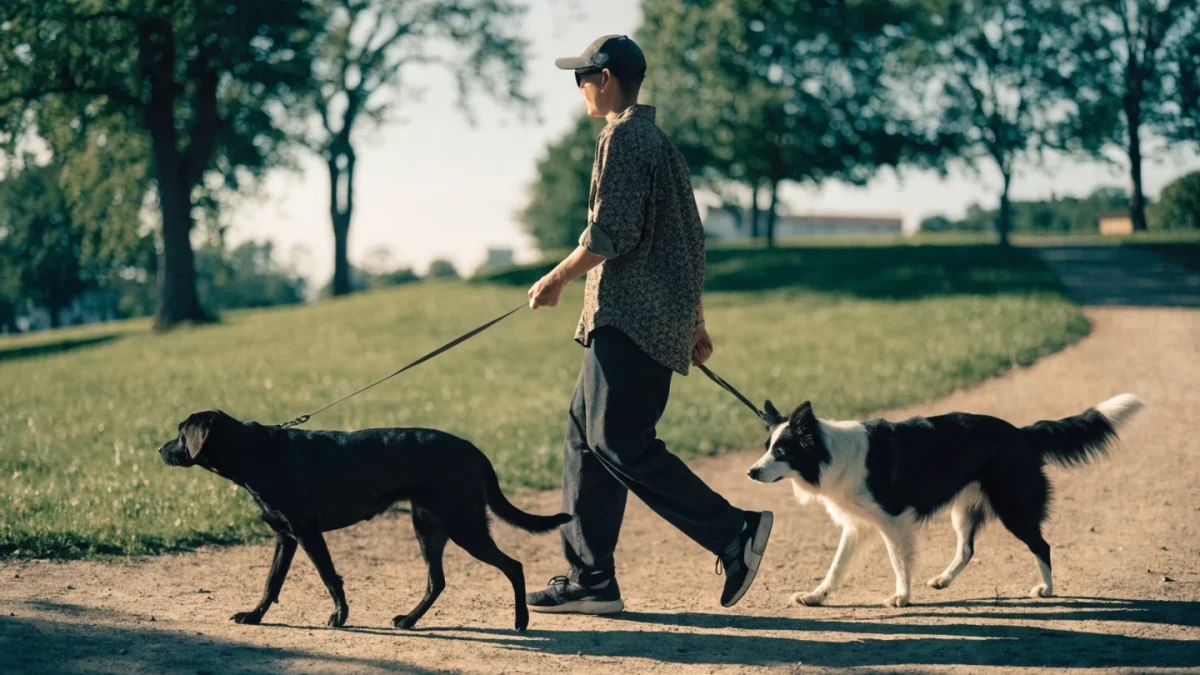
Walking one dog well takes practice. Walking two at once is a different skill entirely — and trying to manage two dogs that pull in different directions toward different things is exhausting.
The good news: it doesn't have to be chaos. But it does require some groundwork.
The Prerequisite You Can't Skip
Both dogs need to walk reasonably well on a leash individually before you combine them. This is non-negotiable.
If either dog pulls hard, lunges, or does anything that requires your full attention to manage, you don't have the physical capacity to handle two at once. You'll be constantly switching attention and both dogs will learn they can pull because you're too busy with the other one.
Get each dog to a level where you're comfortable walking them separately in the environments you'll use for the combined walk. That's your baseline.
Equipment Options
Two separate leashes: The most control. You can manage each dog independently, stop one while the other continues, and respond to individual situations. Requires good hand positioning to avoid tangling — one leash in each hand, dogs on opposite sides.
Coupler leash (Y-shaped splitter): Both dogs attach to a single handle. Simpler to hold, but you lose the ability to manage each dog independently. Works well if both dogs have similar pace and pulling tendencies. Falls apart if one dog is significantly stronger or wants to go different directions.
Double-handled leash (one leash with two handles): A variation on coupler leashes that gives you more control over the combined team while keeping both dogs connected to the same line.
For most people, two separate leashes with dogs on opposite sides is the most practical starting setup.
Positioning That Works
Keep one dog on your left, one on your right. Don't let them both drift to the same side — that's where tangles happen. When they're on opposite sides with you in the middle, the leashes have to travel over your body to cross, which means you'll feel it happening.
Avoid letting them trade sides during the walk. If a dog crosses in front of you, stop and reposition before continuing. The habit of respecting their designated side is worth building early.
Managing the Tangle Points
Tangles happen most at:
- Stopping: Dogs drift toward each other when you pause
- Sniffing the same spot: Both dogs converge on the interesting smell
- Greetings: Either with each other or with other people/dogs
- Direction changes: If one dog anticipates your turn differently than the other
For each tangle point, develop a habit: when you stop, position yourself so the dogs are on opposite sides of you. When both dogs want to sniff the same thing, only let them if the geometry of the leashes allows it safely. Keep turning to one side consistent (always turn into the same dog first so both learn the pattern).
When It's Not Working
If you're regularly having to drop one leash to manage the other, the session has exceeded your capacity. End early and work more on individual leash skills before combining again. Progress in multi-dog walking is slower than single-dog — that's normal.
Check out the complete guide to leash training for building the individual foundation, and managing multiple dogs for the broader picture of a multi-dog home. (See also: multi-dog household training.)
The key is patience and not trying to do too much at once. Build it in progressions — short walks in quiet areas first, then gradually longer and more complex routes as both dogs and you become comfortable with the mechanics.