
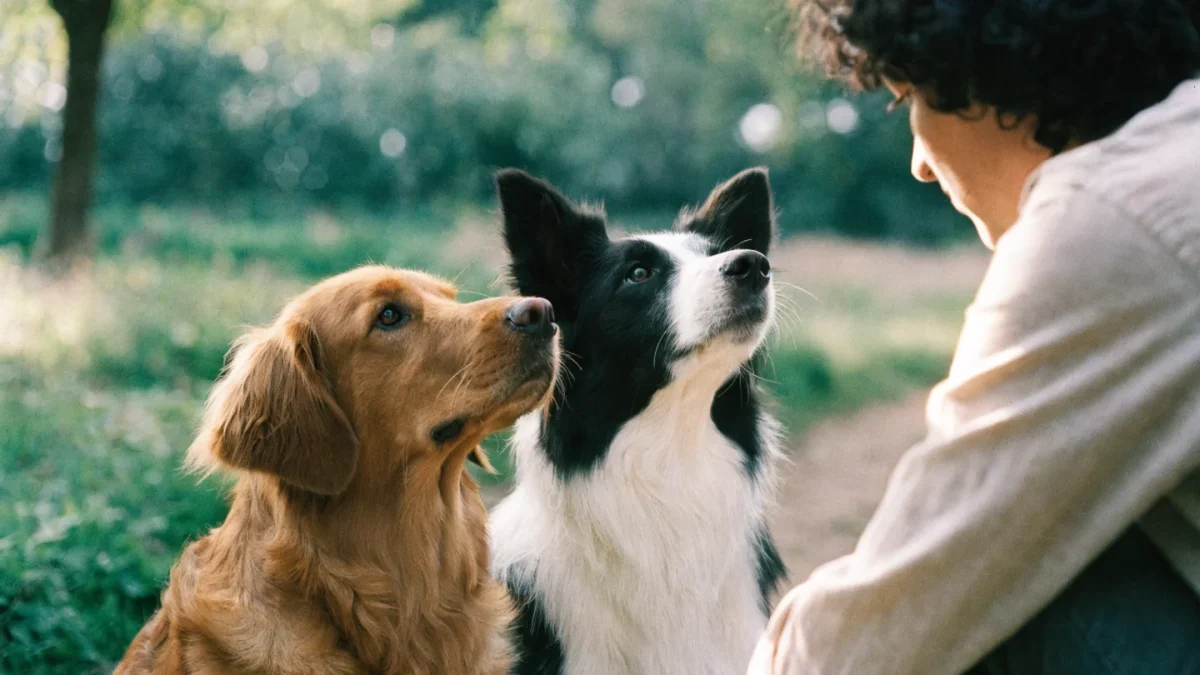
The number one mistake people make when they get a second dog is trying to train them together from the start. The logic seems reasonable — you're there, both dogs are there, why not train them at the same time?
Here's what actually happens: the faster learner answers every cue while the slower one watches. The slower dog never gets to practice. The faster dog learns to respond even faster because there's competition. Neither dog learns to focus on you in the presence of the other, because there's always the other dog to look at. And you spend the session managing the interaction between them instead of actually teaching anything.
Train dogs separately first. Every time. No exceptions.
Why Separate Training Matters
Each dog needs to learn behaviors well enough that they can perform them independently — without the other dog's cue-following to copy and without the distraction of a housemate nearby. You're building individual reliability.
Separate training also tells you which dog actually understands a behavior and which one has been social-loafing off the first dog's responses. You'll often find that the second dog knows far fewer reliable behaviors than you thought once they're alone.
Fifteen minutes of focused individual training per dog, per day, accomplishes more than an hour of muddled joint sessions. The separation itself is part of the training — dogs need to learn to exist separately, focus independently, and not require their housemate to feel settled.
Structure for Group Living
Training is individual, but daily life is communal — and that requires its own set of rules.
Feeding separately. Whether that means separate rooms or simply separate spots with supervision, feeding separately prevents resource guarding from developing and reduces mealtime tension. Dogs who are fed together often develop subtle food-related anxiety over time, even without overt fights.
Separate resting spaces. Each dog should have a space — crate, bed, or zone — that's theirs. Shared spaces are fine; a refuge that's unambiguously theirs matters for stress regulation.
Door and threshold manners. A multi-dog household where all dogs rush the door is a management problem and a safety risk. Teaching each dog to wait at thresholds individually, then requiring it in group situations, is worth the investment.
Leash manners separately first. Walking multiple dogs is significantly harder than walking one. Get each dog walking well individually before combining them on walks.
Managing the Faster Learner
In almost every multi-dog household, one dog learns faster, focuses more easily, or is more food-motivated than the other. If you're not careful, this dog answers every cue before the slower dog has a chance to process it.
I go deeper on this in dog socialization.
Management options:
- Separate rooms during individual sessions
- Physical separation within the same space (one dog on a mat, one working)
- Use different cues or locations so dogs learn context-specific behavior
The goal is making sure the slower learner gets genuine independent practice, not just a chance to watch the faster dog and get rewarded for proximity.
Teaching Group Behaviors
Once both dogs have solid individual foundations — reliable sit, down, stay, focus on handler — you can start proofing in each other's presence.
Start with the basics: can each dog hold a sit-stay while the other dog is called away? Can each dog wait at the door while the other goes through first? Can each dog maintain a down while you interact with the other dog?
These are harder than they sound, and they require a lot of repetition. Start in low-distraction environments, with the dogs at a distance from each other, and gradually increase difficulty.
When Dogs Don't Get Along During Training
If there's tension between your dogs, group training is not the right priority. Relationship management — feeding separately, avoiding competition triggers, creating neutral coexistence — comes before asking dogs to work together. Training exercises won't fix inter-dog tension; they may actually increase it by creating competition.
Structured group training only works when the dogs have a neutral or positive relationship. If you're managing active tension or resource guarding, address that first.
FAQ
Can you teach two dogs the same cue without them confusing each other?
Yes, but it requires name targeting first. Make sure each dog responds reliably to their name before using shared cues. "Buddy, sit" and "Molly, sit" work fine once each dog understands that their name precedes the cue meant for them.
My dogs always want to play when I try to train them together. What do I do?
This is normal and a sign they haven't had enough individual training to have a strong "work mode." Separate training builds individual focus. When you do bring them together, start with one dog on a mat in a settle position while you work with the other — don't attempt free-form joint training until each dog has reliable individual focus.
One dog always gets jealous when I work with the other. How do I handle that?
"Jealousy" in this context is usually frustration at being excluded from interaction and rewards. Start the non-working dog in a place stay or on a mat with a chew before starting your session with the other dog. The goal is teaching them that waiting their turn is fine — their session is coming.
Should I always train my dogs in the same order?
Varying the order is actually useful — it prevents the dog who always goes second from learning to switch off during the first dog's session. Randomize which dog gets trained first, and make sure the waiting dog has something to do (mat training, chew) rather than just watching and building frustration.