

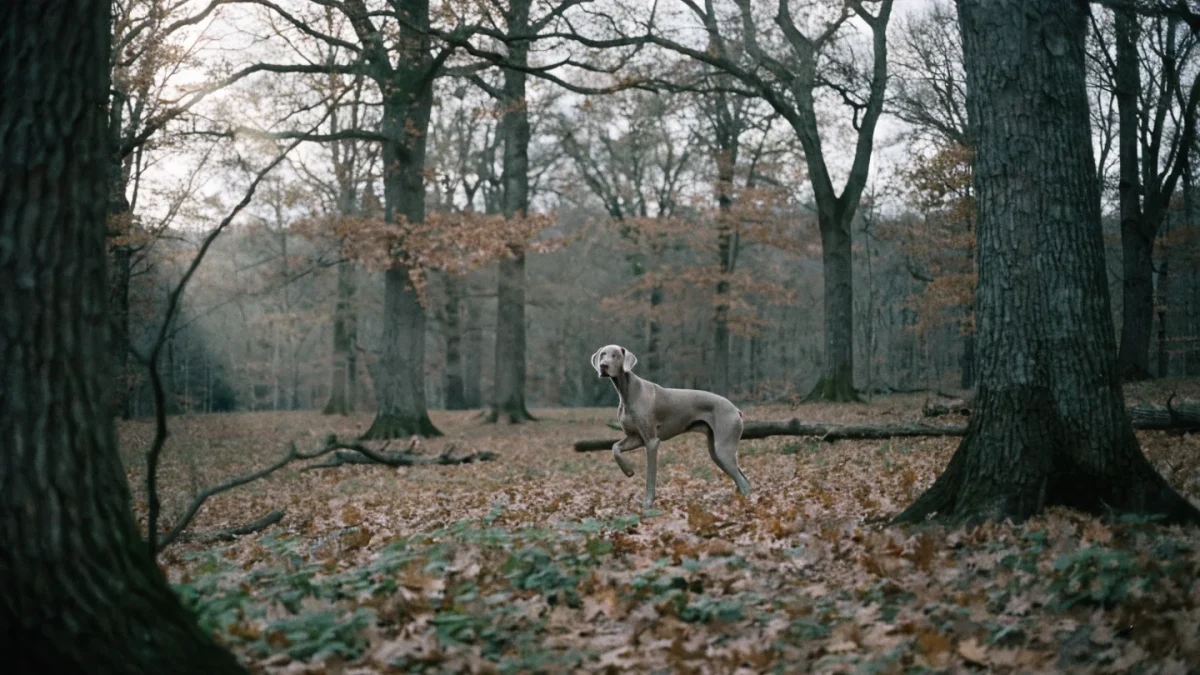
The city of Weimar, Germany, is better known for Goethe, Schiller, the Bauhaus movement, and a failed republic than for a dog breed. But in the early 1800s, the court of Grand Duke Karl August of Saxe-Weimar-Eisenach produced something the literary and artistic legacies never did: a hunting dog so prized that it was treated as classified property for nearly a century. The weimaraner history origins germany trail starts in these forested estates of Thuringia, and it's a story about control, obsession, and the strange things that happen when a breed is developed in secrecy.
Karl August — patron of the arts, political reformer, and passionate hunter — wanted a dog that could handle the full range of game in his territories. Boar, deer, bear, and wolves still roamed the dense forests of central Germany in the early 19th century, and the Duke wanted a single breed versatile enough to track, point, and hold any of them. The dogs that eventually became weimaraners were his answer.
The Foundation Stock Mystery
The exact breeds that went into creating the weimaraner remain genuinely uncertain. The most commonly cited foundation crosses include Bloodhounds, various German pointer breeds, and French hound breeds — likely the St. Hubert Hound (Bloodhound ancestor) among them. Some breed historians have proposed that the now-extinct Leithund, a breed from the court of Louis IX of France, contributed to the weimaraner's early bloodlines, but documentary evidence is thin.
What is documented is that by the 1830s, dogs matching the weimaraner description were established as a recognizable type in the Weimar court. Paintings from the period show silver-grey hunting dogs with the breed's characteristic build — lean, long-legged, and athletic — working alongside mounted hunters in forest settings.
The lack of precise records from the earliest decades isn't unusual for breeds of this era. Systematic pedigree documentation didn't become standard practice until the latter half of the 1800s. What makes the weimaraner's case unusual is that the documentation gap wasn't accidental. It was deliberate. The Weimar court had little interest in sharing breeding knowledge with outsiders.
The Club and the Lockdown
The turning point in the breed's organizational history came in 1897, when the Weimaraner Club of Germany (Weimaraner Klub e.V.) was formally established. The club didn't just promote the breed — it locked it down.
Membership was restricted. Breeding was controlled. Only club members could own registered weimaraners, and the club maintained authority over which dogs were bred to which. Dogs that failed hunting aptitude tests or showed physical faults were required to be neutered or, in some cases, euthanized. Puppies from unauthorized breedings were not registered.
This level of control accomplished two things. First, it maintained exceptional breed quality. The weimaraners coming out of the club's program were consistent in type, sound in health, and proven in the field. Second, it created an aura of exclusivity that made the breed almost mythological among hunters who'd heard of it but couldn't access it.
The club's gatekeeping also kept the breed numerically small. Through the late 1800s and into the early 1900s, the total weimaraner population remained in the hundreds, concentrated almost entirely in Germany. Compare this to breeds like the German Shepherd, which was being aggressively promoted and exported worldwide during the same period.
The Transition From Big Game to Birds
The weimaraner's original purpose — big-game pursuit — began losing relevance in the late 1800s as large predator and game populations declined across Germany. Boar remained, but deer populations were managed, bears were functionally extinct in most regions, and wolves were gone from all but the most remote areas.
The breed adapted. By the early 1900s, weimaraners were being trained as versatile gun dogs for upland bird work and waterfowl retrieval. This required refinements: a steadier pointing instinct, softer mouth for retrieving game birds without damage, and better responsiveness to handler direction at distances typical of bird hunting rather than the close-quarters work of big-game pursuit.
The transition wasn't seamless. Early weimaraners brought to bird work retained high prey drive and a tendency toward hard-mouthing — traits advantageous when confronting a cornered boar but less helpful when delivering a quail. Selective breeding within the club addressed this over several generations, producing dogs that could point staunchly, retrieve tenderly, and still summon the intensity to track a wounded boar through dense cover when needed.
This versatility — the ability to shift from one type of hunting to another without losing competence in either — is the trait that ultimately made the weimaraner attractive to sportsmen outside Germany. It's also the trait that makes the modern breed simultaneously adaptable and demanding: the same neural flexibility that allows a weimaraner to learn new tasks quickly also means it needs constant stimulation and novel challenges.
Howard Knight and the American Chapter
The story of how the weimaraner reached America has been told many times, but the details matter because they reveal exactly how reluctant the German club was to let the breed go.
Howard Knight, an American sportsman and dog enthusiast from Rhode Island, discovered the weimaraner during a visit to Germany in the late 1920s. Impressed by the breed's field performance, he applied for membership in the Weimaraner Club of Germany — a prerequisite for obtaining breeding stock.
The club admitted him. Then they sent him two sterilized dogs.
Knight persisted. Over nearly a decade of correspondence, visits, and relationship-building with German club members, he eventually received an intact male and an intact female in 1938. Some accounts identify these dogs as Mars aus der Wulfsreide and Dorle v. Schwarzen Kamp, while other sources give different names. Regardless of the precise pair, these dogs became the foundation of the American weimaraner population.
The timing was significant. Within a year of Knight's import, World War II began. German breeders, facing wartime scarcity, reportedly sent additional dogs to America for safekeeping — a pragmatic decision that expanded the American gene pool at a critical moment. By the time the war ended, the American weimaraner population was established enough to sustain itself independently.
The American Kennel Club recognized the weimaraner in 1943. The Weimaraner Club of America, founded by Knight, adopted breed standards closely modeled on the German original.
The Popularity Explosion
Through the late 1940s and 1950s, the weimaraner's star rose fast in America. The breed earned a reputation as the "wonder dog" — partly on merit, partly on marketing. Magazine articles portrayed weimaraners as all-purpose hunting dogs, obedient family pets, and natural protectors of home and property. President Eisenhower's weimaraner, Heidi, added White House prestige.
The breed's striking appearance amplified the attention. In an era of brown and black sporting dogs, the silver-grey weimaraner stood out at every field trial and dog show. Grace Kelly was photographed with one. The breed became fashionable in a way that hunting dogs rarely manage.
As the complete weimaraner breed guide details, this surge of popularity brought the same consequences it always does: rapid expansion of breeding, dilution of working temperament, and a flood of dogs entering homes that were chosen for aesthetics rather than lifestyle fit. The very exclusivity that had protected the breed for a century evaporated in less than a decade.
Breed registrations peaked, leveled, and eventually declined as the gap between the weimaraner's marketing image and its actual demands became obvious to the broader public. The dogs that were returned, rehomed, or surrendered during this period were not defective. They were weimaraners — acting like weimaraners — in homes that expected something simpler.
The Modern Breed
Today's weimaraner exists across a spectrum. Working lines — maintained by breeders who hunt with their dogs and test for field aptitude — retain the drive, stamina, and hunting instinct of the original type. Show lines, selected primarily for conformation and appearance, tend toward somewhat calmer temperaments but still carry the breed's characteristic intensity and bonding behavior.
The German club's influence persists. Germany's breeding program still requires hunting aptitude tests for breeding stock, maintaining a connection to function that many breed programs have abandoned. In America and much of the rest of the world, that requirement doesn't exist, and the gap between working weimaraners and companion weimaraners has widened.
The weimaraner temperament that modern owners encounter — the velcro bonding, the separation anxiety, the prey drive, the need for exhaustive exercise — is the direct product of two centuries of deliberate selection by people who wanted a specific kind of dog and got exactly what they designed. The breed's challenges aren't defects. They're features, engineered into the dog by hunters who needed every one of them.
Understanding weimaraner history origins germany tells you something that temperament descriptions alone cannot: this dog was never meant to be easy. It was meant to be exceptional. The two have never been the same thing.