

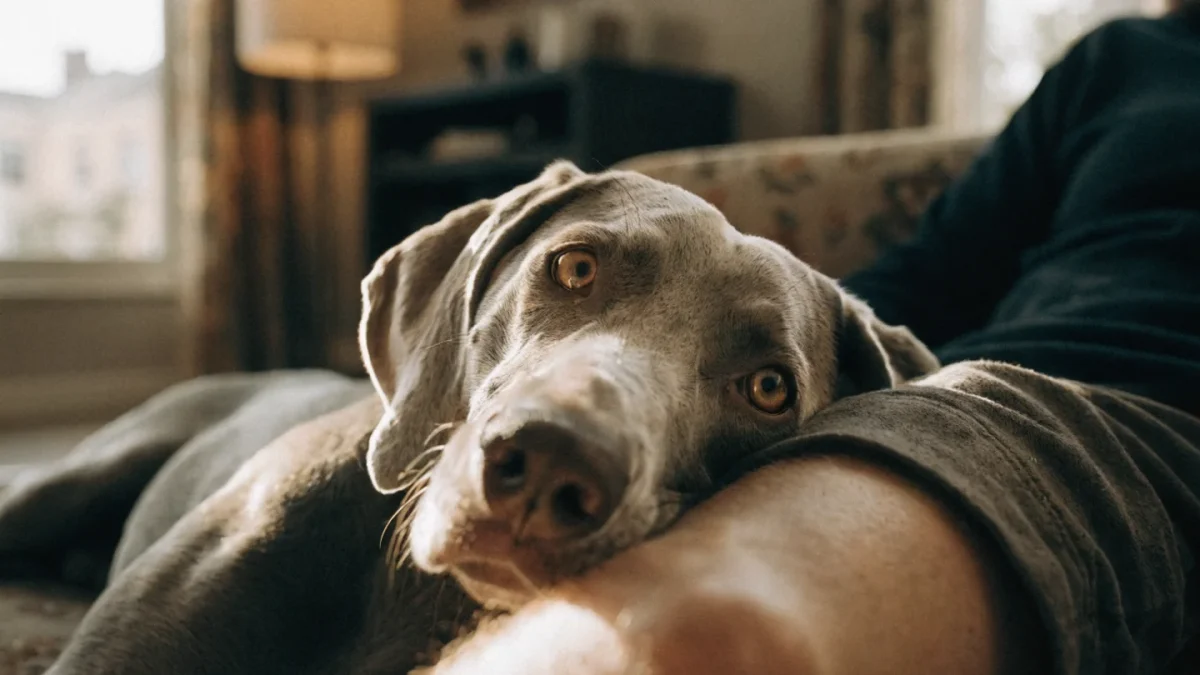
William Wegman didn't choose the weimaraner for his photographs by accident. When he acquired his first weimaraner, Man Ray, in 1970, Wegman discovered a dog that would hold perfectly still and stare directly into a camera lens with an almost human intensity — a trait that made his subsequent four decades of weimaraner portraiture possible. That willingness to lock onto their person's face and simply hold the gaze isn't a trick Wegman trained. It's weimaraner temperament personality in its purest expression: total, unwavering focus on the human they've chosen.
Living with a weimaraner means living with a dog that wants to know where you are at every moment. Not occasionally, not when it feels like checking in. Every moment. They follow you between rooms. They press their body against your legs when you stand still. They rest their head on your lap when you sit down. They nose open the bathroom door. If you're the kind of person who values personal space, the weimaraner will cure you of that preference or drive you to frustration — possibly both.
The Velcro Bond
The term "velcro dog" gets applied loosely to breeds that enjoy human contact. With weimaraners, it's not loose enough. Vizslas are velcro dogs. Cavalier King Charles Spaniels are velcro dogs. Weimaraners are industrial-grade adhesive.
This attachment is rooted in the breed's working history. The weimaraner was developed as a personal hunting companion to German nobility — one dog, one handler, working in close partnership through dense forest. Unlike pack hounds that operated semi-independently, the weimaraner was bred to read its handler's body language, anticipate direction changes, and maintain proximity while covering ground. That handler-focus got selected for over two centuries, and modern weimaraners carry the result in their DNA.
The bond typically centers on one person. In a household of four, the weimaraner will be polite to three of them and psychologically fused to one. That chosen person becomes the dog's gravitational center — the one whose movements dictate the dog's position in any room, whose departure triggers anxiety, whose return triggers ecstatic reunion even after a five-minute absence.
For the complete weimaraner breed overview, including physical characteristics and health profile, this bonding pattern is covered in the context of the whole dog. Here, it's worth examining as the temperament trait that everything else radiates from.
Separation Anxiety: The Breed's Defining Challenge
Separation anxiety in weimaraners isn't a behavioral problem that some dogs develop. It's a breed-wide predisposition that nearly all weimaraners express to some degree. The severity varies — some dogs whine and pace, others destroy furniture and injure themselves attempting to escape crates — but the underlying distress at being separated from their person is essentially universal.
The physical symptoms are distinctive. Drooling, panting, dilated pupils, and trembling begin within minutes of the owner's departure. Destructive behavior tends to focus on exit points: doorframes, window sills, and crate bars show the most damage. Some weimaraners will chew through drywall. Others vocalize at a pitch and volume that generates noise complaints from several houses away.
This isn't a training failure. You can manage it — graduated desensitization, exercise before departure, puzzle toys, calming protocols — but you cannot train it out of the breed. A weimaraner doesn't choose to be anxious when you leave. Its nervous system reacts to your absence the way yours would react to a sudden loud noise: automatically, physiologically, beyond conscious control.
The practical implication is blunt. If your life requires the dog to be alone for more than four or five hours regularly, a weimaraner is not the right breed for you. No kennel, daycare arrangement, or enrichment toy substitutes for the physical presence of the person the dog is bonded to.
Prey Drive
The weimaraner was originally a big-game dog that pursued boar, deer, and bear. Let that sink in before you consider how it might interact with the neighbor's cat.
Prey drive in this breed is strong, fast-triggering, and difficult to redirect once activated. The pursuit sequence — eye, orient, chase, grab — happens in seconds, and the physical tools the weimaraner brings to that sequence are formidable. This is a 35 kg dog that can accelerate from standing to a full sprint fast enough to surprise people who've never seen it happen.
Small animals — cats, rabbits, small dogs, chickens — can trigger the sequence. Not all weimaraners will pursue all small animals, and dogs raised alongside cats from puppyhood sometimes generalize tolerance to their household companions. But "sometimes" is not "reliably," and a moment of failed impulse control with an animal this powerful has permanent consequences.
Off-leash reliability in unfenced areas is aspirational for most weimaraners when prey is present. Training can build a solid recall under moderate distraction, but a flushed rabbit or a fleeing cat overrides obedience in the majority of individuals. Secure fencing, leash management, and realistic expectations about the limits of training against genetic drive are non-negotiable.
With Other Dogs
Weimaraners are social dogs that generally enjoy canine company, but their play style and assertiveness create friction points that need management.
The typical weimaraner plays rough. Body slams, chase-and-tackle, hip checks, and mounting during play are common. This style works beautifully with breeds of similar size and temperament — other weimaraners, German Shorthaired Pointers, Vizslas, and similarly robust sporting breeds tend to match the energy well. It works poorly with smaller breeds, older dogs, or breeds that interpret physical contact during play as a threat.
Same-sex aggression is reported with enough frequency to warrant mention. It's not a breed majority, but it's not rare either. Intact males are most likely to show it. Careful introductions, monitoring play for escalation signals, and knowing your individual dog's tolerance threshold prevent most incidents.
Intelligence and Stubbornness
The weimaraner learns fast. Inconveniently fast, sometimes. These dogs figure out door handles, cabinet latches, and gate mechanisms. They observe routines with enough precision to anticipate departures and arrivals. They remember where food was stored three houses ago during a walk last month.
That intelligence combines with willfulness in a way that frustrates owners who expect compliance to follow comprehension. The weimaraner that understands "stay" perfectly may still break the stay when something more interesting appears. This isn't disobedience in the defiant sense. It's cost-benefit analysis from a dog smart enough to weigh options and confident enough to choose its own.
Compare this to a Labrador Retriever — a breed selected for generations to comply with handler direction as its primary reward. The weimaraner was selected to work semi-independently, making field decisions while staying in general proximity to its handler. The result is a dog that cooperates when the partnership makes sense and freelances when it doesn't.
Experienced owners find this engaging. First-time large-breed owners find it maddening.
Emotional Sensitivity
Beneath the athleticism and drive, the weimaraner is a remarkably sensitive dog. They read human emotion with an accuracy that catches owners off guard. A tense conversation in another room, a change in household routine, a shift in their person's mood — the weimaraner registers and responds to all of it.
This sensitivity makes them responsive to positive training methods. A pleased tone produces visible joy. A disappointed tone produces visible deflation. Harsh corrections produce anxiety, avoidance, and sometimes fear-based reactivity that's much harder to reverse than the original behavior problem.
It also means they absorb household stress. In homes with frequent conflict, unpredictable schedules, or high emotional volatility, weimaraners often develop displacement behaviors — excessive licking, pacing, whining, and digestive upset that mirrors the stress they're detecting from their people.
What Most People Get Wrong
The misconception that causes the most surrenders: treating the weimaraner's intensity as a problem to solve rather than a trait to accommodate.
People buy a weimaraner because it's beautiful and athletic. They discover it's also needy, demanding, and relentless about contact. They try to create distance — crating more, leaving the dog in the yard, closing doors between rooms. The dog's anxiety escalates. The behavior worsens. The owner concludes the dog is broken.
The dog isn't broken. The match is broken. A weimaraner that shadows you constantly, rests its chin on your keyboard while you work, and sleeps with its spine pressed against yours isn't misbehaving. It's doing exactly what two hundred years of selective breeding built it to do.
The Right Temperament Match
A weimaraner's temperament fits someone who wants a partnership, not a pet. Someone who finds the constant presence comforting rather than suffocating. Someone who has the time, the energy, and the emotional bandwidth to match a dog that will never, at any point in its life, dial back the intensity.
If the thought of a dog staring into your eyes from six inches away while you try to read sounds like heaven, this is your breed. If it sounds claustrophobic, it isn't. The weimaraner doesn't adjust. You either match it or you don't.