

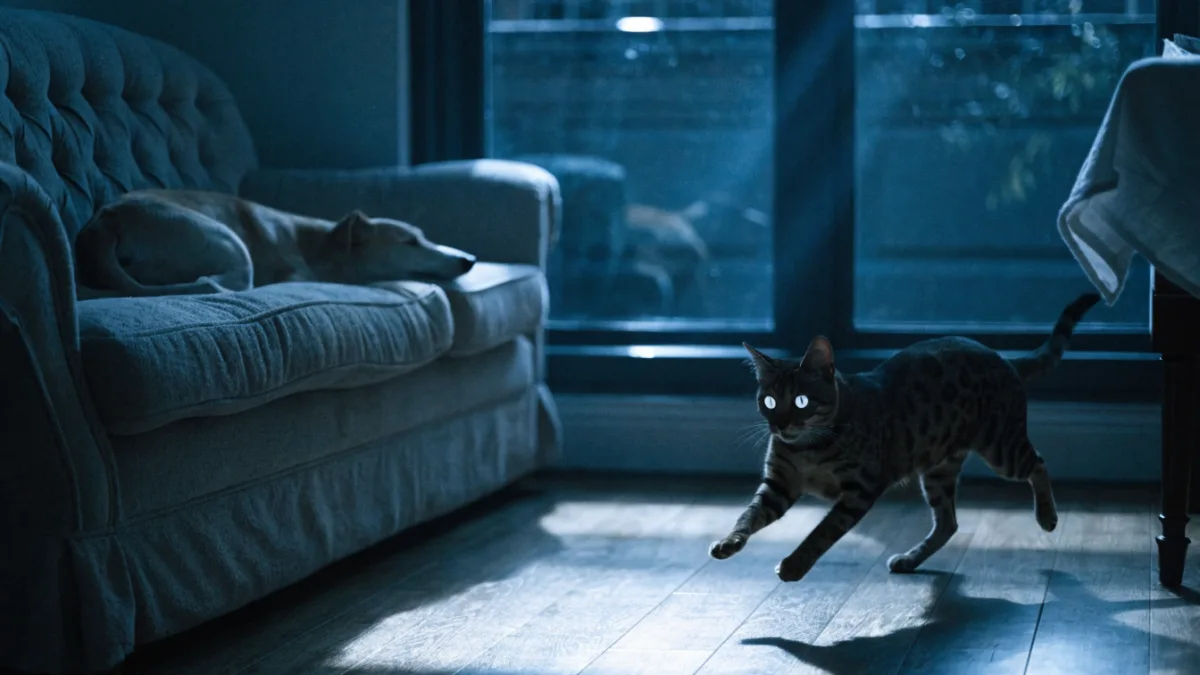
There is a very specific sound a cat makes when they are preparing to break the sound barrier at 3:00 AM. It usually involves a sudden, inexplicable silence, followed by the aggressive rustling of a plastic bag, and culminates in the heavy thud of a ten-pound fur missile launching off your dresser.
If you live with a cat, you know this scenario intimately. You also know the feeling of lying in the dark, wondering why your feline companion has suddenly decided to train for the feline Olympics. Meanwhile, if you have a dog, they are likely snoring at the foot of the bed, completely unfazed by the chaos unfolding above them.
This disparity isn’t a coincidence, and it certainly doesn’t mean your cat is secretly plotting your sleep deprivation. The midnight zoomies—or, as animal behaviorists call them, Frenetic Random Activity Periods (FRAPs)—are driven by deep-rooted biological programming. Your dog’s lack of participation in the midnight sprint is equally hardwired. Let’s look at why your cat turns into a nighttime menace while your dog happily sleeps through the entire spectacle.
Hardwired for the Dark: The Biology of the Cat Schedule
To understand the 3:00 AM chaos, you have to look at what your cat actually is: a highly specialized, incredibly efficient predator. While house cats have comfortably moved into our homes and onto our velvet armchairs, their internal operating systems haven’t changed much from their wild ancestors.
Cats sleep an average of 12 to 16 hours a day. They do this to conserve energy for hunting. When they are awake, they are designed to be intensely active. But the timing of that activity is the real kicker. There is an ongoing debate in animal behavior circles about whether cats are strictly nocturnal (active at night) or crepuscular (most active at dawn and dusk). For the sake of your sleep schedule, the distinction hardly matters. Either way, their biological peak hunting hours perfectly align with the exact moment you enter your deepest stage of REM sleep.
At 3:00 AM, your cat’s instinct to hunt kicks into high gear. When they get the zoomies, they are essentially practicing for a hunt. The sudden bursts of speed, the sharp corners, and the gravity-defying leaps are all practice maneuvers for catching elusive prey. The fact that the only available “prey” in your dark bedroom is a stray sock, a dust bunny, or your twitching toes under the blankets is entirely beside the point.
The Post-Litter Box Rocket
As a brief but necessary sidebar: if your cat’s zoomies reliably happen right after they use the litter box, you are not alone. My own cat, Biscuit, treats every bowel movement like a prison break. There are a couple of reasons for this specific brand of FRAP.
Biologically, the act of defecating can stimulate the vagus nerve, which runs from the brain to the colon. This stimulation can cause a sudden drop in heart rate and blood pressure, which the cat’s body counteracts with a sudden, frantic burst of adrenaline and energy. But there is also an evolutionary explanation. In the wild, leaving a pile of scat is like leaving a calling card for predators. Wild cats will often fiercely bury their waste and then sprint away from the area to avoid being tracked by a larger animal. So, if your cat launches out of the litter box like a furry little bat out of hell, just remember: they are running from imaginary lions.
Why Your Dog Is Still Snoring
So, why isn’t your dog joining in on the fun? Why are dogs perfectly content to sleep through the night and wake up when your alarm goes off?
The answer comes down to thousands of years of domestication and a fundamentally different daily rhythm. While cats are solitary hunters who rely on stealth and darkness to ambush small prey, dogs are pack animals. Historically, wild canids hunted larger prey, which required coordinated group effort during daylight hours.
Because of this, dogs are naturally diurnal, meaning their active periods match ours. Over the millennia of living alongside humans, dogs adapted their sleep-wake cycles to sync perfectly with our daily routines. They wake up when we wake up, they nap when we go to work, and they go to sleep when we turn the lights off.
Furthermore, dogs generally get their energy out during the day. A daily walk, a game of fetch, or even just sniffing the grass at the park satisfies their physical and mental enrichment needs. By the time 3:00 AM rolls around, your dog’s energy reserves are fully depleted. Your dog isn’t inherently “better” behaved than your cat; they just operate on a biological clock that actually respects human boundaries.
The Energy Deficit: Why Indoor Cats Explode
While biology sets the stage for the 3:00 AM zoomies, lifestyle pours gasoline on the fire.
Outdoor cats burn massive amounts of energy actually hunting. They stalk, they chase, they climb trees, and they defend their territory. Indoor cats, by contrast, live in the lap of luxury. Their food is magically delivered to a bowl twice a day, their water is fresh, and their most strenuous daily activity is deciding which sunbeam to nap in.
If you are at work all day, your cat is likely sleeping. By the time 3:00 AM arrives, your cat has built up a massive reserve of pent-up physical and mental energy. The zoomies aren’t a behavioral problem; they are a pressure release valve on a boiler that is about to burst. This is especially true for kittens and young cats. A seven-month-old cat has the energy of a toddler who just drank an espresso, and confining that energy to a small apartment requires some strategic management.
Solving the Midnight Marathon (Without Losing Your Mind)
If you are currently reading this with bags under your eyes, do not despair. There are heated debates online about how to react when the zoomies hit. Some owners swear by ignoring the cat completely so they don’t reinforce the behavior with attention. Others will actually get out of bed and play with the cat to tire them out.
The general expert consensus? Don’t wait until 3:00 AM to solve the problem. You have to prevent the energy buildup before you go to sleep.
Cats naturally follow a specific daily rhythm: hunt, catch, kill, eat, groom, sleep. If you can mimic this cycle right before bed, you can significantly reduce—or entirely eliminate—the midnight sprinting.
- The Pre-Bed Hunt: About thirty minutes before you plan to go to sleep, initiate a rigorous, interactive play session with your cat. Use a wand toy with a feather or a string—something that mimics the movement of prey. You want them running, jumping, and pouncing until they are visibly panting and tired.
- The “Kill” and the Feast: Once your cat has successfully “caught” the toy a few times and is winding down, it’s time for the feast. Feed them their final meal of the day, or a high-protein treat, immediately after the play session ends.
- The Sleep: With a full belly and depleted energy reserves, your cat will naturally transition into the grooming and sleeping phases of the cycle. Instead of waking up at 3:00 AM to hunt, they will likely sleep straight through the night.
There has also been a massive boom in pet-tech designed specifically to intercept these midnight zoomies. If you are a heavy sleeper, or if you just want to sleep in on the weekends, you can look into timed, microchip-activated smart feeders that dispense a small meal in the middle of the night, or automated laser toys that silently entertain your cat on the other side of the house while you sleep. I’m generally skeptical of toys that do the work for you, but when it comes to preserving your sanity, automated enrichment can be a lifesaver.
A Wild Instinct in a Modern World
It’s easy to view our cats as spoiled house pets, but the reality is much more complex. When Biscuit tears through my hallway at 3:00 AM, knocking over the occasional lamp in her wake, I try to remind myself that she is acting on an ancient, unavoidable instinct. She isn’t trying to annoy me; she’s just being a cat in a world that doesn’t require her to hunt for her survival.
In fact, if you want proof of just how strong that 3:00 AM hunting instinct is, look no further than the global outdoor cat population. While domestic cats are obviously not endangered, outdoor and feral cats are actually considered one of the most destructive invasive species on the planet. When we let them roam at night, they don’t just run around—they actively hunt and decimate local bird and small mammal populations. It is a stark reminder of the efficient, relentless predators hiding behind those cute whiskers.
By keeping our cats indoors, we protect local wildlife and keep our cats safe from the very real dangers of the outside world. But in doing so, we take on the responsibility of giving them an outlet for that wild energy. The midnight zoomies are just the price of admission for living with a miniature apex predator. Play with them before bed, feed them a late snack, and maybe invest in some earplugs. Your cat isn’t broken—they’re just doing exactly what they were designed to do. And if all else fails, just pull the blankets over your head and wait for the 3:00 AM parkour session to pass.