

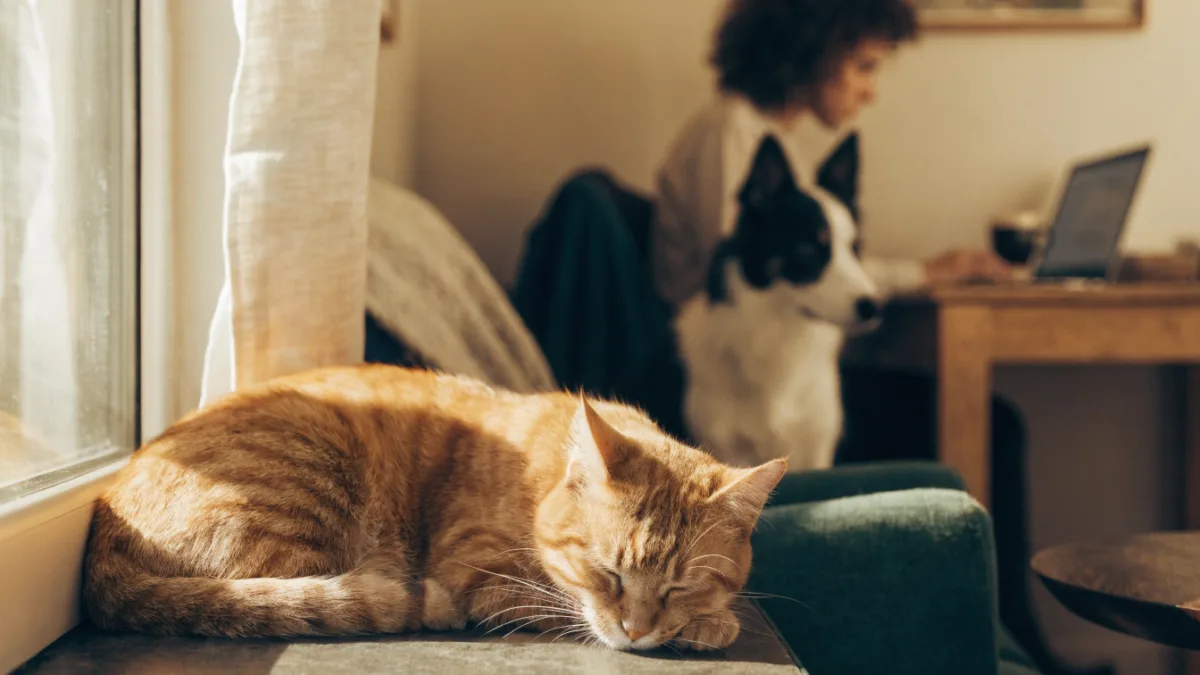
There is a very specific moment in the morning when you realize your household runs on completely incompatible time zones. For me, it usually happens around 6:00 AM. I am stumbling around the kitchen trying to operate a coffee maker, my dog is stretching and yawning like he is ready to immediately hike the entire Appalachian Trail, and my cat, Mochi, is glaring at me from inside her heated donut bed. While I am desperately trying to wake up, Mochi is already calculating which sunbeam she is going to nap in after she finishes her post-breakfast pre-nap snooze.
If you have ever looked at your feline friend and wondered if they are just profoundly, chronically lazy, let me reassure you: they are, but it is biologically mandated. Cats sleep an average of 16 to 18 hours a day. Depending on their age and mood, anywhere from 12 to 20 hours of sleep per day is considered completely normal and healthy. Meanwhile, your dog is probably trying to sync their sleep cycle to yours, waiting for you to finish your Netflix binge so they can officially call it a night.
The Predator’s Paradox: Conserving Energy for the Hunt
To understand why cats spend roughly two-thirds of their lives unconscious, we have to look at their wild ancestors. Cats are obligate carnivores, meaning their bodies are designed to run entirely on meat. In the wild, hunting is an incredibly high-risk, high-reward activity. It requires massive, explosive bursts of energy to stalk, chase, and pounce on prey. To afford those intense athletic feats, cats evolved to aggressively conserve energy in between meals.
Even though Mochi’s most strenuous daily activity is walking twelve feet to her food bowl, her DNA doesn’t know that. She is still wired to sleep all day so she has the stamina to take down a hypothetical gazelle in the living room. Interestingly, most other fur-covered mammals only need about 8 hours of sleep (or less) per cycle, making cats uniquely heavy sleepers in the animal kingdom.
Heat Seekers and Brain Builders
Energy conservation isn’t the only reason your cat is passed out in the laundry basket. Sleep also plays a massive role in feline temperature regulation. Cats have a higher internal body temperature than humans—usually hovering around 101.5 degrees Fahrenheit. Because they lose body heat quickly, they seek out warm spots and use sleep to slow down their metabolism and maintain that cozy temperature. This is exactly why Mochi will migrate across the living room rug over the course of the afternoon, slowly tracking a four-inch square of sunlight like a fuzzy blonde GPS.
Age also plays a massive role in how much shut-eye they need:
- Kittens: They require massive amounts of sleep to support rapid physical growth and crucial brain development. If a kitten isn’t actively causing chaos, they are probably dead asleep recharging for the next chaos session.
- Senior cats: As cats age, they naturally slow down. Older cats tend to nap more frequently due to natural aging processes, lower overall energy levels, and aching joints. If your twelve-year-old cat wants to sleep on a heated orthopedic bed all day, let her.
The “Is My Cat Depressed?” Debate
A common debate I see constantly in online pet forums—often from panicked first-time owners—is whether a cat sleeping all day is a sign of a health crisis or just normal behavior. I completely understand the panic. When I first brought home a rescue kitten who slept for 18 hours straight, I was convinced something was terribly wrong.
But as the,[1] cats do not get their rest from one long, continuous slumber like humans do. Instead, their sleep is comprised of a series of short and long naps throughout the day and night. Up to 20 hours is perfectly fine.
The trick is to differentiate between normal napping and true lethargy. I don’t give health diagnoses—that is strictly your vet’s job—but as a general rule of thumb: a sleeping cat is relaxed, often stretches, and will get up for high-value things like the sound of a can opener. A lethargic cat is hiding, ignoring food, and their personality has fundamentally shifted. If your cat’s sleep patterns suddenly change drastically, that is your cue to talk to your vet.
City Life and the Restless Pet
While we are talking about sleep, we have to acknowledge the environment. If you live in an apartment in a bustling city, your pet’s natural sleep cycle is probably taking a hit. A growing conversation in animal welfare right now revolves around how urban environments negatively impact pet mental health and rest.
Loud city noises—sirens, garbage trucks, loud neighbors, and heavy traffic—can lead to nighttime restlessness. Cats and dogs have incredibly sensitive hearing. A environment that is acoustically chaotic during the night disrupts their natural ability to settle into those deep, restorative naps. If your cat is doing the “3 AM zoomies,” it might not just be natural cat logic; they might be trying to burn off energy because they were kept awake by outside noise all night. [2] that providing quiet, elevated hiding spots away from street-level noise can dramatically improve an urban pet’s rest.
Syncing Up: Why Dogs Match Your Schedule
Then we have dogs. While cats are dictated by the sun, their stomachs, and their inner panther, dogs are dictated by you.
Biologically, dogs are polyphasic sleepers, meaning they take multiple naps throughout the day. But behaviorally, they are highly adaptable “social sleepers.” This means they will actively adjust their waking and sleeping hours to match their human family’s routine. If you are a night owl who stays up until 2 AM, your dog will likely hang out on the couch with you, catching naps while you watch TV, and sleep in when you do. If you are an early bird, they will happily become an early bird.
My dog, Barnaby, is basically a mirror of my own schedule. He will stay awake if I am moving around the house, patiently waiting for me to settle down. The second I close my laptop and sit on the couch, he immediately collapses into a deep sleep. Dogs have evolved alongside humans for thousands of years, and reading our social cues is quite literally in their DNA. They sacrifice their natural daytime wakefulness to keep an eye on the house—and on you.
I won’t give dog training advice—that is strictly Jake’s expertise—but I will say this: dogs don’t need us to manage their sleep schedules. They just need us to be relatively consistent so they know when it’s time to be alert and when it’s time to snooze.
Respecting the Differences
The truth is, the ways our pets sleep reveal exactly who they are. Cats are fiercely independent, standalone predators wired to conserve energy and track heat, perfectly content to ignore us for 18 hours. Dogs are loyal, socially flexible companions who structure their entire lives around our weird human habits.
The biggest takeaway for us as pet guardians is to respect those biological rhythms rather than fighting them. Don’t force your cat to stay awake to play when they just want to roast themselves in a sunbeam. Don’t force your dog to adjust to a wildly erratic, sleep-deprived schedule just because you’re busy. By understanding the science behind their slumber—and doing our best to provide a quiet, safe environment for them to actually rest—we give them the best possible life in our human world.
Sources
- experts at Oakland Veterinary Referral Service note — ovrs.com
- Animal welfare organizations increasingly point out — bchumane.org