

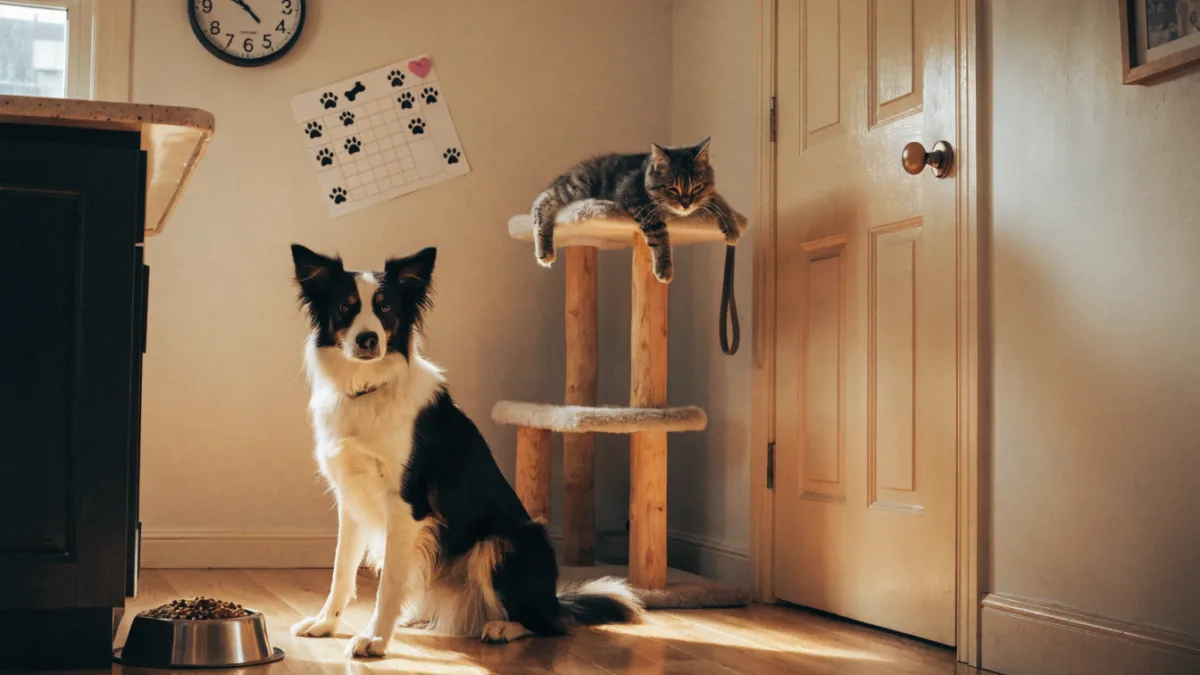
6:47 AM. Biscuit is sitting on my chest, purring with the intensity of a small generator, subtly suggesting that breakfast was supposed to happen seventeen minutes ago. Meanwhile, Mochi — our 65-pound mutt with the energy of a toddler who just discovered espresso — is spinning in circles by the front door because the morning walk is late. And I haven’t even had coffee yet.
If you live with both a dog and a cat, you already know this dance. The dog needs structure. The cat demands sovereignty. And you’re standing in the middle in your pajamas, trying to figure out how to serve two very different masters without losing your mind. Here’s what I’ve learned after years of fumbling through it: you don’t need a perfect schedule. You need a flexible framework that honors what each animal actually needs.
Why Routines Matter More Than You Think
Here’s something that genuinely surprised me when I started digging into the research: predictability isn’t just a “nice to have” for pets. It’s biologically calming. Studies in veterinary behavior consistently show that consistent daily routines reduce anxiety and stress in both dogs and cats by letting them know when to expect vital resources — food, attention, exercise, access to outdoors or favorite spots.
Dogs have remarkably precise internal clocks. Their circadian rhythms pick up on environmental cues — light changes, the sound of your alarm, the mail carrier’s arrival — and they build their entire day around these signals. When those signals happen consistently, dogs feel secure. When they don’t, you get the canine equivalent of jet lag: restless, anxious, sometimes destructive behavior from a dog who literally doesn’t know what’s happening next.
And cats? This is where people get it wrong. We see the aloof cat napping on a shelf and assume they don’t care about routine. They absolutely do. Sudden changes in a cat’s schedule or environment are among the most common triggers for feline stress — which doesn’t always look like stress in the way we expect. It shows up as litter box avoidance, over-grooming, hiding, or even health issues like feline lower urinary tract disease. Cats just express their anxiety differently than dogs do. Less spinning and barking, more quiet withdrawal.
The Canine Schedule: Structure as Love
Dogs are social animals who evolved to work alongside humans. They look to us for cues about what the day holds, and a consistent schedule gives them a sense of purpose — which, for a dog, is almost as important as food.
A solid canine routine typically looks something like this: morning feeding and walk, midday mental enrichment or rest, evening exercise and connection time, then bedtime. Mochi’s day revolves around her morning walk like the earth revolves around the sun. It’s not just about bladder relief — it’s about information gathering. She sniffs every blade of grass, checks her “pee mail,” and comes home mentally satisfied in a way that a quick potty break never achieves.
And here’s the thing that took me too long to learn: that “busy” feeling dogs get isn’t about constant activity. Mochi takes her job of “monitoring the front window for suspicious delivery vehicles” very seriously. Giving her structured downtime where she’s still technically “on duty” — settling on her bed while I work — satisfies her need to feel useful without overstimulating her.
Adult dogs need roughly 12 to 14 hours of sleep per day. Yes, really. That dog who seems to be always ready to go? They’re probably actually sleep-deprived, and that can manifest as the same cranky, unfocused behavior you’d expect from a tired toddler.
The Exercise Question
Every breed is different, but a general baseline for dogs is 30 minutes to 2 hours of physical activity daily. But here’s the part that changed everything for us: recent shifts in animal behavior science emphasize that mental enrichment can tire out a dog just as effectively as physical exercise. Sniffaris, puzzle feeders, lick mats, training sessions — these activities engage a dog’s brain in ways that a long walk sometimes can’t. On rainy days when Mochi’s walk gets cut short, fifteen minutes of scent work wears her out more than a thirty-minute trot around the block.
The Feline Non-Schedule: Autonomy as a Love Language
Now we get to cats. And I say this with deep affection: cats are not small dogs, and treating them like they are is a recipe for mutual frustration.
Biscuit does not want to be “scheduled.” Biscuit wants to be available to. There’s a difference. Cats thrive on predictability — knowing that food will appear, that the litter box will be clean, that their favorite sunny spot will be accessible — but they resist being forced into activities on a human’s exact timeline. The walk you drag your dog on at 7 AM? The cat wants no part of that energy.
Instead of a rigid schedule, cats do better with what I think of as a “flexible scaffold.” Feeding times stay generally consistent (cats’ bodies do appreciate regularity), but how they eat can be autonomous. Puzzle feeders, food-dispensing toys, and multiple small meals throughout the day mimic their natural hunting and grazing patterns far better than one rigid bowl-filling at 6 AM sharp.
Adult cats need 12 to 16 hours of sleep and short, intense bursts of activity — think 10 to 15 minutes of active play, two to three times a day, that mimic their natural hunting sequences: stalk, chase, pounce, capture. Biscuit’s evening play session is non-negotiable in our house, but whether it happens at 7 PM or 8:30 PM is up to her. If she’s napping when I wave the wand toy, she’ll ignore me. If she’s in “hunting mode,” she’ll let me know.
Vertical Space Is Autonomy Space
If you want a cat to feel in control of their life, give them height. Cat trees, shelves, the top of a bookcase — vertical spaces allow cats to observe their territory from a safe distance, escape the dog’s enthusiasm, and make choices about when and how to engage. Biscuit’s favorite spot is a shelf above the kitchen doorway where she can monitor all household activity without participating in any of it. It’s her control tower, and it’s sacred ground.
When Worlds Collide: The Multi-Pet Balancing Act
So what happens when you have both? The logistics get real.
The biggest flashpoint in most dog-and-cat households is food. Dogs love cat food — it’s higher in protein and fat, which makes it basically canine junk food — and cats love to nibble on dog food out of spite or curiosity or some deep feline logic I’ll never fully understand. The solution that worked for us: feeding them in separate spaces, with the cat’s food elevated on a counter the dog can’t reach. This isn’t just about portion control; it’s about the cat feeling safe and autonomous while eating, not competing with a larger, pushier animal.
Dog-free zones are essential. Biscuit has access to our bedroom and office — spaces where Mochi isn’t allowed — so she always has a retreat. This single change reduced her stress noticeably within a week. She became more willing to hang out in shared spaces when she knew she had an escape route that was hers.
- Stagger play sessions — Don’t try to exercise both pets simultaneously. Give each one focused, individual attention.
- Use baby gates — Freestanding or pressure-mounted gates with cat-sized gaps allow feline passage while keeping canine enthusiasm contained.
- Respect the litter box — Keep it somewhere the dog can’t access. Dogs eating from the litter box (yes, it happens, no, I don’t want to talk about it) isn’t just gross — it’s stressful for the cat.
When Your Schedule Isn’t 9-to-5
Not everyone works standard hours, and pretending they do helps no one. Shift workers, freelancers, people with irregular commutes — you can still give your pets the predictability they need. The secret is focusing on anchor points rather than exact times.
If your wake-up time varies by three hours, your dog might not get a walk at exactly 6:30 AM. But if the sequence stays consistent — wake up, coffee, walk, breakfast — the routine still registers. Dogs and cats pick up on patterns of behavior more than clock times.
And we live in an era where technology can genuinely help. Smart feeders that dispense food on a timer, programmable interactive toys, cameras with two-way audio — these aren’t replacements for your presence, but they can bridge gaps when life gets complicated. The key is setting them up before you need them, so the pet learns the new routine gradually rather than having a robot suddenly start hurling kibble at 3 PM on a random Tuesday.
The Post-Pandemic Wake-Up Call
If you adopted pets during the pandemic work-from-home era, you may be dealing with a particularly tricky transition right now. Many pets got deeply accustomed to 24/7 human presence, and the return to office life has triggered real separation issues — not because pets are being dramatic, but because their “normal” got completely rewritten.
The fix isn’t to feel guilty. It’s to gradually rebuild independent downtime into their day. Practice short absences. Make sure they have enrichment that doesn’t require your participation. And if you’re seeing signs of genuine distress — not just initial adjustment, but persistent anxiety — talk to your vet or a qualified behavior professional.
The Messy, Beautiful Middle
There is no master schedule that works for every household. Your dog might need two hours of exercise while mine is content with forty-five minutes. Your cat might demand breakfast at 5 AM sharp while Biscuit is flexible until she isn’t. The goal isn’t perfection — it’s consistency within flexibility. A framework that gives your dog the structure they crave, your cat the autonomy they demand, and you enough sanity to actually enjoy the animals you share your life with.
And if you’re still figuring it out? Join the club. Last Tuesday, Biscuit knocked a full glass of water off my nightstand at 4:30 AM because dinner had been served “too early” the night before. Mochi responded by barking at the sound, which woke the neighbor’s dog, which started a chain reaction that ended with me standing in the kitchen at dawn, feeding both of them just to restore order. The schedule held. Sort of. And that, honestly, is close enough.
A final note worth remembering: while we’re focused on our pets’ routines, it’s worth acknowledging that free-roaming and outdoor cats have a significant ecological impact — they’re considered one of the leading causes of mortality for native birds and small mammals globally. Keeping cats enriched indoors, or providing safe outdoor access like catios, protects both your cat and local wildlife. Good routine, good citizenship.