

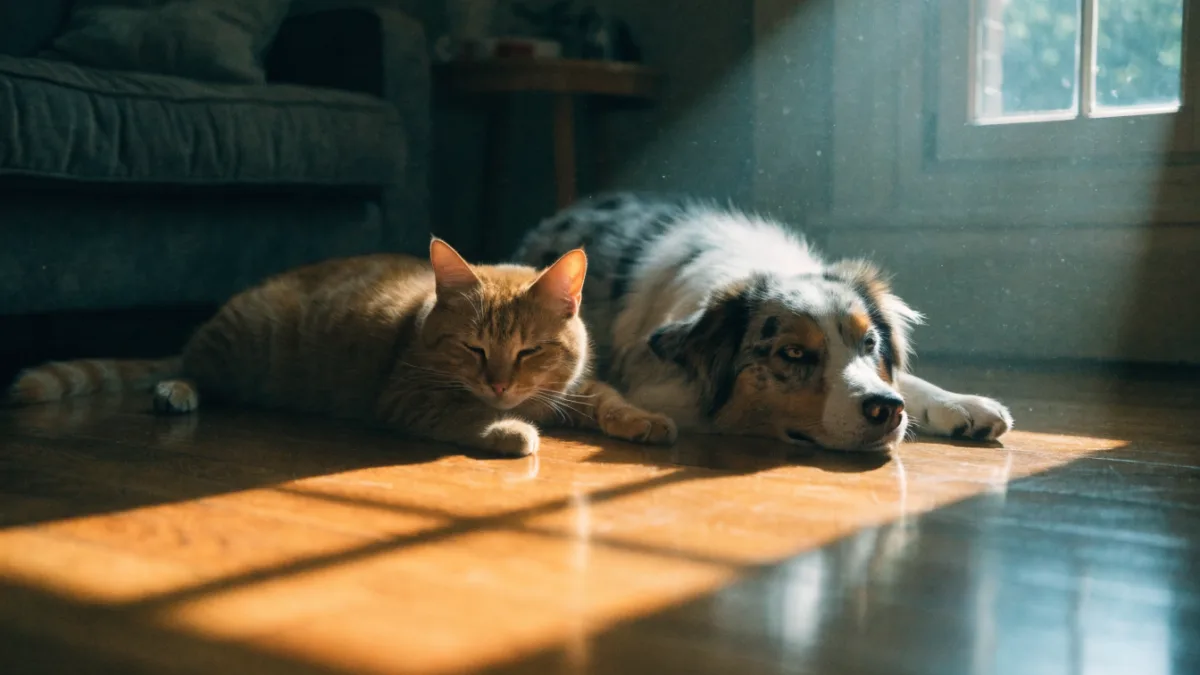
Every afternoon around three o’clock, a familiar ritual unfolds in my living room. My own dog, a thick-coated shepherd mix named Finn, gets up from his bed, walks over to the sliding glass door, and flops down directly in the center of a three-foot square patch of sunlight on the rug. An hour later, he will shuffle a few feet to the left, chasing that beam of light as the sun moves across the floor.
I see this exact same behavior in my clinic all the time. Just last week, I was on a video consult with a client, Susan, who was worried about her nine-year-old calico cat, Penelope. Susan apologizing for Penelope’s loud purring in the background. “She insists on baking herself right in the front window every single afternoon,” Susan laughed. “Is she just part lizard? Should I be worried she’s going to overheat?”
Susan’s question is one I hear constantly. We tend to project our own ideas of comfort onto our pets, assuming that if we would be sweating in a heavy fur coat, they must be miserable, too. But the truth is far more fascinating. Your dog or cat’s obsession with sunbathing isn’t just a quirky personality trait. It is a complex, hardwired biological instinct that triggers everything from vitamin synthesis to deep, healing relaxation.
The Great Sunbeam Migration
If you have a cat, you are intimately familiar with what I like to call the “sunbeam migration.” Felines are particularly dedicated solar-seekers. They will wake up from a dead sleep solely to relocate to a newly formed patch of sunlight on the hardwood floor.
This behavior is deeply embedded in their evolutionary history. Long before our pets lived in climate-controlled homes with central heating, their wild ancestors had to find creative ways to survive dropping temperatures. While dogs often hunted in packs and could generate heat through movement, cats are solitary ambush predators. They conserve energy between hunts by finding the warmest possible microclimates in their environment—usually a sun-baked rock or a patch of dry earth.
Even though Penelope the calico has never had to hunt for her dinner, her brain is still telling her that finding a localized heat source is a matter of survival. The sunbeam on the living room rug is just a modern stand-in for a warm boulder in the wild.
The Biology of the Basking: How Fur Makes Vitamin D
We all know that when humans sit in the sun, our skin absorbs UVB rays and synthesizes Vitamin D, which is crucial for our bone health. But have you ever wondered how a thick-coated Golden Retriever or a fluffy Maine Coon manages to get any vitamins from the sun at all?
The answer is one of the most amazing biological workarounds in the animal kingdom. Because their thick fur blocks most UVB rays from ever reaching their skin, dogs and cats cannot synthesize Vitamin D the exact same way we do. Instead, they rely on a two-step process involving their skin oils.
When your pet lies in the sun, the UVB rays interact with the sebaceous glands in their skin. This reaction creates a chemical precursor to Vitamin D3, which then sits on the surface of their fur and skin. So, how does it actually get into their body? They ingest it.
Think about the meticulous grooming habits of a cat, or how a dog will lick its paws and coat after a long nap. When they groom themselves, they are actively licking up that UVB-activated oil and swallowing it. Their digestive system then processes it into usable Vitamin D3. It’s an incredibly elegant system, but it only works if they actually expose themselves to the sun in the first place. That drive to “bake” themselves is a fundamental biological imperative. Without it, they would struggle to maintain proper bone formation, muscle development, and healthy nerve function.
More Than Just Warmth: The Science of Deep Recovery
Beyond vitamin production, lying in the sun is a brilliant thermoregulation strategy. Dogs and cats naturally run a slightly higher basal body temperature than humans—usually between 100.5 and 102.5 degrees Fahrenheit (38 to 39.2 degrees Celsius). Basking in external heat allows them to maintain this temperature without having to burn precious calories to generate internal heat.
But there is another layer to this behavior: profound relaxation. I’ve changed my mind on this over the course of my career. Early on, I used to think sunbathing was just a lazy habit. But recent behavioral science shows us that deep heat therapy acts as a biological trigger for the parasympathetic nervous system—the system responsible for “rest and digest” functions.
When a pet stretches out in a sunbeam, the gentle, radiant heat increases blood flow to their muscles and joints. This helps to soothe microscopic tears from physical exertion and eases the chronic ache of conditions like osteoarthritis. I see this frequently with older patients. An eight-year-old Boxer named Buster came in a few months ago with mild hip dysplasia. His owner, Mark, was convinced Buster was depressed because he was sleeping more. In reality, Buster had just figured out that spending two hours a day in the sunny back room significantly reduced his joint inflammation. He wasn’t depressed; he was doing physical therapy.
When Instincts Mislead: The Heatwave Debate
However, this deep-seated evolutionary instinct comes with a very real, modern danger. Dogs and cats are remarkably poor at recognizing when they are pushing their bodies too far. They simply do not possess the foresight to realize that their instinctual drive to bake in the sun could actually cause them to overheat and develop heatstroke.
This is a hot topic among veterinary behaviorists right now, especially as global temperatures rise and severe heatwaves become more common. In the wild, a cat or dog could simply walk away from a sun-baked rock when they got too warm and find a shaded bush to cool down in. But an indoor pet lying in a greenhouse-like sunroom, or a double-coated Husky lying on a sunny patio, might fall asleep in the sun and fail to notice that the ambient temperature has reached dangerous levels.
Your pet’s instinct overrides their body’s need to actively cool down. They will stay in the sun until it is almost too late. This means the responsibility of heatwave management falls entirely on us. You cannot rely on your pet to self-regulate their sun exposure during the peak sunlight hours of summer.
If you know your pet loves to sunbathe, you don’t have to ban them from the joy of the sunbeam, but you do need to manage their environment. Here is what I recommend to my clients:
- Enforce indoor shade: During peak afternoon heat, close your curtains or blinds halfway. It breaks up the intense, direct UVB exposure while still letting light into the room.
- Provide active cooling options: Look for pet cooling mats that use pressure-activated gel to draw heat away from the body. Place these right next to their favorite sunny spot so they can easily transition from baking to cooling off.
- Set up hydration stations: Make sure fresh, cool water is easily accessible near their favorite resting spots. Running water fountains often encourage cats to drink more than still bowls of water.
Ultimately, our pets haven’t quite caught up to the modern, climate-controlled world we’ve brought them into. Their wild instincts still tell them to soak up every last ray of sunlight they can find. By understanding the science behind their sun-seeking behavior—how it helps them process vital nutrients and heal their muscles—we can appreciate just how beautifully complex they are. We just have to make sure we’re paying close enough attention to step in and close the blinds when that ancient instinct stops serving them well.