

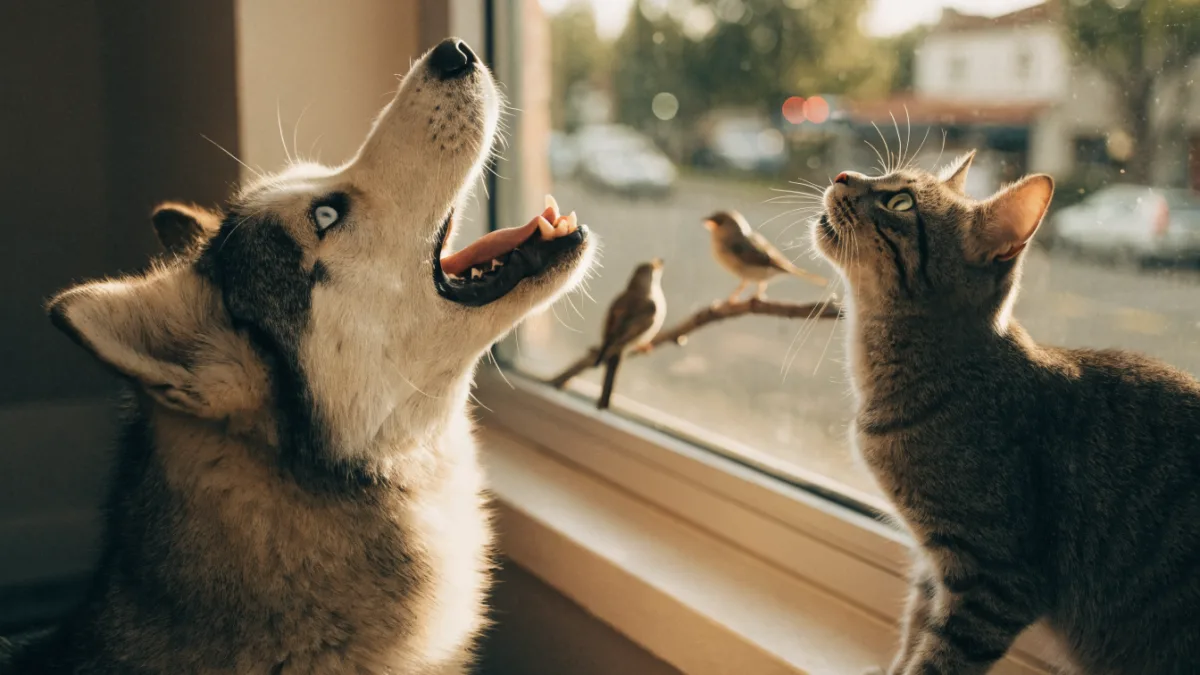
You are sitting on the couch, enjoying a quiet afternoon, when an ambulance flies by three blocks away. Suddenly, your dog throws their head back and lets out a long, mournful howl. A few minutes later, your cat marches over to the window, spots a sparrow on the sidewalk, and starts making a bizarre clicking, chattering sound that makes her look like she has a motor in her throat.
To us, it looks like our pets are losing their minds over absolutely nothing. But your dog and cat aren’t going crazy. They are actually tapping into some deeply ingrained, ancient instincts. Once you understand what is actually happening in their heads, that weird behavior starts to make perfect sense.
The Siren Mystery: Is It a Phone Call?
For a long time, a lot of us thought dogs howled at sirens because the noise physically hurt their ears. It is an easy mistake to make. When a fire truck blares its air horn right next to your car, you want to cover your ears, too. But most modern animal behaviorists and veterinarians agree that pain is not the main driver here. If sirens truly hurt their ears, a dog would typically run away and hide. Instead, they stand tall, throw their heads back, and join in.
The real reason is all about pitch. A dog’s ears are incredibly tuned into specific frequencies. The high-pitched frequency of an ambulance or police siren just happens to closely mimic the pitch of another dog’s howl. When your dog hears that wail, they are not thinking, “Ouch, my ears!” They are thinking, “Wow, listen to that massive, distant pack mate calling out!”
Your dog’s howl is an instinctual response to communicate. In the wild, canines use howls to assemble the group, announce their location, or warn off intruders. When your dog howls at a siren, they are just answering the call. They are announcing their presence to what they assume is a very loud, very faraway friend.
The Neighborhood Choir
Have you ever noticed that once one dog in the neighborhood starts howling at a siren, every other dog joins in? This is known as contagious howling. It taps right into a dog’s deeply ingrained pack mentality and their instinct for distance communication.
I remember working with a client who had a Husky mix. Every Tuesday morning, the garbage truck would roll through the alley. The Husky would let out one long howl, and within ten seconds, you could hear three other dogs down the street answering back. They were not complaining about the trash. They were simply holding a neighborhood roll call. When one dog says, “I am right here!” the others feel compelled to reply, “I am right here, too!”
The Canine Dictionary: Not Just Random Noise
We tend to lump all dog vocalizations into one category: barking. But scientific studies show that dogs have an entire dictionary of specific vocalizations for specific triggers. They can discriminate between different sounds and exactly what those sounds mean.
According to the,[1] dogs have highly structured, context-specific ways of communicating. They know the exact difference between a sharp, territorial bark meant to signal a stranger’s presence and a high-pitched, repetitive bark expressing dissatisfaction, like when they are left alone in a crate. Even the pitch and rhythm change depending on the situation.
Attention-Seeking vs. Alarm Barking
It is crucial to figure out why your dog is making noise, because how you handle an attention-seeker is totally different from how you handle an alarm barker.
If your dog is barking or howling just to get your attention, they will usually sneak a glance at you while they do it. They want you to engage. You might accidentally reward this behavior by yelling at them to stop. To a bored dog, even negative attention is still attention.
Alarm barking is a totally different beast. When a dog engages in alarm barking, they are reacting to a perceived threat or a territorial invasion. You will notice their body language gets noticeably stiffer and more rigid. Their hackles might go up, and their weight will shift forward onto their front paws. They are not looking at you. They are locked onto the stimulus, whether it is a squirrel, a delivery driver, or a weird shadow outside. They are just doing their job as the household security system.
In fact, recent developments in veterinary behavioral science are using AI and acoustic mapping to decode these vocalizations. This new technology is proving once and for all that dog barks and howls are highly structured communication tools, not just random noise. They are talking. We just need to learn how to listen.
Switching Gears: Why Cats Chatter at Birds
Dogs are not the only ones with weird vocalization habits. If you have an indoor cat, you have probably seen them sitting on the windowsill, staring at a pigeon or a squirrel, and suddenly making a rapid, clicking, chattering sound. Their jaw vibrates, their pupils dilate, and they look like they are short-circuiting.
This feline behavior is incredibly common, and it comes down to one thing: predatory frustration.
Cats are ambush predators. Their entire evolutionary blueprint is built around stalking, chasing, and catching prey. When your indoor cat sees a bird on the feeder through the glass, their predatory drive kicks into high gear. But they cannot reach the bird. The window gets in the way. All of that pent-up predatory excitement and frustration has to go somewhere, and it comes out as that strange chatter.
The Killing Bite Rehearsal
There is a bit of an expert debate about exactly what this chatter means, but most behaviorists fall into one of two camps.
Some believe it is purely an expression of frustration. Your cat is essentially swearing at the bird because they cannot get to it. It is the feline equivalent of throwing your controller at the TV during a difficult video game.
However, [2] also suggest another, more fascinating theory. That rapid jaw movement is an involuntary reflex related to their “killing bite.” When a wild cat catches a bird or a mouse, they use a specialized, ultra-fast jaw movement to snap the prey’s neck. When your housecat is chattering at the window, they might be involuntarily practicing the killing bite they would use on the bird’s neck if the glass were not there. They are mentally running through the hunt.
What Should You Do About It?
The most important thing to remember is that your pet is not being bad. They are not trying to annoy you. They are just experiencing a wild instinct in a very domestic setting.
If your dog is howling at sirens, you can usually just let them sing it out. It passes in a few seconds. However, a growing topic of discussion among pet experts right now is city noise pollution. As our neighborhoods get louder, our pets are getting exposed to more high-frequency sounds than ever before, leading to unnecessary stress and alarm barking.
If your dog’s reaction to outdoor noises is becoming chronic, do not reach for aversive tools like shock collars or prong collars. Those just suppress the behavior and add anxiety to the equation. Instead, manage the environment. Close the windows or play classical music or white noise to muffle the high-frequency outdoor sounds. You can also work on building a positive association with the noise by rewarding your dog for checking in with you when a siren passes, rather than demanding silence.
As for your cat, if they are chattering at birds, let them enjoy the show. It provides vital mental enrichment. Just make sure your windows have secure screens so that frustrated hunting instinct does not lead to an accidental escape.
At the end of the day, we share our homes with animals whose brains are still wired for the wild. When your dog howls at a passing siren or your cat chatters at a sparrow, they are just doing exactly what nature designed them to do. A little patience, a lot of observation, and a good sense of humor go a long way in bridging the gap between their wild instincts and our living rooms.
Sources
- ASPCA's guidelines on canine behavior — aspca.org
- experts studying animal instincts — facebook.com