

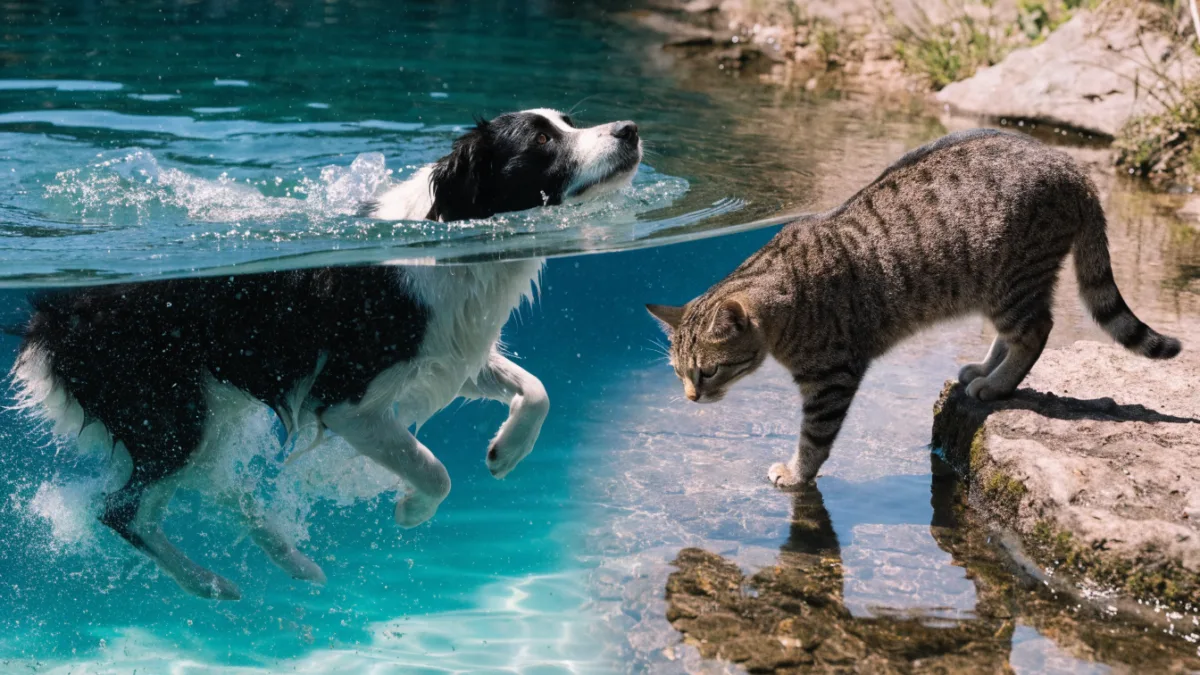
You take your dog to a lake, throw a bumper off the end of the dock, and he launches himself into the water without a second thought. Meanwhile, you accidentally turn the bathroom faucet on a little too hard, and your cat acts like you’ve declared biological warfare. It is easy to look at these two reactions and assume that dogs are natural-born swimmers while cats are physically incapable of keeping their heads above water.
But the biology behind how our pets interact with water is a whole lot weirder than that. The truth is, cats are actually incredible swimmers. And dogs? Well, their natural instinct to paddle can actually get them into serious trouble if they don’t know what they’re doing. Let’s break down exactly why dogs and cats react to water so differently, and why you might want to rethink how you introduce your pet to the deep end.
Trotting on Water: The Mechanics of the Dog Paddle
When a dog falls into the water, their brain tells their legs to do exactly what they do on land. The.[1] we call the “doggy paddle” is actually just a submerged trot. They move their diagonal pairs of legs together—front left with back right, then front right with back left—exactly like they do when walking down the sidewalk.
Humans can’t do this. If you tried to swim using the exact same biomechanics you use to walk, your heavy legs would sink straight to the bottom, and you’d be dragging yourself under. But a dog’s center of gravity, combined with their buoyant lungs, allows them to keep their bodies relatively horizontal while they trot through the water. It is a brilliant evolutionary crossover. Their brain recognizes that they are no longer on solid ground, but the motor pattern doesn’t change. They just keep trotting.
Nature Meets Panic
However, just because the instinct kicks in does not mean the dog executes it perfectly on day one. I had a client a few years back with a rescue Coonhound. They were convinced their dog would naturally take to the local quarry lake. The moment the dog stepped off a submerged shelf and lost his footing, absolute chaos broke out.
He furiously windmilled his front legs, barely keeping his chin above the surface, while his back legs dragged uselessly behind him. He was exhausted within twenty seconds, and we had to guide him back to the shallows. He wasn’t drowning, but he was a terrible swimmer because panic overrode his natural trotting instinct.
The “Front Wheel Drive” Problem
When a dog (or a human, for that matter) panics in the water, their brain hyper-focuses on keeping their eyes, nose, and mouth above the surface. To do this, the dog slams their front legs down into the water, using their front shoulders to push their head up. This creates what behaviorists and canine rehab specialists call the front wheel drive problem.
Because all the energy and forward momentum is coming from the front end, the dog’s back end inevitably begins to sink. A sinking rear end pulls the dog’s whole body into a vertical position. And the more vertical a dog gets, the harder it is to stay afloat. It becomes a frantic, vertical thrashing session that burns through a dog’s energy reserves incredibly fast.
This is exactly why the old-school myth of “just throw them in, they’ll figure it out” is so dangerous. Tossing a dog into deep water forces them straight into a panic state. If they default to front-wheel drive, they might not figure out that they need to kick their back legs before they run out of steam. Modern animal behavior experts heavily advocate for the exact opposite approach: gradual, positive acclimation using a ramp or a shallows, sometimes paired with a dog-specific life jacket, to help the dog learn to trust the water and engage their whole body.
Anatomy vs. Instinct: Not Every Dog Belongs in the Deep
Even if a dog completely masters the physical trotting motion, their body shape might be working against them. While the [2] is universal in domestic dogs, the physical execution is on a massive spectrum.
You can’t talk about dogs and water without looking at how different breeds are built. A Labrador Retriever or a Portuguese Water Dog is built like a floating torpedo. They have deep, barrel chests that provide natural buoyancy, thick otter-like tails that act as rudders, and water-resistant double coats that keep them warm.
On the flip side, try putting a Bulldog, a Pug, or a Frenchie in a pool. These dogs are essentially built with sink-rates. They have incredibly dense, heavy body masses packed into short frames, and their heavy heads sit right on top of brachycephalic (short-nosed) airways. When a heavy-chested, short-snouted dog tries to swim, their chest pulls them straight down. Their flat faces make it incredibly difficult to angle their noses out of the water without tipping their whole heavy head forward. Many of these dogs physically cannot swim safely, no matter how strong their instinct to paddle is. If you have a dog built like a brick, a well-fitted canine life jacket with a chin-rest float isn’t an accessory; it’s a requirement.
The Feline Paradox: Incredible Swimmers Who Hate Getting Wet
Let’s shift gears to your cat. If you’ve ever tried to bathe a feline, you know the sheer, unadulterated panic that a running faucet can induce. But here is the irony: [3]
If a domestic cat falls into a body of water, their instinct kicks in flawlessly. They don’t need to be taught the butterfly or the backstroke. They automatically drop into a highly efficient swimming motion. They keep their heads perfectly still and above the water, using their powerful back legs to paddle in a smooth, synchronized rhythm. In fact, many big cats—like tigers and jaguars—regularly hunt, swim, and play in water to cool off. Physically, the feline body is built for aquatic survival.
So, if they are so good at it, why do they act like a few raindrops are going to end their lives?
Evolutionary Caution and the Fur Coat
It comes down to two things: evolutionary strategy and grooming. Cats are apex ambush predators. Their entire survival strategy relies on stealth, precise balance, and total control of their environment. Water removes all of that control. A wet floor is slippery. A deep pool is an unpredictable trap. Cats are hardwired to avoid situations where they cannot perfectly control their footing, because a broken leg or a surprise predator in the wild means certain death.
People often assume cats hate water because they can’t swim. In reality, they are excellent swimmers who simply choose not to.
Then there’s the fur. Unlike a Golden Retriever whose coat is designed to repel water and lock in warmth, a domestic cat’s coat acts like a thick, heavy sponge. When a cat gets soaked, their fur weighs them down dramatically. It throws off their natural agility and takes hours of meticulous grooming to dry, leaving them vulnerable to cold and completely miserable. It almost looks like they are embarrassed by their stroke, but really, they just despise losing their stealth advantage.
Respecting the Divide
Understanding the divide between how dogs and cats handle water completely changes how we should manage our pets around pools, lakes, and bathtubs. Stop assuming your dog is automatically water-safe just because he’s a dog. Introduce him to water slowly, watch to see if he uses his back legs, and invest in a life jacket if he’s heavy-set or easily spooked. And stop assuming your cat is a helpless victim of the deep. If she ever takes an unexpected tumble into the pool, she’ll probably paddle to the edge and climb out just fine—she’ll just be incredibly annoyed at you for letting it happen. Whether you’re dealing with a water-loving retriever or a bath-hating tabby, respect their biology, manage their environment safely, and let them tell you where they feel most comfortable.
Sources
- instinctive swimming motion — reddit.com
- instinct to paddle — facebook.com
- cats are physiologically incredible swimmers — facebook.com