

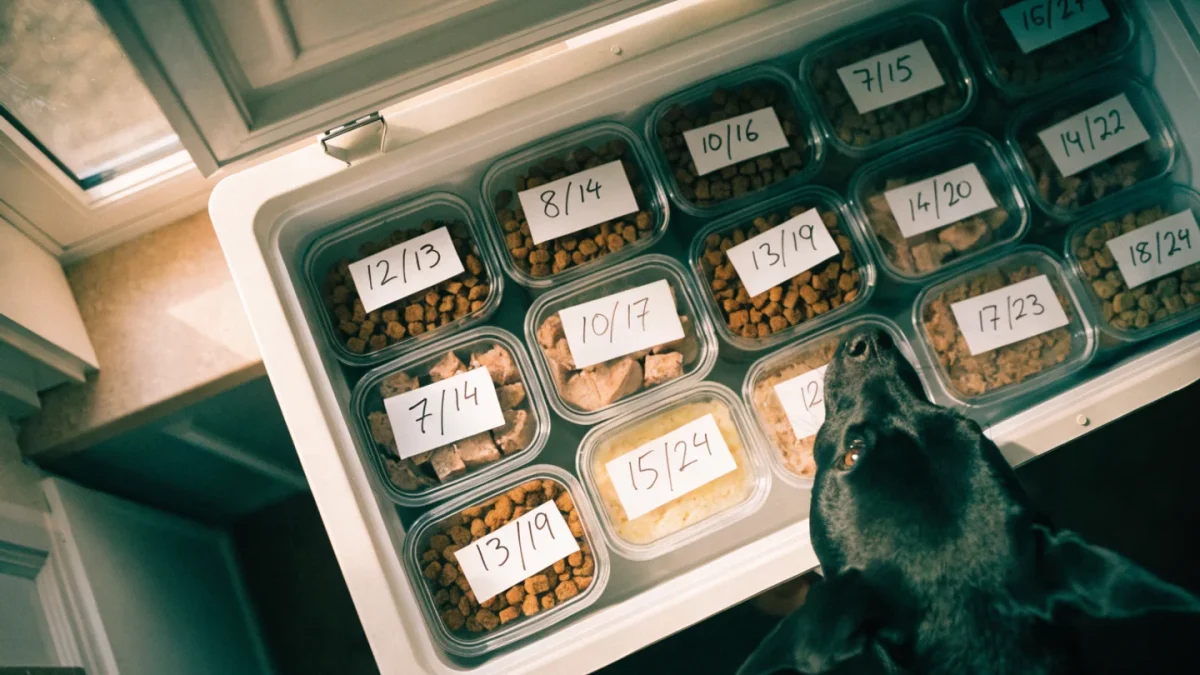
My client David — a high school science teacher with a very large, very food-motivated Newfoundland named Atlas — started batch cooking Atlas's food about two years ago, after months of daily cooking had worn him down. His system is one of the more organized I've seen: Sunday afternoon, two hours, twelve portions in the freezer, done for the week. He told me the turning point was realizing he was cooking for his dog more carefully than he was cooking for himself.
That's essentially the batch cooking mindset — front-loading the work so daily feeding is simple and consistent.
Why Batch Cooking Makes Sense
Daily cooking of homemade pet food is fine in theory but impractical for most people long-term. The fatigue of daily prep is one of the most common reasons owners eventually abandon homemade feeding — not because they stop caring, but because it stops fitting into real life.
Batch cooking solves this. You spend a few hours once or twice a week preparing large quantities, portion it into individual meal-sized containers, freeze most of it, and pull from the freezer as needed. The daily feeding routine becomes no more complicated than thawing a portion overnight in the refrigerator.
Consistency is another underrated benefit. When you make the same recipe in large batches and follow it carefully, the nutritional profile stays consistent meal to meal. This matters more than it sounds — one of the ways homemade diets drift toward deficiency is through informal recipe variation when people cook in small quantities and "eyeball" proportions.
The Basic Batch Cooking Process
-
Calculate the total quantity needed. For a week's batch for a 25 kg dog eating 2.5% of body weight daily (roughly 625g/day), you need about 4.4 kg of total prepared food for a week. Scale up or down based on your dog's size and how often you want to batch cook.
-
Prepare all ingredients. Cook proteins through (if cooking rather than raw). Cook starchy vegetables. Lightly cook or steam any vegetables that are difficult to digest raw. Organ meats (if included) can be cooked briefly or, in a raw protocol, kept separate and portioned raw.
-
Add supplements after cooking. If your recipe includes fish oil, vitamin E, kelp, or other supplements — add these after the food has cooled, not during cooking. Heat degrades some vitamins and oxidizes fish oil. This is a detail that matters for nutritional accuracy.
-
Cool quickly. Before refrigerating or freezing, the food needs to cool to safe temperature. The danger zone (4–60°C / 40–140°F) is where bacterial growth is most rapid. Spread the food in a shallow container to cool faster, or set the pot in an ice bath. Don't leave a large hot pot of food to cool slowly at room temperature — it stays in the danger zone too long.
-
Portion before freezing. Divide into individual meal portions before freezing. Trying to break apart a large frozen block of pet food at meal time is miserable and inaccurate. Individual portions thaw quickly and consistently.
Storage Times
Refrigerator (4°C / 40°F or below): Three to four days maximum for cooked homemade food. I'd be conservative — after three days, the bacteria count is meaningful even in refrigerated food.
Freezer (-18°C / 0°F): Two to three months for best quality. Technically safe for longer, but freezer burn and flavor/texture degradation become factors. Label containers with the date you prepared them — it's easy to lose track.
Container Selection
Airtight containers matter, both for safety and for preventing freezer burn. Glass containers with locking lids work well, are easy to clean, and don't absorb odors over time. BPA-free plastic containers designed for freezer use are also fine. Ice cube trays are useful for small dogs or cats — freeze in the tray, then transfer the cubes to a sealed bag. Silicone freezer molds in larger sizes (100–150g per cavity) work well for medium dogs.
Label everything with the date and the recipe batch, particularly if you're rotating between different formulations.
Thawing Safely
The same rules apply as for any raw or cooked meat: thaw in the refrigerator overnight, not on the counter at room temperature. Counter-thawing at room temperature allows the outer layers to reach temperatures that support rapid bacterial growth while the interior is still frozen.
If you need to thaw quickly, a sealed container submerged in cold water (changed every 30 minutes) is safe. Microwave thawing works if you're feeding immediately.
Don't refreeze thawed homemade food — once thawed, use it within two to three days.
Adding Supplements at the Right Step
This comes up enough in practice that I want to be specific. Fish oil oxidizes when heated — cooking with it in the pot means the beneficial fatty acids are largely degraded by the time the food cools. Same issue with vitamin E and some B vitamins.
Add oil-based supplements (fish oil, vitamin E) to the cooled food when portioning. Add water-soluble supplements (B vitamins, iodine) at the same point. This preserves the nutrient value you're adding the supplement to provide.
A Note on Raw Components
If your recipe includes raw elements — whether you're doing a partly raw, partly cooked diet or including raw organ meats that you prefer not to cook — the storage and handling rules become more stringent. Raw components have the full bacterial load of raw meat and need to be kept frozen until use, thawed in the refrigerator, and not left at room temperature.
In practice, most batch-cooking approaches are fully cooked, which simplifies handling significantly. Fully cooked homemade food has a similar safety profile to other cooked leftovers.
For making nutritionally complete homemade pet food — the complete formulation guide — batch cooking works best when you have a solid recipe to batch cook from. And balancing the nutrients in homemade dog food covers the specific nutrients you need to make sure are present in your recipe before you commit to batching it at scale.