

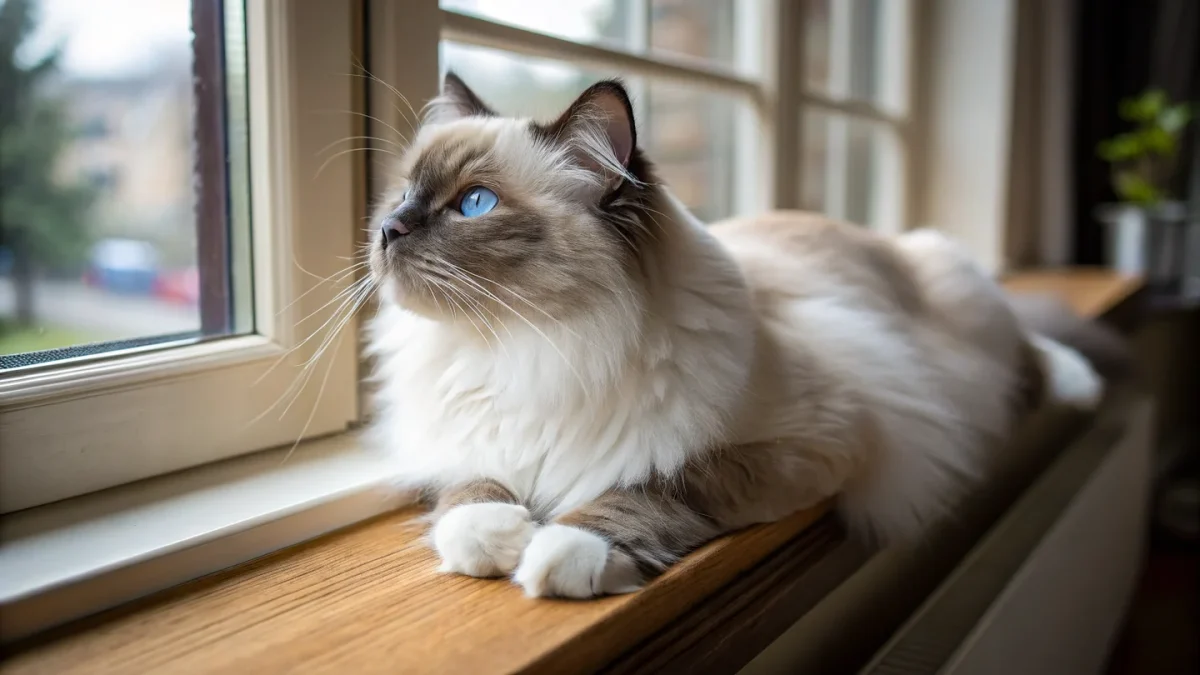
Every breed has a story about where it came from. Most of those stories contain some truth, some legend, and a significant amount of embellishment that accumulated as the story was retold. The Birman's origin story is the most elaborated of any breed I know — and the gap between the legend and what history can actually verify is wider than most breed enthusiasts acknowledge.
The Legend of the Sacred Cat of Burma
The story that has been attached to the Birman for most of the breed's formal history goes roughly like this:
In ancient Burma, white cats with yellow eyes served as guardians at the temple of Lao-Tsun, where the monks venerated the golden goddess Tsun-Kyan-Kse. The head priest, Mun-Ha, meditated nightly before a golden statue of the goddess. One night, during a raid on the temple, Mun-Ha died at the foot of the statue. His devoted cat, Sinh, placed his paws on his master's body — and at that moment, through the power of the goddess, a transformation occurred. The cat's white coat turned golden, its eyes became sapphire blue, and its paws where they touched the white hair of the dying priest remained eternally pure white. The nose, ears, face, and tail darkened to the color of earth. The following morning, all the other temple cats had transformed in the same way. Seven days later, Sinh died, carrying the soul of his master before the goddess.
It is a genuinely beautiful story. The specific visual elements — the golden coat, the sapphire eyes, the eternally white paws — correspond directly to the breed's actual physical characteristics.
The problem is that it is mythology, not history.
What Documentation Shows
The earliest verifiable records of Birman cats appear in France in the early 1920s. The breed was formally recognized in France in 1925, by the Cat Club de France — that's the one hard date in this whole story, and even it is just a year. Nobody's ever produced a day or month for it, which tells you something about how thin the paper trail is even at the "official" end of this history.
Two early individuals — often cited in breed histories as Dieu d'Arakan and Maldapour — appear in French breeding records, but the claims about how they arrived in France vary significantly between sources. The most frequently repeated story is that a pair of temple cats were brought to France by Westerners from Burma — some sources say they were purchased, some say they were given as a gift, some say they were smuggled. I went looking for anything harder than folklore on this and came up empty. The most detailed version circulating in breed histories names the cats Maldapour and Sita, has them leaving a Burmese temple in 1919, and has Sita giving birth in Nice to a kitten called Poupée de Maldapour who became the actual foundation of the French line. It's a specific story. It's just not a documented one — it comes from breed enthusiast accounts passed down through the fancy, not from anything a genealogist could verify.
What can be said with confidence: the Birman emerged as a recognized breed in France in the early 20th century. The physical type — pointed coloration, semi-long silky coat, blue eyes, white paws — was established and consistent enough by 1925 to receive formal recognition. Whether this breed was developed from imported foundation animals, from crossbreeding existing French cats, or through some combination, is not established by surviving records.
World War II nearly ended the breed entirely. By the end of the war, essentially no pure Birmans remained in Europe. The postwar reconstruction involved crossbreeding — likely with Persians and other longhaired cats — before the breed was reestablished to its current type through careful selection.
The Legend's Function
It would be unkind and uncharitable to dismiss the Sacred Cat of Burma legend as simply a marketing device, though it has certainly served that purpose. Breed legends serve a real function in human culture: they give animals a narrative weight, an ancestral dignity, that reinforces why we value them.
The Birman doesn't need the legend to justify its existence. The actual breed — the animal you might share your home with, with its silky pointed coat and white-gloved paws and gentle, considered temperament — is worth knowing and appreciating on the merits of what it actually is.
What the legend does is tell us something about the people who developed the breed and the communities that treasured it: that this was a cat worth constructing a mythology around, worth imagining in temples, worth endowing with the marks of divine favor. That impulse, at least, is understandable.
The Birman cat breed guide situates these origins in the full picture of the breed. The honest summary of where the Birman came from is: France, in the 1920s, from foundations that remain genuinely uncertain. The legend of the temple is a beautiful story the breed carries. The breed itself is real, consistent, and documented enough to know exactly what it is — even if exactly how it came to be remains a mystery.