

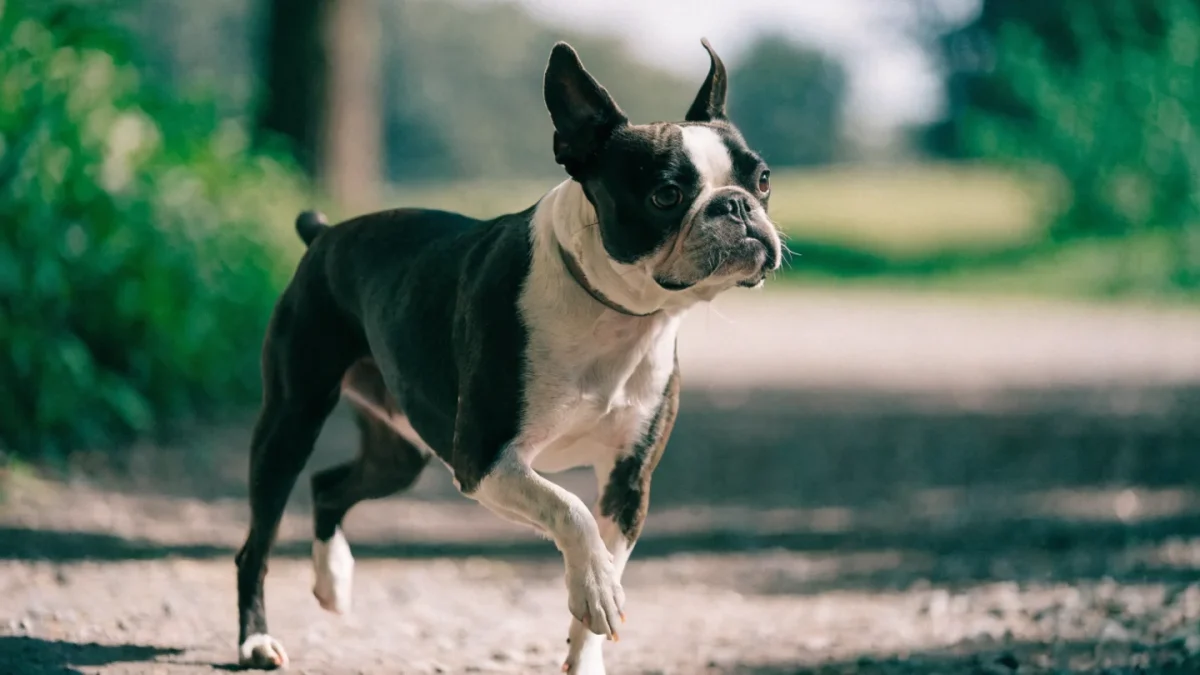
The first Boston Terrier I spent extended time with belonged to a veterinary technician who ran three miles with the dog every morning in autumn and switched to fifteen-minute walks in July. Same dog, same owner, completely different routines depending on the season. That flexibility captures the central reality of boston terrier exercise needs: the breed is more athletic than people assume, but its brachycephalic anatomy imposes a hard ceiling that shifts with the weather.
Getting this balance right matters. An under-exercised Boston gains weight, gets bored, and develops behavioral problems. An over-exercised one — particularly in heat — risks respiratory distress and heatstroke. The window between those extremes is wider than it is for bulldogs or Pekingese, but it's still narrower than for any muzzled breed.
The Daily Baseline
A healthy adult Boston Terrier at appropriate weight needs 30 to 60 minutes of daily activity. Two walks of 15 to 25 minutes each, plus one or two interactive play sessions, covers most individuals well.
That range reflects the breed's genuine variation. Smaller Bostons (under 7 kg) and those with more significant brachycephalic compromise may do well at the lower end. Larger, more athletic individuals — particularly those from lines bred for moderate facial structure — can handle and benefit from the upper end.
Walk pace matters. Bostons are natural trotters with a confident, rhythmic gait. A moderate walking pace that lets the dog explore, sniff, and engage with the environment provides better physical and mental value than a brisk power walk that has the dog panting within ten minutes.
Heat Is the Hard Limit
Boston Terriers cool themselves through panting, and their shortened airways make panting less efficient than in longer-muzzled breeds. When air temperature and humidity rise, the dog's ability to shed excess body heat drops.
Temperature threshold. Above roughly 26 degrees Celsius (79 degrees Fahrenheit), shift outdoor activity to early morning or evening. Above 30 degrees Celsius with any meaningful humidity, outdoor exercise beyond brief bathroom breaks becomes risky.
Warning signs. Heavy rasping pants, thick drool, a wide-eyed or glazed expression, stumbling, or reluctance to continue moving. If you see any of these, stop immediately, move to shade or air conditioning, offer water, and apply cool (not ice-cold) water to the belly and paw pads.
Carry water. On every walk, in every season above mild temperatures.
Indoor Alternatives
Climate restrictions mean many Boston owners need indoor exercise options for parts of the year.
Fetch in a hallway or open room. Short retrieval games satisfy the breed's play drive without sustained cardiovascular demand. Keep sessions to ten minutes.
Puzzle feeders and scent games. Scatter part of the dog's daily food ration across a room or hide it in puzzle toys. Nosework is mentally taxing without any respiratory stress. Many Bostons take to it immediately.
Training as exercise. Five-minute trick-training sessions engage the brain and tire the dog more effectively than you'd expect. Bostons respond well to variety — rotate through different commands and behaviors rather than drilling the same one.
Tug and interactive play. Short tug sessions with a toy provide physical engagement. Let the dog win sometimes. Quit before the dog starts panting hard.
Puppy Exercise
Young Bostons have chaotic bursts of energy followed by sudden naps. The general guideline of five minutes of structured exercise per month of age, twice daily, applies as a starting point. An eight-week-old puppy gets two sessions of roughly ten minutes each — light play, short garden exploration, gentle socialization walks.
Avoid repetitive high-impact exercise (jumping, stairs, hard-surface running) until the puppy is at least twelve months old and growth plates have closed. Free play on soft surfaces — grass, carpet — lets the puppy self-regulate intensity, which puppies do naturally if you don't push them.
The Weight Connection
A Boston carrying excess weight faces a compounding problem: it needs more exercise to lose weight but tolerates less before overheating. The French Bulldog exercise needs profile presents a closely related challenge, with similar brachycephalic constraints — a useful comparison for owners managing flat-faced breeds. The solution is always diet first, activity second. Reduce caloric intake, then gradually increase activity as weight comes down.
An ideal-weight Boston has a visible tuck behind the ribs when viewed from the side and a detectable waist from above. Ribs should be easily felt with light pressure. On a dog this small, even half a kilogram of excess weight is proportionally significant.
For the complete picture of Boston Terrier care — health profile, grooming, nutrition, and lifestyle compatibility — the complete breed guide covers it all. And if you're still deciding whether the breed fits your daily routine, the honest ownership assessment breaks down what's actually required.