

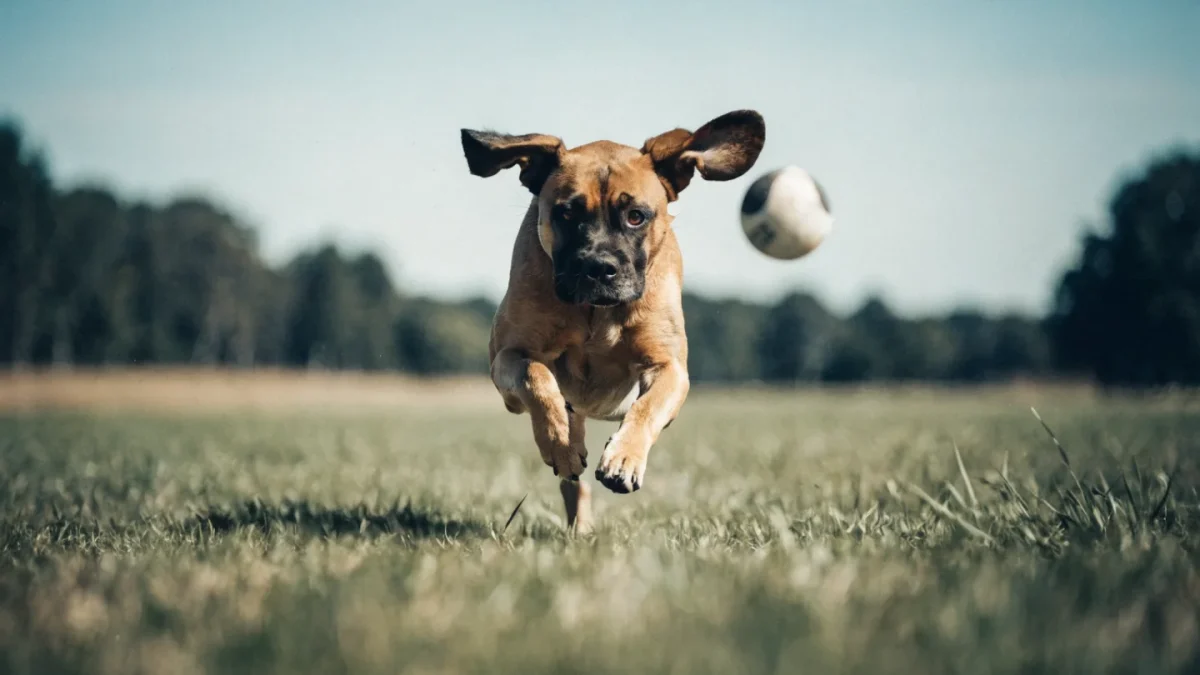
A boxer's muscular build tells you almost everything you need to know about its exercise requirements before you read a single word. This is a dog engineered for explosive physical output — deep chest, powerful hindquarters, compact athletic frame. A breed shaped like a sprinter doesn't become a couch dog just because it lives in a house.
The most useful number for boxer dog exercise needs: 60 to 90 minutes of vigorous activity daily for a healthy adult. Vigorous means the dog is moving hard enough to pant, engage its muscles fully, and arrive home ready to rest. A leisurely walk around the block doesn't count.
The Daily Baseline
Adults (2+ Years)
Two exercise sessions per day works best for most boxers — a longer session of 30 to 45 minutes and a shorter session of 20 to 30 minutes. Splitting the activity prevents the build-up of restless energy that turns an under-exercised boxer into a destructive force inside the house.
Effective options for the breed's build and drive:
Running and sprinting. Boxers are built for speed over short to moderate distances. Most conditioned adults handle 5 to 8 km comfortably. They make attentive running partners — alert to their surroundings, responsive to pace changes. Avoid sustained distance running on pavement with dogs under 18 months, as growth plates remain open.
Fetch and retrieving games. High-intensity, self-limiting. The dog sprints, returns, and pauses before repeating. A ball launcher extends the distance and reduces wear on your arm. Most boxers maintain interest in fetch longer than many breeds.
Tug and interactive play. Engages the breed's jaw strength and competitive drive. Tug sessions build muscle in the neck and shoulders. Establish clear start and stop rules — boxers play hard and need to learn that the game ends on the handler's terms.
Structured dog sports. Agility courses channel the boxer's natural athleticism and jumping ability. Rally obedience combines physical movement with mental focus. Both are excellent for boxers because they satisfy the breed's need for handler-directed activity.
Puppies (Under 18 Months)
The guideline of five minutes of structured exercise per month of age, twice daily, provides a conservative starting point. A four-month-old puppy gets two 20-minute sessions. An eight-month-old gets two 40-minute sessions.
Free play on soft surfaces — grass, dirt, sand — is different from forced repetitive exercise. Let puppies play at their own pace. A puppy that lies down during play is communicating its limit. Pushing past that limit risks damage to developing joints, growth plates, and soft tissue in a breed already predisposed to hip dysplasia.
Avoid: repetitive jumping (no agility courses until skeletal maturity), long runs on hard surfaces, and stair climbing with young puppies.
Senior Boxers (8+ Years)
Older boxers self-regulate, often shortening their own walks and choosing lower-intensity play. Follow their lead. Two moderate walks of 20 to 30 minutes, supplemented by gentle play, keeps an aging boxer mobile without overstressing joints that may be developing arthritis. Swimming — if the dog enjoys it — provides excellent low-impact exercise for seniors.
Heat Management
This is the section that separates informed boxer ownership from general dog ownership. Boxers overheat faster than non-brachycephalic breeds of comparable size. Their shortened airways reduce the efficiency of panting, which is the primary cooling mechanism in dogs.
Temperature threshold. When air temperature exceeds roughly 25 degrees Celsius (77 Fahrenheit), shift exercise to early morning or evening. Above 30 degrees Celsius, limit outdoor activity to bathroom breaks.
Humidity amplifies risk. High humidity reduces evaporative cooling from panting. A humid 24-degree day can be more dangerous than a dry 28-degree day.
Warning signs. Excessive panting that doesn't slow after rest. Thick, ropy drool. Glazed eyes. Stumbling. Bright red or blue-tinged gums. Stop immediately, move to shade or air conditioning, apply lukewarm water to the belly and paw pads, and seek veterinary care.
Always carry water. Collapsible bowl, fresh water, every walk, every time. Non-negotiable.
For a comprehensive look at how exercise requirements fit within the breed's full health and care profile, the boxer complete breed guide covers the broader picture.
Mental Exercise
Physical output alone doesn't satisfy a boxer. The breed is smarter than its clownish reputation suggests, and a physically tired boxer with an unstimulated mind will still find destructive outlets.
Puzzle feeders and scatter feeding — distributing a portion of daily food across the yard or in a snuffle mat — engage the nose and problem-solving circuits without taxing the respiratory system. Nose work and scent detection games are excellent indoor options during extreme weather. Training sessions of 10 to 15 minutes, focused on new skills or trick work, provide concentrated mental load.
The goal isn't exhaustion. It's a balanced dog whose body and brain have both been adequately worked. That balance — as the boxer temperament guide explains in detail — is what activates the breed's genuine off switch and produces the calm, settled companion that makes boxers so rewarding to live with.