

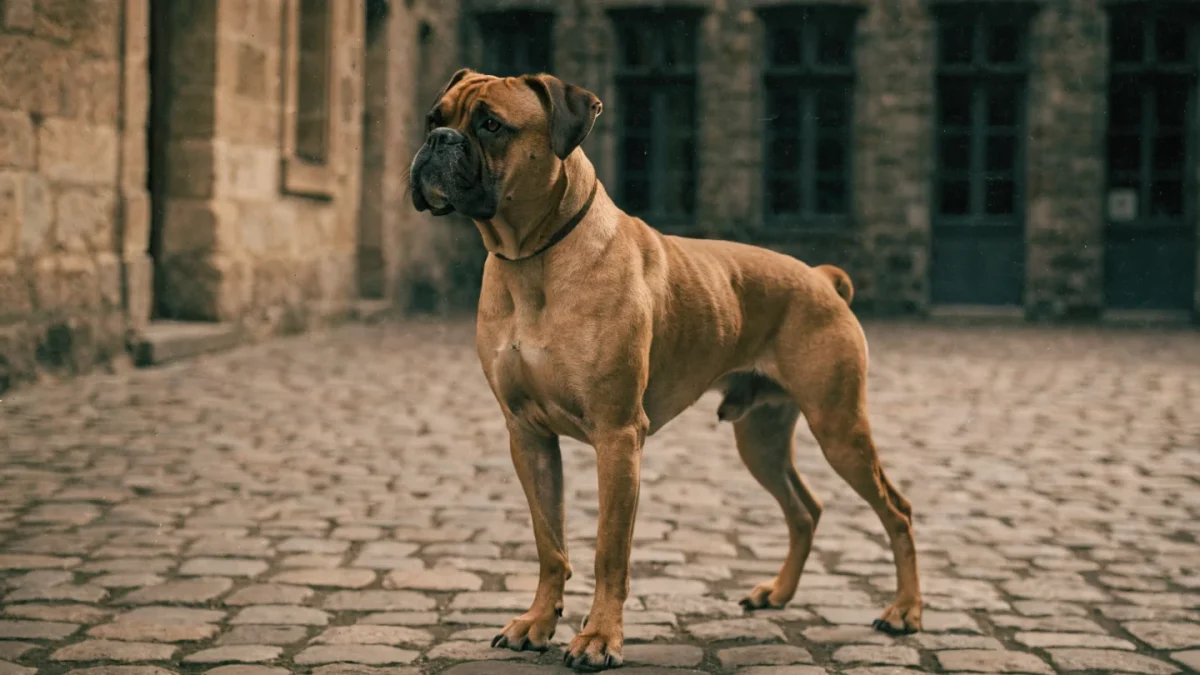
The Boxer's face is objectively ridiculous. Undershot jaw, pushed-in nose, jowls that flap when the dog shakes its head — the whole arrangement looks like an industrial accident involving a perfectly normal dog and something immovable. And yet it's not accidental. That face was engineered over centuries for one very specific purpose: to clamp onto a wild boar's snout and hold on while the animal tried to kill the dog attached to it. Two hundred years of working selection. For that face.
The boxer dog's history is a study in reinvention. No other breed has pivoted so completely — from medieval hunting tool to military asset to household companion — in such a compressed timeline. Understanding where that absurd, functional head came from makes the modern Boxer considerably more interesting than its current reputation as a family clown suggests.
The Bullenbeisser: A Dog Built for Blood Sport
The boxer's primary ancestor was the Bullenbeisser, a name that translates bluntly as "bull biter." But these dogs didn't fight bulls in pits, the way English Bulldogs did. The Bullenbeisser was a hunting dog, used across Central Europe from at least the Middle Ages to hold large game — wild boar, bear, and deer — after the pack of lighter hounds had run the quarry to exhaustion.
The job required a specific anatomy: broad, powerful jaws with an undershot bite that could clamp onto a boar's snout and maintain grip while the animal thrashed; a muscular, compact body low enough to avoid a boar's tusks; and a recessed nose that allowed breathing while the jaws were locked. Every physical trait that defines the modern boxer's head traces directly to this function.
Bullenbeissers were not a single standardized breed in the modern sense. They varied regionally — the larger Danziger Bullenbeisser in the north, the smaller Brabant variant in the south. By the 1800s, as large-game hunting became the province of a shrinking aristocracy, the smaller Brabant type survived in greater numbers. It was this variant that Munich breeders would use to create the boxer.
The Bullenbeisser's decline was already well underway by mid-century. Firearm improvements made holding dogs less necessary. The game estates that sustained them fragmented. A working breed without work faces a simple equation: adapt or disappear. The Bullenbeisser, in its original form, disappeared.
Munich in the 1880s: The Crossing That Changed Everything
The creation of the boxer happened in a specific place during a specific cultural moment. Munich in the 1880s was gripped by the Victorian-era dog show movement that had swept from Britain across Europe. Suddenly, breeding dogs wasn't just practical — it was a competitive hobby, a social activity, and a way to demonstrate both wealth and taste.
Munich breeders — some of them butchers and cattle dealers who had used Bullenbeissers professionally, others middle-class enthusiasts drawn to the new sport — began crossing the remaining Brabant Bullenbeissers with imported English Bulldogs. The English Bulldog of the 1880s was itself in transition, being bred away from its bull-baiting past toward a more compact companion form. It brought new traits to the mix: a more defined head shape, a shorter muzzle, and a temperament already shifting toward human sociability.
The first crosses were experimental and the results inconsistent. Some offspring favored the Bullenbeisser's leggier, more athletic build. Others took after the Bulldog's stockier frame. Breeders selected ruthlessly for the combination they wanted: the Bullenbeisser's athleticism and working drive with the Bulldog's compact structure and companion-friendly disposition.
Flocki, born in 1893 and shown successfully in 1895, wasn't the first of these crosses — but his show success gave the emerging breed public validation. His entry into the Munich stud book is generally cited as the breed's founding moment. A dog named Mühlbauer's Flocki appears in the genealogy of nearly every boxer alive today, though the direct genetic contribution is diluted across more than a century of subsequent breeding.
The Standard and the Club
Friedrich Robert, Elard König, and R. Höpner founded the first Boxer Club (Boxer Klub — Sitz München) in 1896 and published the initial breed standard in 1904. That standard codified what the Munich breeders had been working toward: a medium-large, square-bodied dog with a distinctive undershot jaw, a short smooth coat, and a temperament described in the original German text as "honest" — a word that, in context, meant straightforward, predictable, and free of the treacherous unpredictability that plagued some other bull-type breeds of the era.
The early breed standard also specified function alongside form. The boxer was classified as a working dog from the beginning, expected to demonstrate both physical capability and trainable temperament. This dual emphasis — a dog that looked right and worked right — shaped boxer breeding for the next century and distinguishes the breed's development from breeds created primarily for appearance.
By the 1910s, the boxer had established itself as a police and Schutzhund (protection sport) dog across Germany. The breed's combination of intelligence, physical power, courage, and handler-focus made it a natural for work that required both controlled aggression and absolute obedience.
Two World Wars
The First World War conscripted boxers into military service on a large scale. They served as messenger dogs, running communications between trenches and command posts through artillery fire. They carried supplies strapped to their backs. They stood guard. The breed's courage under extreme conditions was documented repeatedly, and the war cemented the boxer's reputation as a serious working dog rather than just a show ring novelty.
The interwar period saw boxer breeding continue to refine in Germany, with the breed club maintaining strict standards and testing requirements. Boxers entering the stud book needed to pass temperament evaluations — a practice ahead of its time and one that contributed to the breed's consistently stable disposition.
The Second World War deployed boxers again, and this time the war's aftermath would transform the breed's global profile. As Allied forces occupied Germany, soldiers encountered boxers serving in both military and civilian roles. The dogs' temperament — loyal, brave, playful with friendly people, protective in uncertain situations — resonated with servicemen who'd been living in close quarters with dogs for years.
When those soldiers went home, many brought boxers with them. The post-war importation of boxers to North America, Britain, and Australia created breeding populations that would diverge, over subsequent decades, from their German ancestors. The exact number of boxers imported during this period is not reliably documented, but the influx was substantial enough to establish a self-sustaining breeding population within a few years.
The American Explosion
The boxer's rise in North America was rapid even by the accelerated standards of post-war breed popularity. In 1949, a boxer named Mazelaine's Dorian won Best in Show at Westminster. In 1951, a dog named Bang Away repeated the feat — and then went on a show career that became legendary, winning over 100 Best in Show awards across multiple countries.
The 1950s and 1960s were the boxer's golden era in the American show ring and living room simultaneously. The breed ranked among the most popular in the country, fueled by a combination of show ring glamour, returning soldiers' loyalty to the breed, and the boxer's genuine suitability as a family dog in the suburban homes being built by the millions across post-war North America.
But popularity, as always, carried a cost. Demand outstripped the supply of carefully health-tested breeding stock. Commercial breeders produced puppies for volume rather than quality. The genetic bottleneck tightened. Health problems that had been manageable in a smaller, more carefully managed population — cardiac disease, cancer predisposition, hip dysplasia — became more prevalent as the breeding population expanded without proportional attention to health screening.
The breed's trajectory from that point mirrors other popular breeds: a surge of demand, an expansion of breeding programs of variable quality, and a gradual recognition that some of the health burdens the breed carries today were amplified by decades of prioritizing appearance and availability over genetic health.
Two Divergent Paths
The boxer today is not a single unified breed so much as a family of related populations shaped by different breeding priorities across continents. German and European lines, still influenced by the working-dog testing requirements of clubs like the ATIBOX (Association Technique Internationale du Boxer), tend to produce dogs that are leaner, more athletic, and assessed for temperament as a condition of breeding.
North American and British lines, developed primarily within show ring culture, tend toward a stockier build, broader head, and more pronounced brachycephalic features. Neither type is more "correct" — they reflect divergent selections from the same genetic source.
The historical threads that connect Flocki to today's boxer run through genetic patterns — from coat color inheritance to the health markers that trace back to the breed's founding population. For a broader view of how this history shapes the breed's daily reality, the boxer complete breed guide ties these origins to contemporary temperament, health, and care.
What began in a Munich show ring in 1895 with a white dog of mixed parentage has produced one of the world's most versatile and recognizable breeds. The Bullenbeisser is extinct. The boxer is everywhere. That transformation, accomplished in barely four human generations, remains one of the most compressed breed evolutions in canine history.
The boxer's temperament today — the playful intensity, the guarding instinct held in check by human-focus, the emotional attunement — carries the fingerprints of every stage of that history. The boar hunter's tenacity. The military dog's courage and handler-loyalty. The companion dog's need for human presence. Understanding where the breed came from is the most reliable way to understand why it behaves the way it does now.