

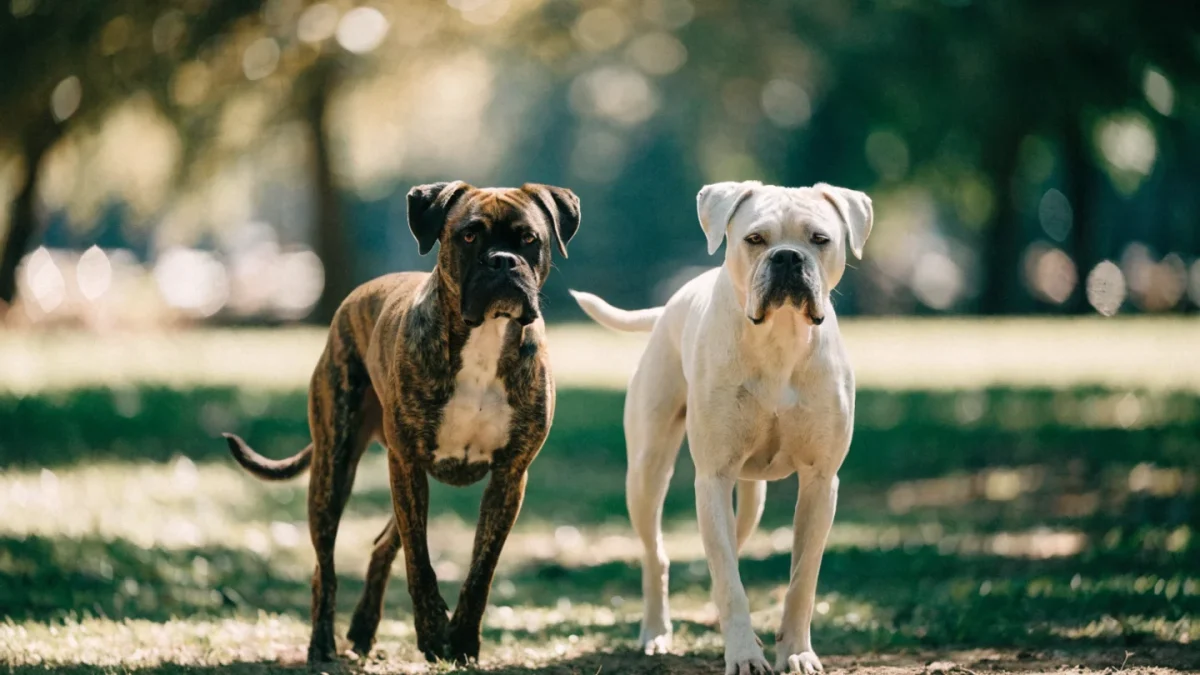
The first boxer entered into a stud book — Flocki, registered in Munich in 1895 — was white. That a white dog founded the breed and white dogs are now excluded from the show ring across most breed organizations tells a compressed story about how genetics, aesthetics, and health science have shaped the boxer over the past century.
Boxer coat genetics are more layered than the fawn-or-brindle binary most people encounter. Understanding how boxer genetics white boxer brindle patterns actually work clarifies several questions that surface repeatedly: why white boxers appear so frequently, whether brindle is dominant or recessive, and which genetic health markers matter most for the breed's future.
The Base Color System
Every boxer's coat starts with a simple genetic question: fawn or brindle?
The answer sits at the K-locus (DEFB103 gene). Brindle is produced by the Kbr allele, which creates black striping over a fawn base. Fawn (the absence of brindle striping) is produced by the ky allele. In boxers, the Kbr allele is dominant over ky, which means:
- Kbr/Kbr (two copies of brindle): Brindle. Will only pass brindle to offspring.
- Kbr/ky (one brindle, one fawn): Brindle. Can pass either brindle or fawn to offspring.
- ky/ky (two copies of fawn): Fawn. Will only pass fawn to offspring.
Two fawn boxers bred together will always produce fawn puppies. Two brindle boxers can produce fawn puppies if both carry the ky allele. This simple inheritance pattern is why breeders can predict coat color outcomes with reasonable accuracy when the parents' genotypes are known.
The shade of fawn — from pale tan to deep red-mahogany — is influenced by additional modifier genes that are less well characterized. The intensity of brindle striping (light "tiger stripes" versus heavy, nearly black "reverse brindle") also varies and involves modifier genes beyond the K-locus alone. The precise modifier loci controlling fawn shade and brindle density in boxers have not been fully characterized, though research into intensity modifiers across breeds is ongoing.
The White Question
White boxers are not albino. This is the single most important genetic distinction to understand about the boxer's color range.
Albinism involves a complete absence of melanin production — affected animals have pink or red eyes and are extremely sensitive to light. White boxers produce melanin normally. They have dark eyes, dark nose leather (often), and — when examined under a microscope — normal melanocytes in most of their skin. What they lack is the distribution of pigment cells across the coat.
The white pattern in boxers is controlled by the S-locus (MITF gene), which governs white spotting. In boxers, the relevant alleles are:
- S (solid): Minimal white. The dog is predominantly fawn or brindle with little to no white markings.
- sp (piebald): Moderate white. The dog shows white on the chest, face, paws, and potentially the collar — the "flash" markings familiar on most boxers.
- sw (extreme white): Extensive white. When a boxer inherits two copies (sw/sw), white extends to cover most or all of the body.
The genetics are complicated by incomplete dominance and variable expressivity — the amount of white on a dog carrying one copy of sw can range from modest flash to nearly half-white, depending on modifier genes. But the pattern is consistent: two copies of the extreme white allele produces a white or predominantly white boxer.
Because fawn and brindle boxers commonly carry one copy of sw (expressed as the typical flash markings), breeding two flashy boxers together has roughly a 25% chance of producing white puppies — which is why white boxers appear in approximately 20 to 25 percent of litters from typical breedings — a figure widely cited by the American Boxer Club and consistent with the expected Mendelian ratios for this inheritance pattern.
White Boxers and Deafness
The link between white coat color and deafness in dogs is not unique to boxers — it appears across multiple breeds (Dalmatians, Bull Terriers, white-coated Australian Cattle Dogs) and traces to a shared developmental mechanism.
Melanocytes — the cells that produce pigment — develop from the same embryonic cell population (the neural crest) as the sensory cells of the inner ear. When pigment cell distribution is severely reduced or absent, as in extreme-white dogs, the inner ear may lack the melanocytes necessary for normal cochlear function. The stria vascularis of the cochlea depends on melanocytes for potassium ion recycling, and without them, the sensory hair cells degenerate within the first few weeks of life.
In white boxers, approximately 18% are deaf in one or both ears, based on BAER testing data compiled across multiple breeding populations — a rate consistent with deafness prevalence in other extreme-white dog breeds. Unilateral deafness (one ear) is more common than bilateral (both ears). BAER testing (Brainstem Auditory Evoked Response) performed after approximately five weeks of age provides definitive diagnosis.
Unilaterally deaf boxers typically adapt well and function as normal companion dogs. Bilaterally deaf boxers require modified training approaches (hand signals, vibration cues) and additional management for safety, but many live full, normal lives.
The deafness risk is the primary reason responsible breeders avoid intentionally producing white boxers. It is not a reason to euthanize white puppies — a practice that, while historically common, is now widely rejected by breed communities and veterinary ethics standards.
Genetic Health Markers
Beyond coat color, several genetic tests are directly relevant to boxer breeding and health management.
Degenerative myelopathy (DM). Caused by a mutation in the SOD1 gene. DNA testing identifies dogs as clear (two normal copies), carrier (one mutated copy), or at-risk (two mutated copies). At-risk dogs may develop progressive spinal cord degeneration, typically beginning after age 8. Not all at-risk dogs develop clinical disease — penetrance is incomplete — but the genetic status informs breeding decisions. Mating two carriers produces at-risk puppies at a 25% rate.
Arrhythmogenic right ventricular cardiomyopathy (ARVC). The genetic basis of boxer cardiomyopathy involves a mutation in the striatin (STRN) gene. A DNA test exists, though the relationship between genotype and disease expression is complex. Dogs with one copy of the mutation may or may not develop clinical disease; dogs with two copies appear to be at higher risk of severe disease. The test informs risk assessment but does not predict outcomes with certainty. Holter monitoring remains the primary clinical screening tool.
Aortic stenosis/subaortic stenosis (SAS). The inheritance of SAS in boxers appears polygenic — multiple genes contribute, and no single DNA test exists. Screening relies on cardiac auscultation and echocardiography. The condition's variable expressivity means mildly affected dogs may pass the trait to offspring who develop more severe forms.
What the Genetics Mean for the Breed's Future
The boxer's gene pool carries the consequences of its history — a founding population derived from a small number of crosses in 1890s Munich, rapid breed expansion during the 20th century, and periods of intense popular-sire effect where a small number of winning show dogs sired a disproportionate share of the next generation.
This genetic concentration shows up in the breed's health profile. Cancer predisposition, cardiac disease, and the frequency of several recessive conditions all reflect a gene pool that, while functional, carries a higher-than-average burden of inherited disease risk.
DNA testing gives breeders tools that previous generations didn't have. A breeder who tests for DM, screens for ARVC, evaluates for SAS, and makes informed decisions about white-spotting allele carriers is working to reduce genetic disease burden without further narrowing the gene pool — a balance that requires knowing which risks to manage and which to accept.
For the breed's overall health and care profile, the boxer complete breed guide provides the full context. The boxer's historical journey from Bullenbeisser to modern companion explains how the genetic bottlenecks that shape today's health landscape developed in the first place.