

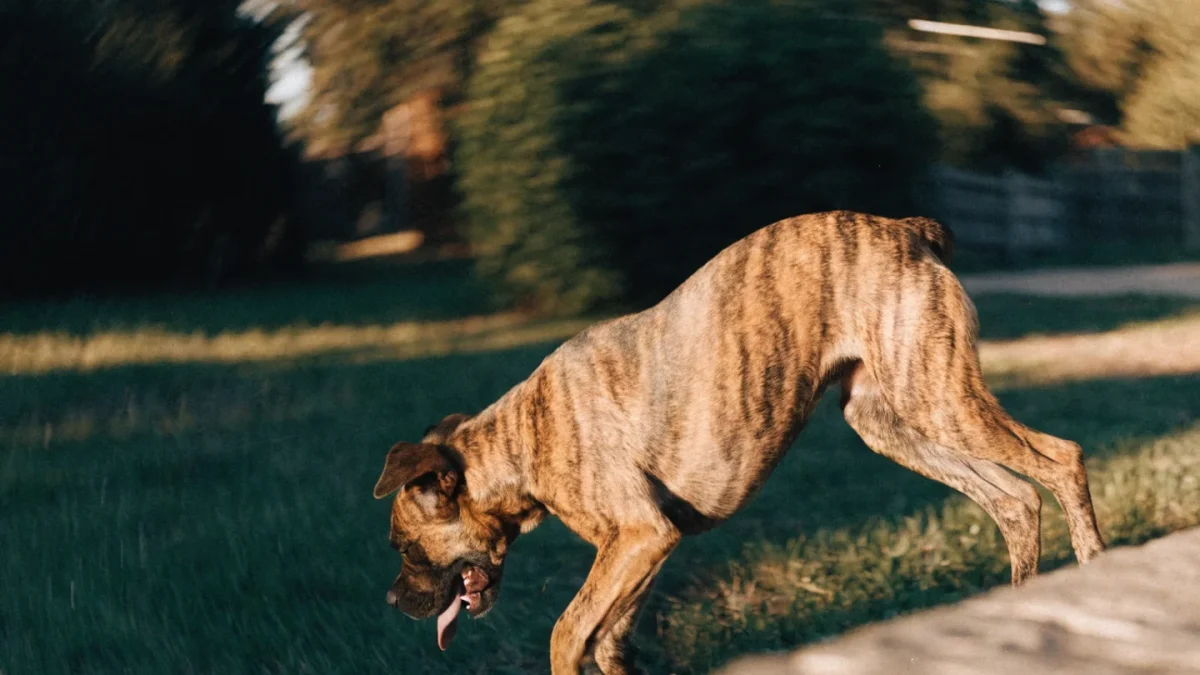
The boxer was bred to hold wild boar by the snout — a job that required a dog willing to lock its jaws onto a thrashing animal several times its weight and not let go until a human arrived with a weapon. That was the breed's founding purpose. The fact that this same animal now sleeps on your couch, brings you a stuffed toy when you look sad, and performs a full-body wiggle dance at the sound of your car in the driveway is one of the more remarkable temperament evolutions in the canine world.
Understanding boxer dog temperament personality means holding two realities at once: the working heritage that still shapes how the breed thinks and reacts, and the century of selective breeding for companionship that transformed a hunting and guarding dog into one of the most human-focused breeds alive.
The Energy Equation
Boxers operate at a higher baseline intensity than most breeds their size. Where a bulldog observes and a retriever eagerly complies, the boxer engages — physically, vocally, and with a full-body commitment that can feel like being hit by a friendly, muscular wave.
This intensity is not hyperactivity. The distinction matters. A hyperactive dog is scattered, unable to focus, and difficult to redirect. A boxer is focused — sometimes laser-focused — and fully present in whatever it's doing. The breed has a genuine off switch, which sets it apart from many high-energy breeds. Thirty minutes of hard play or running, and most boxers will collapse on the nearest soft surface and sleep deeply. The energy is real, but it's channeled, not chaotic.
The problem owners encounter is a math problem, not a temperament problem. A boxer with insufficient outlet for its energy becomes destructive, mouthy, and difficult to manage. A boxer whose exercise needs are met becomes a calm, attentive housemate. The dog doesn't change. The circumstances do.
Adolescent boxers — roughly 6 months to 2.5 years — amplify this energy to a degree that catches many first-time boxer owners off guard. The "boxer bounce" (a vertical leap performed during moments of high excitement) and the "kidney bean" (the full-body C-curve wiggle) are charming in a 10-kg puppy and something else entirely in a 30-kg adolescent launching itself at your midsection.
The Attachment Pattern
Boxers don't just bond with their people. They fuse with them.
The breed's attachment style is closer to a velcro dog than a typical companion. Most boxers follow their person from room to room, position themselves in physical contact whenever possible, and become visibly distressed when separated for extended periods. This isn't a quirk — it's a fundamental breed characteristic rooted in over a century of selection for human partnership in close-working roles: guarding, military service, police work, and guide dog service all required a dog that oriented toward its handler above everything else.
The upside of this attachment is a dog that reads your moods with surprising accuracy. Boxer owners routinely describe their dogs moving closer during moments of stress, resting a heavy head on a lap without being invited, or shifting from play mode to quiet presence when the household energy changes. The emotional attunement is real and not anthropomorphic projection.
The downside is separation anxiety. Boxers left alone for more than four or five hours regularly — without gradual conditioning and environmental enrichment — frequently develop destructive behaviors, vocalization, and distress signals. This breed was not designed to spend eight hours alone in a house, and forcing that arrangement produces a miserable dog and a destroyed living room.
For a complete profile of the breed including physical traits and health, the boxer complete breed guide covers the full picture.
The Protective Instinct
Somewhere between a Golden Retriever's "welcome, stranger, let me show you where we keep everything" and a German Shepherd's formal threat assessment sits the boxer. The breed's guarding instinct is present but measured — alert without paranoid, protective without aggressive.
A boxer's first response to an unfamiliar person approaching its territory is typically a deep, authoritative bark combined with a forward-leaning posture. It's imposing. That's the point. Most boxers will hold this stance until they receive cues from their owner — either relaxing into friendly greeting mode or maintaining watchful distance. They defer to their person's judgment, which is exactly what a century of working-dog selection produced.
This discernment separates boxer temperament from breeds at either extreme. They're not indiscriminately friendly, and they're not indiscriminately suspicious. They assess. They wait. They look to their person. And then they respond accordingly.
The guarding instinct extends strongly to children. Boxers with families frequently position themselves between children and unfamiliar people or dogs — not with aggression, but with a deliberate physical placement that communicates territorial awareness. This behavior appears without training in most boxers and is one of the traits that cements their reputation as family dogs.
Social Dynamics With Other Animals
Boxer-to-dog interactions are more variable than their human relationships. Many boxers are enthusiastically social with other dogs, particularly when socialized early and regularly. The breed's play style, however, is physical and intense — body-slamming, pawing, and full-contact wrestling are standard boxer play, which can overwhelm dogs of calmer breeds or smaller size.
Same-sex tension exists in the breed, particularly between intact males. This isn't universal, but it's common enough that experienced boxer owners frequently recommend opposite-sex pairings when adding a second dog. The tension typically manifests as posturing, resource guarding, and escalating roughness rather than outright aggression, but without management it can progress.
With cats and small animals, the boxer's moderate prey drive creates a mixed picture. Dogs raised with cats from puppyhood usually coexist well — often developing genuine bonds. Adult boxers introduced to cats for the first time require careful, controlled introduction over weeks, not days. The breed's intensity during excitement — even friendly excitement — can trigger a flight response in cats that then triggers the boxer's chase instinct, creating a cycle that's difficult to interrupt once it starts.
As the 5 common misconceptions about boxers article examines, several aspects of boxer social behavior are widely misunderstood — particularly the gap between the breed's reputation for aggression and its actual behavioral profile.
The Maturation Timeline
Boxers mature slowly. This single fact explains more owner frustration than any other breed characteristic.
Physical maturity comes at roughly 18 months — the dog reaches adult height and close to adult weight. Mental maturity arrives considerably later, typically between 2.5 and 3 years. That gap produces a period where owners have a fully-sized, powerfully muscled dog with the impulse control and judgment of a teenager.
During this adolescent window, boxers test boundaries, forget training they appeared to have mastered, and display an almost creative talent for finding the one thing in a room they shouldn't touch and touching it. This isn't defiance. It's developmental. The breed was selected for independent problem-solving in its working roles, and that independence emerges during adolescence before the handler-focus of adulthood settles in.
Patience during this phase is not optional — it's the defining requirement. Owners who ride out the adolescent period with consistent, calm reinforcement end up with one of the most rewarding adult dogs any breed produces. Owners who lose patience, escalate to punishment, or surrender the dog during this window miss the other side of the curve entirely.
The Breed's Emotional Range
Boxers are unusually expressive for a dog. The mobile brow, the head tilts, the vocal range (from deep bark to a distinctive "woo-woo" vocalization that experienced owners recognize immediately), and the whole-body communication style create a dog that's constantly broadcasting its emotional state.
This expressiveness makes the breed feel more communicative than many others. Boxer owners frequently report understanding what their dog wants or feels without any ambiguity — the dog simply makes it obvious through a combination of vocalizations, body posture, and that remarkably readable face.
The emotional depth runs both directions. Boxers respond strongly to household stress, changes in routine, and the emotional states of their people. A household going through conflict will often produce a boxer showing signs of stress — panting, pacing, loss of appetite, or clingy behavior. The breed absorbs its environment's emotional temperature. Calm, structured households produce calm boxers. Chaotic households produce anxious ones.
The history that shaped this breed's temperament — from boar hunter to companion — explains why these emotional circuits are wired the way they are. A dog bred to read a handler's signals during a dangerous hunt, then bred to read a soldier's commands under fire, then bred to guide a blind person through traffic, carries an attentiveness to human emotional states that goes deeper than most people expect from a breed famous for bouncing into walls.