

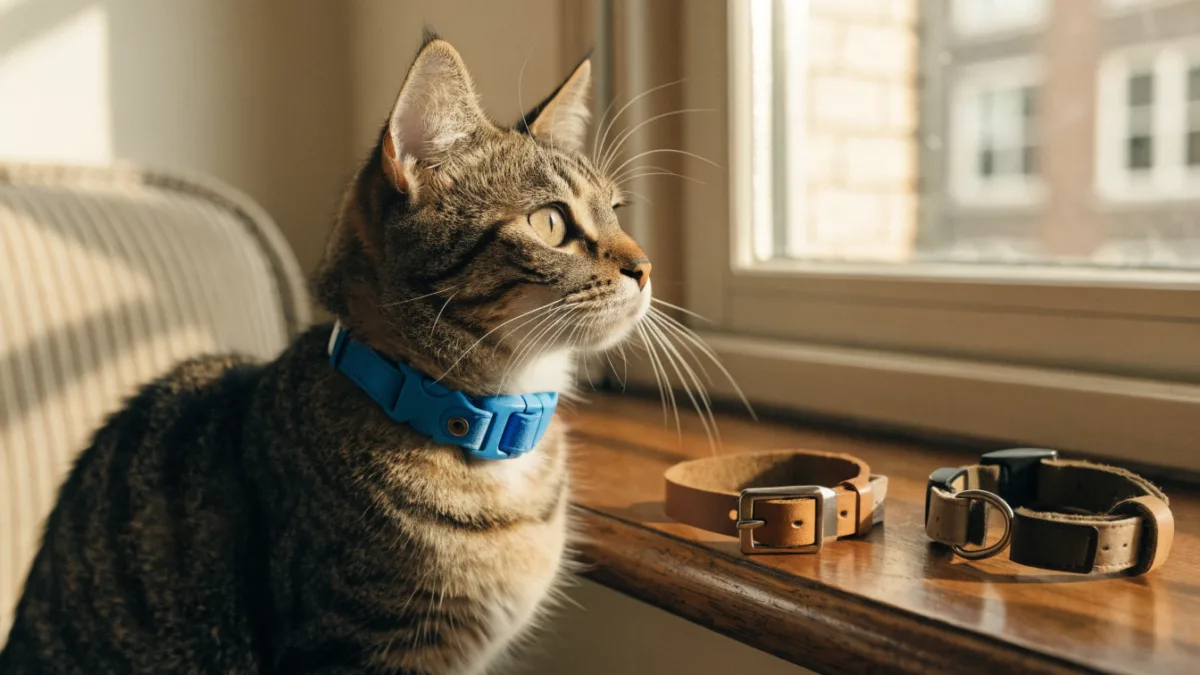
Last spring, a client named Maria rushed her three-year-old indoor tabby named Pepper into the clinic. Pepper had been lounging near a heating vent — her favorite afternoon spot — when her standard buckle collar caught on a loose metal edge. By the time Maria heard the frantic meowing, Pepper had twisted herself into a panic, and the collar was digging painfully into her neck. We treated the abrasions and swelling, and Pepper recovered fully. But Maria sat in the exam room, visibly shaken, and asked me a question I hear all the time: “Should she even be wearing a collar at all?”
The answer is yes — collars save lives by carrying identification that can reunite you with a lost pet. But the type of collar matters enormously, and the choice between a breakaway collar and a standard buckle collar is one of the most consequential safety decisions a pet owner can make. Let me walk you through what I’ve learned from years of treating collar-related injuries, and what the current evidence tells us about keeping cats and small dogs safe.
The Breakaway Buckle: How It Works and Why It Exists
Breakaway collars feature a specially designed plastic buckle that snaps open when subjected to a specific amount of force — typically around five to six pounds of pressure. The mechanism is simple but ingeniously calibrated. If a cat’s collar gets snagged on a branch, a fence post, a carpet edge, or even a heating vent (as Pepper discovered), the buckle releases before the collar can cause strangulation or serious injury.
I used to recommend breakaway collars primarily for outdoor cats. After all, they’re the ones climbing trees and squeezing through fences, right? But I’ve changed my mind on this. In my practice, I’ve seen nearly as many collar incidents involving strictly indoor cats as outdoor ones. Indoor cats explore heating vents, rub against door hinges, squeeze behind furniture, and get into tight spaces with surprising regularity. A standard collar in any of these scenarios can become a genuine hazard.
The choke-prevention benefit of breakaway collars cannot be overstated. When a cat’s collar catches on something and the cat panics, it will often twist and thrash, tightening the collar further. A breakaway buckle interrupts this dangerous cycle before it becomes lethal. I’ve seen enough near-misses to be convinced: for cats, breakaway collars should be the default choice, regardless of lifestyle.
The Standard Buckle Problem
Standard buckle collars — whether they use a traditional prong buckle or a snap closure — do not release automatically. They stay fastened no matter how much pressure is applied. This makes them reliable for leash walking with dogs, but it creates a significant choking hazard for cats, particularly those who climb, jump, or explore tight spaces.
I remember treating a sweet eight-year-old Siamese named Oliver who wore a standard buckle collar because his owner liked the look of it. Oliver was an indoor cat who loved to perch on bookshelves. One afternoon, he misjudged a jump, and his collar looped around a decorative hook. His owner was home and intervened quickly, but Oliver had already begun to show signs of respiratory distress. The tissue damage to his trachea — the windpipe that carries air to the lungs — took weeks to heal. His owner switched to a breakaway collar that same week.
The risk with standard buckles is that they turn everyday feline behavior into a potential emergency. Cats are anatomically built to squeeze through small spaces, and their heads are roughly the same width as their necks. This means a collar can easily catch on objects that a cat’s head passed through without issue.
Getting the Fit Right
Even the safest collar design is ineffective if it doesn’t fit properly. I check collar fit on nearly every cat and small dog that comes into my practice, and I’d estimate that at least a third are wearing collars that are either too loose or too tight.
Here’s the standard I use: you should be able to comfortably slide two fingers between the collar and your pet’s neck. This is what’s commonly called the “two-finger rule,” and it gives you a reliable baseline. If you can’t fit two fingers underneath, the collar is too tight and could cause skin irritation, hair loss, or breathing difficulty. If the collar slides easily over your pet’s jaw and head when you apply gentle upward pressure, it’s too loose — loose enough to catch on objects or even slip off entirely.
For kittens and puppies, check the fit weekly. They grow quickly, and a collar that fit perfectly at twelve weeks may be dangerously tight by sixteen weeks. For adult pets, a monthly check is usually sufficient.
The Leash Dilemma: Walking a Cat in a Breakaway Collar
One of the most common questions I get from cat owners is some variation of: “If breakaway collars snap open under pressure, how am I supposed to walk my cat?” It’s a fair question, and the answer surprises some people.
Breakaway collars are genuinely incompatible with leash walking. The sustained tension of a cat pulling against a leash — even a cat who walks calmly most of the time — can trigger the breakaway mechanism. When that happens mid-walk, your cat is suddenly loose, potentially frightened, and possibly near traffic or other hazards. I’ve had clients lose cats this way, and it’s heartbreaking every time.
My recommendation for cat owners who want to leash walk is straightforward: invest in a well-fitted cat harness instead. A harness distributes pressure across the cat’s chest and shoulders, away from the delicate neck area, and provides secure leash attachment points that won’t release unexpectedly. Look for a harness that fits snugly without restricting movement, and always introduce it gradually indoors before venturing outside.
If you feel you absolutely must walk your cat on a collar — perhaps your cat refuses a harness despite patient training — look for a breakaway collar with a secondary non-breakaway leash loop. These are designed so that the safety buckle protects the cat during normal wear, but the leash attaches to a separate point that bypasses the breakaway mechanism entirely.
Tracking Tech Meets Breakaway Design
The rise of GPS trackers and Bluetooth location devices has created a fascinating new tension in collar safety. Pet owners increasingly want to attach expensive tracking technology to their cats’ collars. But if you attach a tracking device to a collar designed to snap off and get lost, you’ve created a paradox: the technology that’s supposed to help you find your cat may disappear along with the collar if the breakaway mechanism triggers.
Some manufacturers are responding with hybrid collar designs that attempt to solve this. These collars maintain a breakaway safety function for everyday wear but include specialized leash attachment systems that bypass the breakaway buckle when the pet is tethered. It’s a thoughtful compromise, though I’d still recommend a harness for actual leash walking.
Another promising development is the emergence of adjustable breakaway buckles. These allow you to calibrate the amount of force required to open the collar — typically somewhere between five and eight pounds — based on your individual pet’s size, strength, and activity level. This is particularly useful for households with cats of very different builds. A five-pound breakaway threshold might be appropriate for a petite adult cat, while a muscular fifteen-pound Maine Coon might benefit from a slightly higher resistance setting.
Can Dogs Wear Breakaway Collars?
Breakaway collars are marketed primarily for cats, but I occasionally have small dog owners ask about them. The appeal is understandable — if you have a ten-pound Chihuahua or a small terrier, the same strangulation concerns apply, particularly if the dog spends time unsupervised in a yard with fences or playground equipment.
However, breakaway collars present unique challenges for dogs. Dogs pull on leashes far more frequently and forcefully than most cats, and they’re more likely to engage in rough play with other dogs that could trigger the breakaway mechanism at an inopportune moment. If you’re considering a breakaway collar for a small dog, think carefully about how and where the dog spends time, and discuss the option with your veterinarian.
The Bottom Line
After years of treating collar injuries — and seeing how easily most of them could have been prevented — I’ve landed on a clear position: for cats, breakaway collars are the only responsible choice for everyday wear. Yes, they can be lost, and yes, that means your cat might occasionally come home without ID tags. But a collar that falls off is infinitely preferable to a collar that causes injury. As one colleague of mine puts it bluntly: a lost collar can be replaced. A lost cat can be found. A cat lost to a collar accident cannot be undone.
The identification debate is real, and it’s worth addressing proactively. If your cat wears a breakaway collar, consider microchipping as a permanent backup form of identification. Check the collar’s fit regularly, inspect the breakaway mechanism for wear, and replace the collar if the buckle becomes stiff or shows signs of fatigue. Keep a spare collar on hand so you’re never tempted to skip the breakaway option when one gets lost.
The best collar is one your pet never has to think about — until the moment it saves their life.