

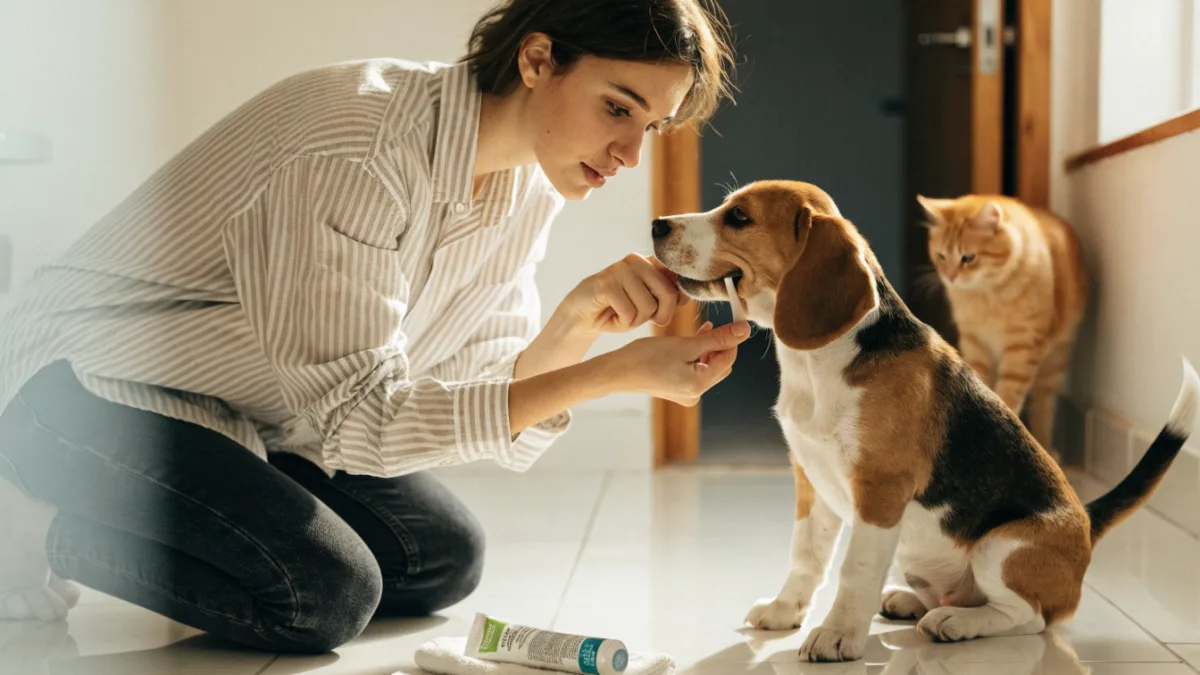
Nobody warns you that one of the most expensive parts of owning a small dog might be its mouth. By age three, most dogs and cats already show signs of periodontal disease — veterinary organizations consistently put the figure somewhere between 70 and 80 percent of pets. A professional cleaning under anesthesia starts around $300 to $700. Add X-rays and a few extractions and you’re staring at a $1,500 to $3,000 invoice. Meanwhile, a finger brush and a tube of pet toothpaste cost about as much as a takeout dinner. That’s the deal on the table: a two-minute daily habit versus a four-figure bill and a pet with a sore mouth. The catch, of course, is that your pet has to actually let you do it. Here’s how to win that negotiation without pinning anyone to the floor.
The Stakes: Why This Fight Is Worth Picking
Periodontal disease doesn’t stay politely in the mouth. Plaque hardens into tartar, tartar pushes under the gum line, and the bacteria living there can enter the bloodstream — which is why gum disease in pets is associated with complications in the kidneys, liver, and heart valves. Small breeds get hit earliest and hardest. Chihuahuas, Yorkshire Terriers, and Dachshunds cram a full set of teeth into tiny jaws, and the crowding gives plaque places to hide.
Cats have their own problem on top of the usual gum disease: tooth resorption, a painful condition where the tooth structure itself erodes, affecting an estimated 30 percent or more of cats. Brushing can’t fix resorption — that’s a job for your vet. But a cat who lets you handle her mouth is a cat whose problem gets caught early instead of discovered two years and a dozen teeth too late.
I’ll never forget Waffles, a four-year-old Yorkie whose owner brought him in for “a little bad breath.” The bill came to $2,300 and nine extractions. His owner told me afterward she’d always thought dog breath was just dog breath. It isn’t. Bad breath is the smell of infection, and it’s one of the clearest signals that something’s wrong.
Gearing Up: Toothpaste and Tools That Won’t Sabotage You
The non-negotiable toothpaste rules
Never use human toothpaste. Not occasionally, not “just a little.” Fluoride causes stomach upset when swallowed — and pets can’t rinse and spit — while xylitol, a sweetener common in human pastes, is acutely toxic to dogs and can cause hypoglycemia and liver failure. This is the one gear mistake that can turn a training session into an emergency trip.
What you want instead is a pet-specific enzymatic toothpaste. The enzymes keep working after application, which matters a lot when nobody’s spitting. Look for the VOHC (Veterinary Oral Health Council) seal of acceptance, which means the product’s claims have actually been evaluated. And take flavors seriously — poultry, beef, malt, and seafood options exist for a reason. Honestly, the best pet toothpaste is the one your pet will mob you for. If the paste is a treat, half your training battle is over before you touch a tooth.
Choosing your brush
- Finger brush: a soft rubber cap that slips over your fingertip. Best starting tool for most dogs — you can feel exactly what you’re touching, and there’s no long handle waving around.
- Gauze square: wrap it around your finger. Even lower-tech, and often the winning move for cats.
- Long-handled pet brush: soft bristles, sized to your pet’s mouth. A graduation reward, not a starting point.
The Seven-Day Truce: A Gradual Plan for Brushing Your Dog’s Teeth
The method here isn’t a trick — it’s the same,[1] veterinary behavior teams recommend, paired with something called counterconditioning. Plain English: you break the scary thing into pieces so small they’re boring, and you pay your pet well for each piece. Here’s what a typical first week looks like.
- Days 1–2: Let your pet lick toothpaste off your finger like a treat. Gently touch the muzzle and lift the lips for a second. Reward, done.
- Days 3–4: Rub a bare finger along the gums and teeth for a few seconds. Keep it casual.
- Days 5–6: Introduce the finger brush or gauze-wrapped finger. Brief contact, immediate reward.
- Day 7 and beyond: Short brushing sessions, 30 to 60 seconds, gradually getting longer.
A confession: I used to skip steps. I’d muscle through a twenty-second wrestling match with a dog, decide the teeth technically got touched, and call it a win. It wasn’t. All I trained was that brushing means conflict. When I finally slowed down with a ten-week-old Lab puppy named Biscuit, I was humbled — by day four she was sitting at the bathroom sink waiting for her turn. The paste was the point for her at first. The brushing just became part of it.
Technique details that make or break it
- Hold the brush at a 45-degree angle to the gum line and use small circular motions.
- Focus on the outer, cheek-facing surfaces. That’s where most plaque builds up, and it’s the easiest side to reach. Inner surfaces can wait.
- [2] not head-on — looming face-first reads as confrontational to most pets.
- Run sessions before dinner or a walk, so the payoff association is stronger.
- Always stop before frustration sets in. Ending one step early beats squeezing in ten more seconds.
When You’ve Already Lost Round One
Someone on a dog forum recently asked how to brush their dog’s teeth [3] — and honestly, that’s the right question. If your pet already hates brushing, the answer from veterinary professionals is counterintuitive: stop brushing entirely. Go back to simply touching the muzzle and lips with generous rewards, and rebuild from there. Every forced session digs the hole deeper.
You’ll still find old-school advice saying to just hold the dog down and get it done. Don’t. Restraint teaches your pet that dental care is a fight, and that lesson bleeds into every vet visit, nail trim, and pill you give for the rest of their life. Modern Fear Free handling has moved the whole profession toward cooperative care for exactly this reason — restraint is a last resort, not a starting point.
Cats are their own event
Cat dental care at home is slower, full stop. Use gauze or the smallest finger brush you can find, expect extra sensitivity around the muzzle, and be willing to spend a week on a single step. I spent three weeks just resting a finger against a senior tabby’s cheek before she stopped flinching. Then one evening she leaned her chin into my hand, and we were off. Some cats, mind you, taste poultry-flavored paste and decide the whole conflict was unnecessary. You won’t know which cat you have until you try.
What Brushing Can’t Do — So You Don’t Get Complacent
Dental chews, water additives, and dental diets with the VOHC seal genuinely help, but none of them match daily brushing. Use them as backup for the nights you miss, not as a replacement. And be wary of anesthesia-free cleanings: they scrape the visible tartar above the gum line and skip the disease underneath, along with the X-rays that would catch it. Cosmetics, not medicine.
On frequency: daily is the gold standard, but research suggests brushing at least three times a week is the minimum needed for measurable plaque reduction. If you miss a day, you haven’t failed — just get back to it tomorrow. Meanwhile, all that daily mouth handling turns you into an early-warning system. Watch for bad breath, red or bleeding gums, brown tartar, drooling, pawing at the mouth, or dropping food. Any of those means it’s vet time, brush or no brush.
If you have a puppy or kitten, start now — eight to twelve weeks old is ideal, while the socialization window is wide open and adult teeth haven’t even arrived. If your pet is five years old and has never seen a toothbrush, you can still start; just go smaller, slower, and expect more weeks than days. Because the real payoff isn’t just the money you’ll save, though you’ll save plenty. It’s a pet who lets you look inside their mouth without a fight — and that might be the most underrated piece of preventive care there is. Tonight, put a dab of poultry toothpaste on your finger and see what happens. That’s day one.
Sources
- step-by-step desensitization training — vcahospitals.com
- Approach from the side — farmingtonvethospital.com
- "without betraying his trust" — reddit.com